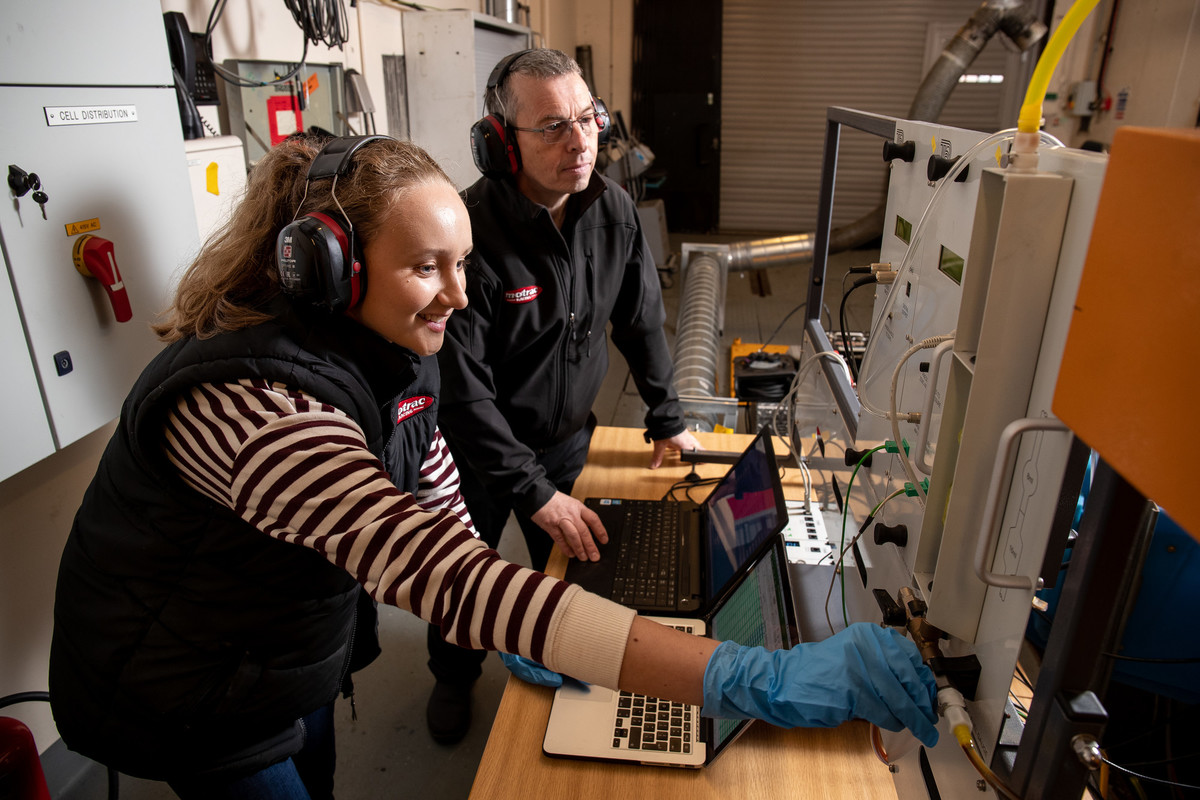


Chemical engineering Beng Hons student conducting process analysis on a digital tablet within an industrial laboratory setting, surrounded by stainless steel reactors, storage tanks, and process piping.

Chemical engineers develop innovative processes to turn raw materials into useful products, such as fuels, plastics, foods and medicines. On this course, you will learn the key set of chemical engineering principles and understand how to use them for a huge range of applications, such as eliminating harmful emissions of greenhouse gases. 

Our BEng and MEng degrees are fully accredited by the IChemE, and have been designed in consultation with major recruiters of chemical engineering graduates. We have a strong, supportive culture underpinned by interactive, problem-based learning and a research-active team. In addition, every student has a personal academic tutor, who will support you in both the academic and practical aspects of university life. 

Preparing you for professional success is a key part of our mission. At Chester, all Chemical Engineering students complete work placements as an integral part of their degree. Opportunities to develop professional skills are embedded throughout the course and good staff-to-student ratios help students build confidence, for example, in giving presentations and participating in class. 

If you have any questions, feel free to reach out to our Course Leader, David Ward d.ward@chester.ac.uk

Accreditations

IChemE Internationally Accredited Degree

Why You'll Love It

What You'll Study

In your Foundation Year you will be introduced to studying Chemical Engineering at undergraduate level through the Physical and Natural Sciences Foundation Year route.

The Foundation Year is designed to give you a strong knowledge and skills base aligned with your chosen four-year degree. Following a solid grounding in scientific principles or behavioural sciences in your first block of teaching, you will study bespoke modules aligned with your discipline. This could involve studying the human body in health and disease and how to encourage healthy and sustainable behaviours, or the biology of terrestrial and marine animals and the impacts of their interactions with humans, or you might focus on the physical sciences and how they can help change the world for the better. Whatever you aspire to, we can offer you a supportive and incremental introduction to your science degree.

This module will present core topics in Chemistry and Biology that will provide a solid foundation for students to build on in Terms 2 & 3 in their course-specific modules. Laboratory sessions will underpin topics and maths skills will be integrated throughout the module.

Indicative content:

  • The scientific method
  • Atomic structure and the periodic table
  • Working with chemical equations
  • Isotopes and relative molecular mass
  • Chemical calculations
  • Scientific form and converting units
  • Scales and magnification
  • Working with formulae
  • Statistics and visualising data
  • Fractions and ratios
  • Compound growth and decay
  • The classification of life
  • Evolution and selection
  • The molecules of life
  • Cells and cell division
  • Nutrient cycles
  • Learning to use and navigate a range of digital spaces specific to your subject
  • Understanding academic conduct and conventions for communicating information
  • Finding and using a range of academic sources relating to your subject

Students will develop key mathematical skills alongside fundamental concepts in chemistry and physics that are needed for degrees in engineering and physical sciences. The content covers elements of pure & applied mathematics, physical & chemical systems, and opportunities to develop laboratory skills. Students will learn to apply problem-solving techniques to real life situations.

Topics covered as follows:

  • Analytical techniques
  • Introduction to inorganic chemistry
  • Introduction to thermodynamics
  • Gas laws
  • Introduction to fluid dynamics
  • Acids and bases 
  • Nuclear energy
  • Mathematical modelling
  • Algebra
  • Coordinate geometry
  • Introduction to calculus
  • Trigonometry
  • Vectors
  • Forces and Newton’s laws
  • Moments
  • Mechanical energy
  • Linear and projectile motion
  • Circular motion
  • Advancing digital and academic skills introduced during Term 1
  • Developing research and information literacy in relation to your subject
  • Creating an academic poster on a chosen research paper

This module introduces students to key topics within the Physical Sciences. They will be undertaking research and performing practical investigations related to their studies. Students will continue to develop and use their mathematical skills to model and solve real-life problems.

Topics covered as follows:

• Introduction to Organic Chemistry

• Introduction to Inorganic Chemistry

• Principles of Green Chemistry

• Analytical techniques

• Spectroscopy

• Separation processes

• Properties of materials

• Mineral structure

• Heat transfer

• Latent heat

• Flow rate

• Gas laws

The information listed in this section is an overview of the academic content of the course that will take the form of either core or option modules and should be used as a guide. We review the content of our courses regularly, making changes where necessary to improve your experience and graduate prospects. If during a review process, course content is significantly changed, we will contact you to notify you of these changes if you receive an offer from us.

At Level 4, you are introduced to basic underlying principles of mathematics and science, together with introductory engineering topics, such as fluid mechanics, heat transfer and thermodynamics. You are also introduced to some of the core chemical engineering topics, such as mass and energy balances and reactor design. Professional skills are also taught at this level.

Core Modules

The purpose of this module is to ease the transition from school to university by setting the multi-disciplinary context and expectations of degree courses and careers in engineering and science. You will be introduced to the transferable study skills that they will develop throughout your university career and beyond (i.e. those softer skills, essential to academic study, employability and good professional conduct). In particular, you will understand the need to take responsibility for your own learning.

Topics may include:

  • Teamwork: Interdisciplinary nature of science/engineering. Roles and responsibilities, effective meetings, record-keeping, leadership.
  • Project planning and delivery: Setting achievable goals, time/resource planning, monitoring progress, risk management, adaptability and final delivery.
  • Design Process: Introduction to the key stages of research, concept, feasibility, requirements, preliminary design, detail design, production.
  • Report writing: technical and laboratory reports, structure, content, grammar, the importance of accurate referencing and avoidance of plagiarism.
  • Presentation skills: Effective communication via visuals and the spoken word. Managing presentation stress.
  • Lab fundamentals: Use of key equipment and practices. Health & safety within the lab. Data collection, processing and error management.
  • Information skills: Effective searching of a range of different information sources. Critical evaluation for appropriateness for academic use. Understand the nature of research journal publishing and the importance of primary research findings.
  • Introduction to professional ethics: Philosophical models, frameworks and theories for ethical decision making. Resolving common ethical conundrums encountered in professional practice. The role/responsibility of the scientist and the engineer in society and in protecting the environment
  • Career Management: Planning and enacting a successful career for life. What to do and when. Researching employers. CV and cover letter writing. Interview skills.

Thermodynamics

  • Basic definitions; energy, working fluid, continuum, property, systems, surroundings, open and closed systems, phase, state, equilibrium, process, cycle.
  • Zeroth Law of Thermodynamics: temperature scales.
  • Perfect gases, ideal gas equation of state, real gases, compressibility factor, van der Waals equation of state, virial coefficients
  • Work and heat definitions, path functions, types of work, sign conventions, definite integrals
  • First Law of Thermodynamics
  • Internal energy, enthalpy, constant specific heats, specific heat variation with temperature
  • Polytropic processes
  • Properties of pure substances; changes of state, sub cooled, saturation and superheated properties, use of tables, phase diagrams.
  • First law analysis of systems, cyclic processes, closed systems, open systems (steady and unsteady flow), application to engineering equipment, internal combustion engines.

Heat Transfer

  • Heat conduction and Fourier's Law
  • Convection and correlations for heat transfer coefficients

Fluid Mechanics

  • Basic definitions and properties: laminar, turbulent, transition flow, boundary layer, units
  • Fluids at rest and applications in pressure measurement; pressure distribution over plane and curved surfaces
  • Static, stagnation and dynamic pressure, centre of pressure, pressure measurement
  • Introduction to the study of flowing fluids and the special case of Bernoulli's equation including applications in flow measurement (free jets, confined flows, flow rate measurement), control volume analysis
  • Streamlines, stream tubes and particle paths and the physical interpretation of the Bernoulli equation
  • Introduction to control volume analysis
  • The conservation principles for open systems and illustrate the applications to simple fluid systems and devices

Essential Physics for Chemical Engineers

  • Dimensions, units and conversions
  • Introduction to fluid flow in pipes
  • Stream composition

Design and Analysis of Processing Systems

  • Chemical process diagrams
  • Batch and continuous processing
  • Material balances

Introduction to Chemical Reactors

  • General reactor design principles
  • Reactor types
  • Batch, semi-batch and continuous reactors
  • Reactor performance
  • Reactor heating and cooling

Introduction to Physical Processing and Separations

  • Rheology of simple fluids and complex mixtures.
  • Mixing and pumping of fluids, and fluid flow in pipes
  • Main separation processes and their characteristics
  • Physical separation: membranes.

Principles of Safe and Sustainable Processing

  • Introduction to safety and risk assessment.
  • Creating and maintaining a safety culture.
  • Incorporating sustainability in process design.
  • Life cycle assessment

Manufacturing

  • Manufacturing performance indicators and improvement strategies.
  • The four V's
  • Types of production, categories of product
  • Layout of production processes

The Chemistry Fundamentals module aims to provide a broad introduction of the basics of theoretical and practical chemistry across organic, inorganic, physical and analytical chemistry. The module is evenly split between practical and classroom sessions and will introduce the basic techniques of laboratory chemistry and an introduction to recording experimental data and writing of reports. You will apply the theories introduced in the classroom and the directed reading.

Differential equations play a pivotal role in modelling numerous mathematical, scientific and engineering problems, stretching across celestial motion dynamics, neuron interactions, cancer progression, bridge stability and financial market trends. This module serves as an introduction to the essential theory and numerical methods used in solving ordinary and partial differential equations (ODEs and PDEs) while exploring their varied applications.

In this module, we will review the essential calculus techniques, including methods of differentiation and integration, necessary to solve ODEs. We will introduce ODEs, see their applications to real-world problems and explore techniques for generating both exact and approximate solutions for ODEs. We will also give a brief introduction to PDEs and their applications.

Topics may include:

  • Review of trigonometric functions, hyperbolic functions, limits and differentiation.
  • Integration, techniques such as integration by parts, partial fractions, and multiple integration.
  • Review of sequences and series, covering convergence and divergence.
  • Exploration of complex numbers, covering axiomatic foundations, complex conjugates, loci, polar form, De Moivre's Theorem, and roots.
  • Notation and classification of ordinary differential equations.
  • Linear ODEs and their applications.
  • Selective exploration of non-linear ODEs and their applications.
  • Introduction to systems of ODEs.
  • Numerical integration: Trapezoidal Rule and Simpson’s Rule.
  • Numerical solutions for ODEs: Euler method, using computer code in, for example, MATLAB, or Python.
  • Partial differentiation, functions of two variables.
  • Brief introduction to PDEs and their applications.

Optional Modules

This module aims to give you an understanding and appreciation of the various environmental systems physically and chemically impacted upon by human and industrial activity - i.e. the atmospheric, aquatic and land-based – and how these impacts can be either controlled or avoided. You will consider:

  • Key environmental issues (e.g. global warming, ozone depletion, acid rain, photochemical smog, eutrophication, land contamination) and their communication to different audiences.
  • The communication of topical issues of environmental quality.
  • Natural cycles (i.e. water, nitrogen, phosphorous, sulphur and carbon) and how these can be disrupted by industrial pollution events.
  • The sources and nature of key pollutants and the mechanisms by which these are transported, dispersed and eventually degraded or sequestered.
  • How are impacts felt at local, regional and global scale?
  • The legislation, regulation and authorisation involved in the fixing of discharge consent limits.
  • The treatment technologies and practices available to process engineers for ensuring discharge compliance and thus, the mitigation/avoidance of environmental impacts (e.g. gas cleaning and water treatment plant).
  • The methods and analytical equipment available to plant operators for the monitoring of pollutant discharges and thus, compliance demonstration. 
  • The collection, analysis and interpretation of environmental data.

Optional Language Modules

This module enables students with A-Level German or equivalent to further develop their grammar, vocabulary and expression and apply these to real world situations.You will work with written and recorded texts on a range of cultural, personal and social topics and will develop your oral and written communication skills at Post-A level.

This module is designed for students that have completed A-Level or equivalent in French. You will further develop your grammar, vocabulary and expression and apply these to real world situations. You will work with written and recorded texts on a range of cultural, personal and social topics and will develop your oral and written communication skills at Post-A level.

This module is designed for students that have completed a A-Level or equivalent in Spanish. You will further develop your grammar, vocabulary and expression and apply these to real world situations. You will work with written and recorded texts on a range of cultural, personal and social topics and will develop oral and written communication skills at Post-A level.

This module is designed for students who have completed GCSE in Chinese or equivalent. You will further develop your grammar, vocabulary and learning conventions for spelling and pronunciation. You will work with written and recorded texts on a range of cultural, personal and social topics and will develop oral and written communication skills at an intermediate level.

This module is designed for students who have completed GCSE or equivalent in French. You will further develop your grammar, vocabulary and learning conventions for spelling and pronunciation. You will work with written and recorded texts on a range of cultural, personal and social topics and will develop oral and written communication skills at an intermediate level.

This module is designed for students that have completed GCSE or equivalent in Spanish. You will further develop your grammar, vocabulary and learning conventions for spelling and pronunciation. You will work with written and recorded texts on a range of cultural, personal and social topics and will develop oral and written communication skills at an intermediate level.

This module provides the opportunity to study a new language from scratch and introduces you to basic grammar, vocabulary and cultural contexts. You will apply the language to practical situations using both oral and written skills. 

The information listed in this section is an overview of the academic content of the course that will take the form of either core or option modules and should be used as a guide. We review the content of our courses regularly, making changes where necessary to improve your experience and graduate prospects. If during a review process, course content is significantly changed, we will contact you to notify you of these changes if you receive an offer from us.

Level 5 builds upon this foundation with more complex learning that deepens knowledge of core chemical engineering subjects and integrates technical, environmental and social considerations. Modelling and system analysis is introduced at this level.

Core Modules

The purpose of this programme of mathematical study is to ensure that you are competent in calculations using a range of mathematical tools. The content will extend your analytical skills by introducing more advanced topics that are required parts of the modern engineers skill set, and enhance your ability and confidence to make sound judgements.

Mathematics and Modelling

  • Statistical methods; distribution, sampling, statistical inference, estimation from a sample, hypothesis testing, significance testing.
  • Matrix Eigen value problems, with application to solutions of Ordinary Differential Equations.
  • Laplace transforms for solution of Ordinary Differential Equations.
  • Fourier series approximation of periodic functions.
  • Solution techniques for partial differential equations including the heat equation.

Numerical Modelling and Computation

  • Construction of algorithms in high-level programming languages including, variables, arrays, operators and expressions, data input and output, flow control and functions.
  • Implementation of numerical methods using MATLAB.
  • Numerical solution of ordinary differential evolution equations using Euler's method and the Runge-Kutta methods.
  • Introduction to Optimization; Optimisation of functions of several variables, with and without constraints.
  • Representation of engineering problems as mathematical optimisation problems and solution using Excel Solver.

This module covers two of the core topics in chemical engineering - thermodynamics and fluid mechanics. Thermodynamics is the science that deals with energy interactions in physical systems. The purpose of this module is to extend the basic principles of heat, work and energy then apply this knowledge to real engineering problems, and also to introduce chemical thermodynamics - the interaction of heat and work with changes of state and chemical reaction. The understanding of fluid mechanics is fundamental to much of chemical engineering, and this module seeks to develop and extend relevant knowledge of fluid mechanics to the point that real world problems can be addressed. Almost every branch of science and engineering includes some kind of heat transfer problem, and there is a need for engineers to have some background in this area. This module further develops students’ understanding of heat transfer, including practical applications of conduction, convection and radiation heat transfer.

Separation processes is perhaps the defining part of the chemical engineering curriculum. This module introduces you to design methods and practice for a range of key unit operations for separation of different components. An aim of this module is to build on the concepts of equilibrium and mass transfer driving force developed in level 4 in order to build knowledge and understanding of equilibrium stage operations for downstream refining and purification operations. Another aim of this module is to give you the appropriate methods and equations to analyse and design continuous and batch equipment for chemical and physical separations.

Flowsheet Analysis and Process Integration

  • Concept of Unit Operations as components making up process flowsheets.
  • Process flow diagram and P&I diagrams.
  • Measured and manipulated process variables.
  • Principles of mass balances for complex flowsheets with recycles.
  • Energy balances, hot and cold utilities and concept of heat integration.
  • Pinch analysis for determination of minimum energy targets.
  • Design of heat exchanger networks.
  • Conceptual extension of process integration to mass transfer networks. 

Process Simulation

  • Simulation principles.
  • Use of PRO/II for solving engineering problems and analysing the results.
  • Thermodynamic methods: available models, selection criteria.
  • Building a flowsheet and Managing Process Flow Diagram (PFD) files.
  • Simulation of various processes.

Dimensional Analysis and Scale-up

  • Examples of physical systems amenable to dimensional analysis: e.g. falling sphere, mass/heat transfer.
  • Outline of Buckingham’s Pi Theorem.
  • Use of engineering correlations for scale-up.
  • Maximising inherent safety for scale-up.  

Optional Modules

In this module, you will have the opportunity to put theory into practice and build essential skills for your future career by gaining invaluable real-world experience through a range of experiential activities (e.g., volunteering, workplace engagement, research projects, field trip (where available and dependent on course), or through a combination of activities). You will develop practical, analytical, and professional skills relevant to your subject, while also enhancing transferable skills that are vital in any graduate-level role. 

Through hands-on experiences, you will critically reflect on your personal and professional growth, using these insights to shape your career path and identify areas for continued development. You'll take ownership of your learning, ensuring that you can effectively articulate your employability skills in a professional context, and be well-prepared for the workplace. This module empowers you to explore new environments, apply your knowledge, and discover how your academic training translates into real-world impact, boosting your confidence and work readiness. 

It is your responsibility to organise any experience undertaken outside of the university as part of this module although you will be provided with support from university staff.

All activities within this module must be university-level; this means:  

  • Undertaking high-skilled work commensurate with level 5 study (e.g. report writing, attending meetings, delivering presentations, producing spreadsheets, writing content on webpages, social media, marketing services/products etc.)  
  • Meeting the professional expectations of the experiential activities you undertake 
  • Where applicable, your existing part-time employer can be approached/used as an experiential activity provider, if the role aligns with your career development and provides you with high skilled work commensurate with level 5 study. 

In this module, you will have the opportunity to put theory into practice and build essential skills for your future career by gaining invaluable real-world experience through a structured, university-level work placement for 5 weeks as one continuous block / period with a placement provider (i.e. a local employer from the private, public, or charitable sector). You will develop practical, analytical, and professional skills relevant to your subject, while also enhancing transferable skills that are vital in any graduate-level role. Therefore this module will enhance your professional skills in a real-world job setting.

Through hands-on experiences, you will critically reflect on your personal and professional growth, using these insights to shape your career path and identify areas for continued development. You'll take ownership of your learning, ensuring that you can effectively articulate your employability skills in a professional context, and be well-prepared for the workplace. This module empowers you to explore new environments, apply your knowledge, and discover how your academic training translates into real-world impact, boosting your confidence and work readiness.

It is your responsibility to organise the placement as part of this module although you will be provided with support from university staff.

All work placements within this module must be university-level; this means:

  • Undertaking high-skilled work commensurate with level 5 study (e.g. report writing, attending meetings, delivering presentations, producing spreadsheets, writing content on webpages, social media, marketing services/products etc.)
  • Physically placed (albeit part of it can be hybrid) within an employer setting in one continuous block / period for 5 weeks for a minimum of 140 hours over the course of the entire work placement
  • Where applicable, your existing part-time employer can be approached/used as the placement provider, if the high-skilled work criterion above is fulfilled for the full duration of the placement.
  • All quality assurances/agreements provided by the University are adhered to, by you and the employer.

The work placement context may not necessarily, reflect your degree discipline per se, but rather, it will give you an enriched experience to enhance your professional skills in a real-world job setting.

Optional Language Modules

The module will provide the opportunity to further develop your language skills, building on your previous learning at advanced level. The second half of the module includes a placement abroad or, alternatively, a project on a sustainability issue in a target language country. The first half of the module will prepare you for placements abroad where appropriate as well as a deeper understanding of sustainability in target language contexts. Students of more than one language may take one language in the first half of the module and spend their time abroad developing a different language. 

The module will provide the opportunity to further develop your language skills, building on your previous learning at intermediate level. The first half of the module includes intensive taught sessions in interactive workshop mode which will prepare you for placements abroad or self-directed language development. The second half of the module includes an placement abroad or, alternatively, a project on a business or tourism issue in a target language country. Students of more than one language may take one language in the first half of the module and spend their time abroad developing a different language. 

The module will provide the opportunity to further develop your language skills, building on your previous learning at beginner level. The first half of the module includes intensive taught sessions in interactive workshop mode which will prepare you for placements abroad or self-directed language development. The second half of the module includes a placement abroad or, alternatively, a project on a cultural issue in a target language country. Students of more than one language may take one language in the first half of the module and spend their time abroad developing a different language. 

  • The multiple facets of global citizenship
  • Ethical engagement and practice
  • The United Nations Sustainable Development Goals
  • Cross-cultural issues and sensitivity
  • Intercultural communication
  • Culture shock
  • Cultural adjustment
  • Self- assessment of needs: identification of the range of transferable skills, competencies and attitudes employees need and employers expect graduates to possess-with a strong focus on understanding the intercultural competencies (ICC) needed to live and work abroad.
  • Critical analysis/evaluation of individual requirements in relation to culture/cultural adjustment/culture shock/visas/medical.
  • Critical analysis/evaluation of skills already acquired in relation to key skills related to ICC.
  • Devising strategies to improve one’s own prospects of working abroad in the future.
  • Devising an action plan to address gaps in transferable skills based on organisational analysis and sector opportunities.

Part A:      

Preparation for Experiential Overseas Learning will take place at the University of Chester during level 5 and will include:  

  • The multiple facets of Global citizenship
  • Ethical engagement and practice
  • Cross-cultural issues and sensitivity
  • Intercultural communication

Theories, models and strategies of learning

  • Theories and models Intercultural competence
  • Theories and models of Integration and Multiculturalism
  • Critical thinking skills and models of Reflection
  • Experiential learning models
  • Self-directed experiential learning

Personal and placement-related skills

  • Enhanced independence
  • Improved command of multicultural behaviour
  • Increased knowledge and confidence in their individual facets of personal identity
  • Effective time management and organisational skills
  • Project management – working away from University and independent study
  • Self-management and personal development
  • Team building and team work

Part B:            Overseas

Students will engage in experiential learning activities overseas for at least 150 hours 

Optional Placement Year

In this module you will build essential skills for your future career by gaining invaluable real-world experience through a year long industrial placement. Through hands-on experiences, you will critically reflect on your personal and professional growth, using these insights to shape your career path and identify areas for continued development. The placement structure does not follow the normal academic course and will be devised in agreement between you, your placement advisor and your University placement supervisor. You'll take ownership of your learning, ensuring that you can effectively articulate your employability skills in a professional context, and be well-prepared for the workplace. The placement should provide you with the ability to develop graduate level skills in an area related to your degree and should allow you to put theory into practice.

All work placements within this module must be university-level; this means:

  • Undertaking high-skilled work commensurate with level 5 study (e.g. report writing, attending meetings, delivering presentations, producing spreadsheets, writing content on webpages, social media, marketing services/products etc.)
  • Physically placed (albeit part of it can be hybrid) within an employer setting for 9-12 months.
  • All quality assurances/agreements provided by the University are adhered to, by you and the employer.

A placement conference will enable peer to peer sharing of experiential learning whsilt permitting feedback on your progress. It will also allow you to share your current knowledge and skills development helping those that are considering taking this route to make a decision. You will also analyse a range of skills and benefits derived from the placement, further developing the construction of learning logs and allowing you to report your progress via a presentation and short VLOG. For those unable to attend, for whatever reason, online via Teams will permit engagement and feedback.  In addition, the conference will provide an opportunity to acquire an overview of final year options and dissertation and/or project research.

For those students where costs or other geographical/logistical difficulties render visits, conference attendance or participation via teleconferencing prohibitive, there will be an augmented portfolio of activities to substitute the conference activities.

All students will engage in the drawing up of a learning agreement on acceptance of the placement that will cover a contact plan and agreed learning outcomes with their designated academic tutor and placement coordinator.

Optional International Placement Year

Preparation for the year abroad will take place in Chester during level 5 and will include:

  • Cross-cultural issues and sensitivity
  • Host-country orientation, study methods– economic, political and social reality of the country
  • Orientation specific to exchange – health, education, gender issues
  • The United Nations Sustainable Development Goals
  • Practical matters relating to living and studying in the wider world

Theories, models and strategies of learning

  • Critical thinking skills, experiential learning and models of reflection

Personal and placement-related transversal skills

  • Effective self-motivation and independent resourcefulness
  • Effective time management and organisational skills
  • Project management – working away from University and independent study
  • Self-management and personal development

Whilst abroad:

You will undertake study at one of the University of Chester's partner universities or undertake and approved work placement or virtual placement. If you are a student,  it is expected that you will choose a series of modules at the university abroad which must be agreed by the host institution and the Module Leader. you must supply details of you modules on a learning agreement within 4 weeks of arrival at the host university.

The information listed in this section is an overview of the academic content of the course that will take the form of either core or option modules and should be used as a guide. We review the content of our courses regularly, making changes where necessary to improve your experience and graduate prospects. If during a review process, course content is significantly changed, we will contact you to notify you of these changes if you receive an offer from us.

At Level 6, you focus on advanced core chemical engineering, with an emphasis on the design of both individual unit operations and entire plants. A major design project is undertaken.

Core Modules

Design of key process engineering operations, and application of flowsheeting software to process plant design.

Chemical Reaction Engineering

  • Advantages and industrial uses of different reactor operating modes: batch, semi-batch, continuous, semi-continuous.
  • Quantitative description of Batch, PFR and CSTR as ideal reactors and associated mass and energy balances.
  • Concepts of conversion, yield and selectivity.
  • Concept of Residence Time Distribution (RTD); C(t), E(t), F(t) curves; and calculation of conversion from RTD.
  • Real (non-ideal) reactors with industrial examples and calculation of reactor size based on reaction rate.
  • Analysis and optimization of multiple reactor configurations: tanks in series, plug flow with recycle etc.
  • Isothermal and adiabatic reactors.
  • Dispersion model for non-Ideal flow in a tubular reactor. 

Catalysis

  • General principles of catalysis in terms of reaction energetics.
  • Organometallic chemistry and transition metal complexes for homogeneous catalysis exemplified by the Cativa process and Wilkinson’s catalyst.
  • Enzyme catalysis mechanisms and examples.
  • Derivation of Michaelis-Menten equation for enzyme kinetics.
  • Adsorption: mathematical description of physisorption and chemisorption.
  • Mechanisms for surface reactions in heterogeneous catalysis (e.g. Langmuir-Hinshelwood, Eley-Rideal). 

Solid-Fluid Diffusion and Reaction

  • Concept of diffusion controlled reactions.
  • Definition and use of effectiveness factor and Thiele modulus.
  • Diffusion and reaction in flat slab and spherical pellet.
  • Fluid particle reaction kinetics: progressive-conversion and shrinking particle models.

The module teaches two related topics,process control and process safety.

Process control presents a brief introduction to control theory, then focuses on the specific application of control in the process industries. The student will become familiar with the interpretation of P&I diagrams, the common types of instrumentation, the use of valves, the main conventional control strategies and their application to specific process plant items, and the operator features of DCS, SCADA and PLC systems.


Process Safety aims to prepare you for safe professional practice by emphasising the responsibilities of management for safety in scientific and engineering activities and how these can be met technically. Chemical and engineering principles from earlier levels of study are used to understand potential chemical and physical hazards. Finally, real examples of major incidents that have led to new regulation are studied.


This module aims to instil in you the regulatory requirements and technical considerations for designing, operating and decommissioning sustainable industrial chemical processes, and in particular sustainable energy generation systems. The benefits of embedding Sustainability in Process Design (to minimise the consumption of scarce material and energy resources) is illustrated through the consideration of specific industrial process examples.

Thermal conversion and microbial degradation processes to derive Energy from Biomass is also presented in this module. A detailed overview is given of the current and future technologies for deriving power, heat and transportation fuels from biological sources.

Other Renewables and Low Carbon Technologies aims to give an insight into the other main sustainable power technologies. The teaching will draw on physical and engineering principles learned earlier and will enable participants to critically assess the relative merits and applicability of these technologies.

Contents may include:

Sustainability in Process Design

  • The concept of sustainability. Environmental, economic and social criteria. The life cycle approach.
  • Process design for sustainability.
  • Specific industrial process examples.

Energy from Biomass

  • Biomass types and characteristics
  • Direct use
    • Combustion based processes
    • Vegetable oils
  • Thermal conversion
    • Gasification based processes
    • Pyrolysis based processes
  • Biological conversion
    • Fermentation-based processes
    • Anaerobic digestion based processes
  • Chemical conversion
    • Transesterification to biodiesel

Other Renewables and Associated Low Carbon Technologies

  • Solar energy systems
    • Solar thermal
    • PV
  • Wind energy systems
  • Water energy systems
    • Hydroelectric
    • Wave
    • Tidal
  • Geothermal power generation
  • Electrochemical energy conversion and storage
    • Fuel Cells
    • Batteries
  • Other energy storage options
  • The Smart Grid

This module is a major exercise, partly group partly individual, in which a process plant is designed.  It forms the centrepiece of the third academic year.

The information listed in this section is an overview of the academic content of the course that will take the form of either core or option modules and should be used as a guide. We review the content of our courses regularly, making changes where necessary to improve your experience and graduate prospects. If during a review process, course content is significantly changed, we will contact you to notify you of these changes if you receive an offer from us.

How You'll Learn

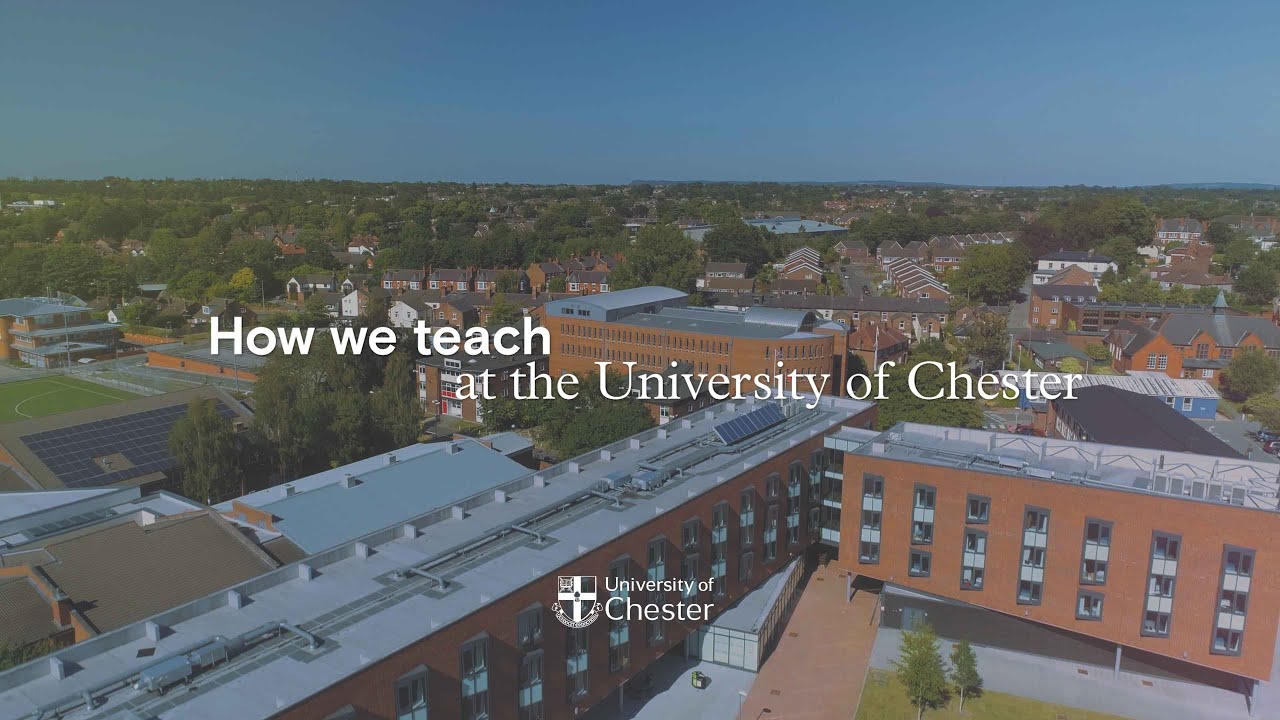
An aerial photograph of Exton Park with the text 'How we teach at the University of Chester'

How we teach at the University of Chester

This course is delivered in three terms of ten weeks each. In each term, you will study 40 credits comprised of either one or two modules. Scheduled contact hours range between approximately six and ten hours per week, depending upon the level of study and the complexity of the material being taught. This course is delivered through a mix of in-person and online learning. You can expect to take part in lectures, laboratories, workshops and peer-led seminars.

You should expect to spend an average of 30-34 hours per week on independent study, which might include following asynchronous learning material on the University’s VLE, tutorial time with staff, using the University’s library, working with peers and preparing work for assessment.

If studied, the Foundation Year, as with the following years of study, will be taught in three 10-week blocks across an academic year. Each block will comprise of a large 40-credit subject-specific module that includes a breadth of topics and subject skills. You will have on average 12-14 hours of contact time per week during the Foundation Year. There may be variations to this where subject practical or specialist space teaching is included.

Teaching will be delivered by experienced academics and practitioners in the subject. This will be supplemented by occasional guest lecturers and speakers. Practical teaching will be included where appropriate (laboratories and other experimental work).

There will be a broad range of assessment methods so you are exposed to the different types of task you might encounter in the workplace. These will include closed-book in-person exams, open-book online exams, coursework in the form of question sheets, laboratory reports, longer project reports, essays and presentations. In some modules, you will encounter class tests and practical assessments.

We continuously review the assessment methods used to ensure they adequately prepare you for graduate level employment. 

All teaching is delivered by experienced academics and practitioners, with the fundamental principles of the Chester Future Skills Curriculum at its core - building your subject competence, confidence and key transferable skills to shape you into a world ready Chester graduate.

Your Future Career

Job Prospects

Chemical engineering graduates are in high demand in sectors such as oil and gas, food, pharmaceuticals, energy, water and waste management. The technical and business expertise developed on the BEng and MEng degrees in Chemical Engineering provides excellent preparation for a wide range of rewarding roles in these, and other, industries. 

Progression Options

  • Programme and Project Management MSc

Careers Service

The University has an award-winning Careers and Employability service, which provides a variety of employability-enhancing experiences; through the curriculum, through employer contact, tailored group sessions, individual information, advice and guidance.

Careers and Employability aims to deliver a service which is inclusive, impartial, welcoming, informed and tailored to your personal goals and aspirations, to enable you to develop as an individual and contribute to the business and community in which you will live and work.

We are here to help you plan your future, make the most of your time at University and to enhance your employability. We provide access to part-time jobs, extra-curricular employability-enhancing workshops and offer practical one-to-one help with career planning, including help with CVs, applications and mock interviews. We also deliver group sessions on career planning within each course, and we have a wide range of extensive information covering graduate jobs and postgraduate study.

What Our Students Think

Entry Requirements

112 UCAS points

UCAS Points

112 UCAS points

GCE A Level

Typical offer – BBC (BEng) BBB (MEng) including grade B in Maths and grade B in Chemistry (112 UCAS points (BEng))

BTEC

BTEC Extended Diploma (Engineering) will be considered alongside A Level Chemistry grade B.

International Baccalaureate

26 points (BEng) 30 (MEng), including 5 in HL Maths and Chemistry

Irish/Scottish Highers

Irish Highers: H3 H3 H3 H3 H4, including H3 in Maths and Chemistry

Scottish Highers: BBBB, including Maths and Chemistry

Access requirements

Access to HE Diploma (Science and Engineering), to include 45 credits at level 3, of which 30 must be at Merit or above in Maths and Chemistry

T Level

T Level will be considered alongside A Level Maths and Chemistry

OCR Cambridge Technicals

OCR Extended Diploma will be considered alongside A Level Maths and Chemistry

Extra Requirements

Welsh Baccalaureate Advanced and A Level General Studies will be recognised . A combination of A Levels and BTECs/OCRs is also considered.

English Language Requirements

IELTS

Students from countries outside the UK applying for an undergraduate degree are expected to have IELTS Academic 6.0 (minimum 5.5 in each band). More information can be found here: https://www.chester.ac.uk/international/how-toapply/entry-requirements/

72 UCAS points

UCAS Points

72 UCAS points from GCE A Levels

GCE A Level

72 points, including grade D in A Level Maths and Chemistry

BTEC

BTEC Extended Diploma (Engineering) will be considered alongside A Level Chemistry.

BTEC Extended Diploma (Applied Science) will be considered alongside A Level Maths.

International Baccalaureate

24 points, including 4 in HL Maths and Chemistry

Irish/Scottish Highers

Irish Highers: H4 H4 H4 H4 H4, including Maths and Chemistry

Scottish Highers: CCDD, including Maths and Chemistry

Access requirements

Access to HE Diploma (Science and Engineering) – Pass overall

T Level

T Level will be considered alongside A Level Maths and Chemistry

OCR Cambridge Technicals

OCR Extended Diploma will be considered alongside A Level Maths and Chemistry

Extra Requirements

Welsh Baccalaureate Advanced and A Level General Studies will be recognised . A combination of A Levels and BTECs/OCRs is also considered.

If you are a mature student (21 or over) and have been out of education for a while or do not have experience or qualifications at Level 3 (equivalent to A Levels), then our Foundation Year courses will help you to develop the skills and knowledge you will need to succeed in your chosen degree.

Fees and Funding

£9,790 per year for a full-time course (2026/27)

The full-time tuition fees for Home students entering in 2026/27 are £9,790 a year, or £1,590 per 20-credit module for part-time study.

£14,950 per year for a full-time course* (2026/27)

The tuition fees for international students studying programmes in 2026/27 are £14,950 per year for a full-time course. This fee is set for each year of study.

For courses with a Foundation Year, the tuition fees for Year 1 are £11,250 and £14,950 for Years 2-4 in 2026/27.

Tuition fees for Home students for the Foundation Year in 2026/27 will be £5,760 (subject to Parliamentary approval) for the first foundation year of a four-year course. Tuition fees for subsequent years will be charged at the standard undergraduate tuition fee rate for that academic year. Standard undergraduate tuition fees for Home students for the academic year 2027/28 will be £10,050 for full-time students and £7,530 for part-time students (subject to Parliamentary approval). Fees for subsequent years may be subject to increase in line with the Government fee cap

  Foundation (First) Year Second Year onwards per year
Home Students £5,760 full-time fee for the first foundation year (2026/27) £10,050 full-time fee per year from the second year onwards (2027/28)
International Students * £11,250 full-time fee for the first foundation year (2026/27) £14,950 full-time fee per year from the second year onwards (2026/27)

* For courses which accept applications from International Students

Who You'll Learn From

Dr David Ward

Programme Leader for Chemical Engineering BEng (Hons)
profile picture of david ward

Dr Maria Sotenko

Senior Lecturer
Maria Sotenko

Dr Yousef Faraj

Senior Lecturer
Dr Yousef Faraj

Dr Andrew Fogg

Senior Lecturer
Andrew Fogg

Dr Graham Spink

Senior Lecturer
Graham Spink

Enquire about a course