





Computer Science with Artificial Intelligence BSc (Hons)

Student studying on smartphone with digital AI graphics overlay, representing Computer Science with Artificial Intelligence BSc (Hons) degree program.

Step into the future with our BSc Computer Science with Artificial Intelligence degree – your path to mastering the digital world. This exciting course blends theory with hands-on learning, giving you the technical expertise and creative problem-solving skills that today’s tech industries crave.

You’ll dive into the core of computer science, from software development and data management to system communication and data processing. Our interactive, project-based curriculum mirrors real-world challenges, allowing you to collaborate in diverse teams and tackle issues like a pro.

Explore everything from coding and networking to AI, and mobile app development. You’ll gain the skills to not only understand today’s technologies but also to drive tomorrow’s innovations. With this degree, you’ll be ready to create ground-breaking solutions and shape the future of tech during a career within AI development, data science, robotics and software engineering, where computer science and AI fuel the next wave of innovation.


Why You'll Love It

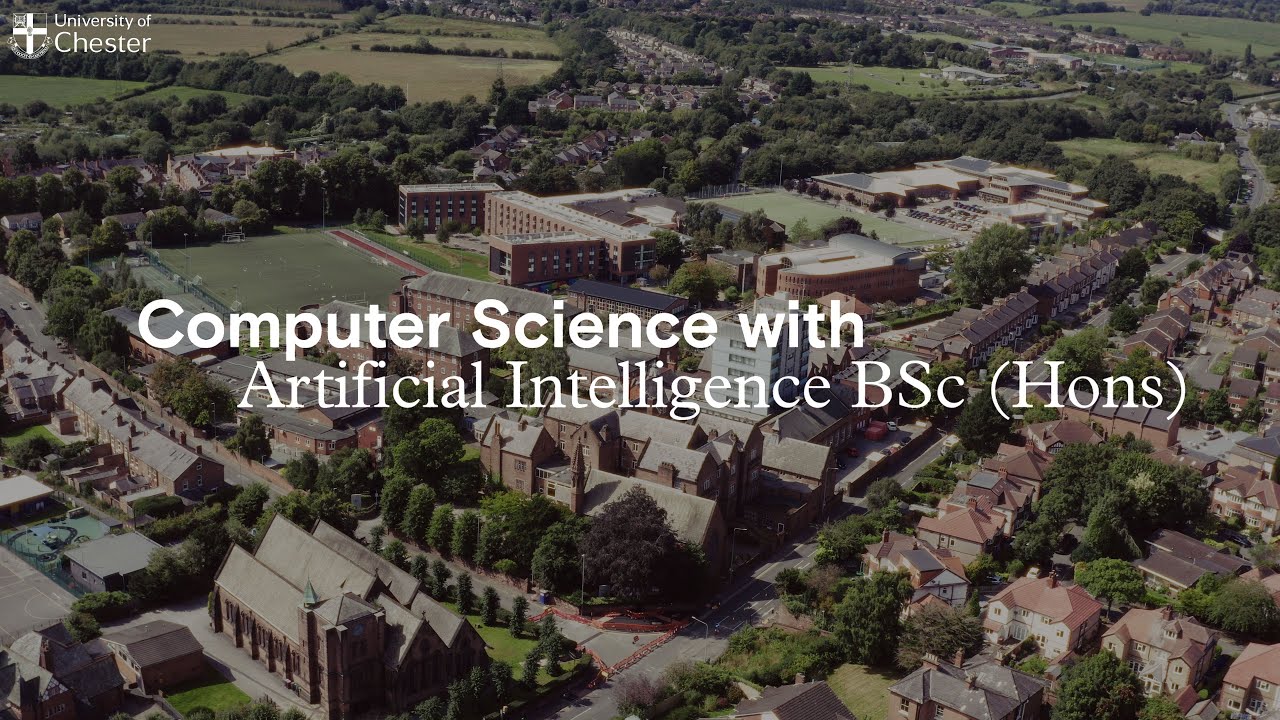
An aerial view of the University of Chester's Exton Park site. Showing a leafy campus with sports pitches, and many of the building on and around the site.

Computer Science with Artificial Intelligence BSc (Hons) | Three Reasons Why

What You'll Study

During the Computing Foundation Year, you are taught to understand key concepts relating to the role of processors, key algorithms, data analysis, HTML website creation, and programming. You will also learn how IT systems and infrastructures are protected from threats.

This module introduces students to general Computing Principles and Skills which will serve as a foundation for all future modules.

During this module, students will explore the purpose of the CPU within a computer, breaking down the steps involved in executing a single instruction in a computer program.

An understanding of algorithms, including key algorithms for searching and sorting data are covered, along with an introduction to measuring algorithm efficiency.

The basics of programming are introduced, including simple commands, controlling program flow, and working with various data types. Students will also learn modern techniques such as object-oriented programming, using APIs, and handling JSON data. A strong practical focus allows them to design, code, and test programs as part of the software development process.

Additionally, key mathematical skills are developed, alongside activities designed to enhance independent and academic study skills.

  • Hardware components in a computer system.
  • CPU architecture
  • Boolean Algebra and the use of logic gates within the computer system.
  • The Fetch-Decode-Execute cycle
  • Key algorithms for searching and sorting
  • Introduction to formal languages used to describe algorithms
  • Assessing algorithm efficiency with Big O notation
  • Types of data including data formats and collections
  • Control flow with programs
  • Object Oriented Programming including Functions, Classes and Methods
  • Connected applications focusing on APIs and JSON data
  • Binary and Hexadecimal number systems, including conversions and mathematical functions.
  • Introduction to set theory.
  • Algebra
  • Functions
  • Trigonometry
  • Vectors
  • Matrices
  • Combinations and Permutations
  • Learning to use and navigate a range of digital spaces specific to your subject
  • Understanding academic conduct and conventions for communicating information
  • Finding and using a range of academic sources relating to your subject

This module gives students the opportunity to learn how computers are used in different ways to build and manage software products and services.

Maths skills are further developed and relevant software is introduced.

Students learn how websites are created using HTML, and how website data is transferred between a server and the end-user’s computer.

Students will be introduced to the essential principles and practices in the field of Cybersecurity covering key subjects such as Confidentiality, Integrity and Availability of data. They will study cyber-threats, cyber-crime and the activities of cyber criminals whilst learning practical ways to protect themselves online, including the use of VPNs and antivirus software.

Students are familiarised with the basics of Information Security Management Systems (ISMS), an understanding of cybersecurity tools and in-depth look at penetration testing.

Hands-on workshops will focus on the practical use of virtualisation and Linux as foundational tools in modern day cloud-based applications and their inherent strengths and weaknesses from a cybersecurity perspective.

  • Website creation with HTML and CSS with an introduction to website hosting.
  • Introduction to The Software Development Lifecycle
  • Network protocols and data transmission techniques.
  • Cybersecurity terminology
  • Cybersecurity tools and technical security solutions
  • Programming from a cybersecurity perspective
  • Introduction to Information and System Security Core threats to Information and System Security (technical, social engineering, organisational structures) Introduction to Information Security Management Systems (ISMS) e.g. the CIA triad, risk management, security policies and standards
  • Introduction to penetration testing
  • Social engineering
  • Virtualisation and Linux
  • Programming in C
  • Defensive programming using encryption, data validation and exception handling
  • Coordinate Geometry
  • Quadratic equations
  • Simultaneous equations
  • Introduction to Calculus
  • Advancing digital and academic skills introduced during Term 1
  • Developing research and information literacy in relation to your subject
  • Creating an academic poster on a chosen research paper

This module is designed to give foundation year students an introduction to the fundamentals of Data Science using the Python language. Students will gain hands-on experience of analysing data, presenting insights into that data and using machine learning to predict future outcomes based upon past events.

  • Understanding the full software development lifecycle from requirements definition to implementation 
  • Working with the NumPy and Pandas libraries for Data Science
  • Exploring data visualisation with Seaborn and Matplotlib
  • Data pre-processing for machine learning
  • Building regression models to explore and utilise trends within data
  • Using a range of common techniques to measure performance of machine learning models
  • Exploring real life uses and practical examples of machine learning
  • Statistical methods such as mean, median, mode, standard deviation
  • Identifying and excluding data outliers
  • Correlation/linear regression
  • Introduction to Statistical tests
  • Introduction to Games Design
  • Use of Artificial Intelligence as a programming assistant
  • Graph Theory
  • Computational Complexity (P vs NP)

The information listed in this section is an overview of the academic content of the course that will take the form of either core or option modules and should be used as a guide. We review the content of our courses regularly, making changes where necessary to improve your experience and graduate prospects. If during a review process, course content is significantly changed, we will contact you to notify you of these changes if you receive an offer from us.

The BSc Computer Science with Artificial Intelligence course contains core modules at each level of study.

In Year 1 (Level 4), you will be introduced to the fundamental and professional skills required to study a computing programme. These fundamental skills are complemented by introductory practical and programming skills, including aspects of user experience.

Core Modules

This module provides a strong foundation in the key areas of computing, i.e., mathematics, modern computing systems, cybersecurity, and professional skills. It equips students with the essential knowledge needed to tackle real-world computing problems and prepare them for advanced computing studies.

The mathematical aspect covers a range of topics that include:

  • Set theory
  • Geometric and trigonometric problem solving
  • Vectors
  • Linear, quadratic, fractional, and simultaneous equations
  • Matrices
  • Logarithmic functions
  • Simple differential equations
  • Introduction to complex numbers

The computing systems considers topics that include:

  • Computer architecture - Hardware, software, and peripherals
  • Basic computing mathematics - Number systems, binary operations, probability
  • Logic gates and Boolean Algebra
  • Machine Code and Assembly Language
  • Compilers and Linkers
  • Data Formats
  • Operating Systems and File Management

The cybersecurity component addresses areas including:

  • Cybersecurity Concepts
  • The Human Weakness in Cybersecurity
  • Cybersecurity Vulnerabilities
  • Cybersecurity Exploitation
  • Cryptography and Information Security
  • Cybersecurity Auditing Methods
  • Cybersecurity Defensive Strategies
  • Programming for Cybersecurity with Python
  • Ethical Hacking and Penetration Testing Lifecycle

The professional skills aspect encompasses subjects including:

  • Employment & Employability
  • Curriculum Vitae
  • Role of Professional Bodies
  • Security Obligations, Ethics and Law
  • Copyright and IPR Concepts
  • Report Writing and Referencing
  • Proposal and Business Plans
  • Social Networks and Collaboration
  • Data Collection Methods
  • Reflection

This module explores the design and development of computer software (applications) from two perspectives:

  1. The implementation of software using programming code, in a high level statically typed, object-oriented programming language, such as Java.
  2. The user-centred design approach to software design, considering human factors, user experience, usability, and prototyping.

The programming aspect covers a range of topics including

  • The syntax and semantics of a programming language
  • Different types of data, including collections
  • Control flow - conditional, iterative and recursive
  • Data input and output (CLI and file based)
  • Object-orientation, including class design and inheritance
  • Unit testing
  • Basic refactoring

The human aspect considers topics that include

  • User-centred design
  • Human factors
  • Usability
  • Accessibility
  • User experience
  • Low and high-fidelity prototyping
  • Evaluation

This module introduces fundamental concepts in database systems, emphasising their importance in modern computing. Students will gain theoretical and practical skills in designing, implementing, and querying relational databases, while also exploring alternative database management systems (DBMS), such as NoSQL and distributed databases. Through hands-on experience with tools like SQL and exposure to NoSQL systems, students will learn to choose the right database solution for different use cases.

The aims of this module are:

  • Understand the role and importance of databases in computer systems and applications.
  • Explain core database concepts, including schemas, tables, keys, and relationships.
  • Design normalised database schemas using Entity-Relationship (ER) modelling.
  • Implement relational databases in a DBMS.
  • Write SQL queries for data definition, manipulation, and retrieval.
  • Compare and contrast relational databases with alternative database models such as NoSQL and distributed systems.
  • Explore use cases for NoSQL databases, including document stores, key-value stores, and graph databases.
  • Understand the challenges and benefits of distributed databases, including replication and scalability.
  • Awareness of basic techniques for database optimisation and indexing.
  • Discuss data security, privacy, and ethical considerations in database design and use.

Optional Modules

The module focuses on the application of computer programming, and related technologies, in solving everyday problems. In this process, problems and challenges will be analysed, leading to the selection and deployment of tools and techniques in response.

As a problem-based learning strategy is employed, the syllabus of the module is fluid from occurrence-to-occurrence. However, central themes and foundational concepts that will be covered are:

  • Computational thinking (decomposition, abstraction, algorithm design, pattern recognition)
  • Collaborative software development
  • Solution evaluation
  • Project portfolios

Optional Language Modules

This module enables students with A-Level German or equivalent to further develop their grammar, vocabulary and expression and apply these to real world situations.You will work with written and recorded texts on a range of cultural, personal and social topics and will develop your oral and written communication skills at Post-A level.

This module is designed for students that have completed A-Level or equivalent in French. You will further develop your grammar, vocabulary and expression and apply these to real world situations. You will work with written and recorded texts on a range of cultural, personal and social topics and will develop your oral and written communication skills at Post-A level.

This module is designed for students that have completed a A-Level or equivalent in Spanish. You will further develop your grammar, vocabulary and expression and apply these to real world situations. You will work with written and recorded texts on a range of cultural, personal and social topics and will develop oral and written communication skills at Post-A level.

This module is designed for students who have completed GCSE in Chinese or equivalent. You will further develop your grammar, vocabulary and learning conventions for spelling and pronunciation. You will work with written and recorded texts on a range of cultural, personal and social topics and will develop oral and written communication skills at an intermediate level.

This module is designed for students who have completed GCSE or equivalent in French. You will further develop your grammar, vocabulary and learning conventions for spelling and pronunciation. You will work with written and recorded texts on a range of cultural, personal and social topics and will develop oral and written communication skills at an intermediate level.

This module is designed for students that have completed GCSE or equivalent in Spanish. You will further develop your grammar, vocabulary and learning conventions for spelling and pronunciation. You will work with written and recorded texts on a range of cultural, personal and social topics and will develop oral and written communication skills at an intermediate level.

This module provides the opportunity to study a new language from scratch and introduces you to basic grammar, vocabulary and cultural contexts. You will apply the language to practical situations using both oral and written skills. 

The information listed in this section is an overview of the academic content of the course that will take the form of either core or option modules and should be used as a guide. We review the content of our courses regularly, making changes where necessary to improve your experience and graduate prospects. If during a review process, course content is significantly changed, we will contact you to notify you of these changes if you receive an offer from us.

Year 2 (Level 5) builds on this foundation and allows you to develop your programming skills, as well as learning foundational skills in artificial intelligence and its application in data analytics. You will then put your skills into practice in a work-based learning module towards the end of the year.

Core Modules

This module provides a critical understanding of the fundamental building blocks of computer systems with an emphasis on performance efficiency. Topics include gate-level minimization, the design of combinational and sequential circuits, and an exploration of performance metrics and techniques for enhancing microprocessor architecture.

The module also covers the below topics of computer networks. 

  • Network representation and topologies
  • Protocols and models
  • SDLC
  • Switching concepts
  • Spanning Tree Protocol
  • VLANs
  • Wireless LAN
  • Subnetting
  • Routing fundamentals
  • Network Virtualisation
  • Cloud Fundamentals
  • Quality-of-Service
  • Network Security

This module introduces intermediate topics in algorithm design, analysis and implementation using industry standard libraries, tools and techniques. Topics include asymptotic analysis, memory management and common data structures and algorithms such as:

  • Arrrays
  • Linked lists
  • Stacks
  • Queues
  • Heaps
  • Binary search trees
  • Hash tables
  • Sorting
  • Searching
  • Pseudorandom number generation

Additionally we cover topics such as multithreaded software development, as well as issues regarding maintainability for larger software projects.

This module explores the fundamental ethics and principles of artificial intelligence and understanding how it impacts on society, specifically examining the ethical, social and technical challenges posed by AI systems. As part of this module, students will develop their understanding of key ethical principles, the societal impact of AI and will evaluate how human factors can influence system design/model development and potentially perpetuate human biases. This module will also explore different governance approaches and legislative requirements for AI and will examine the diverse strategies for mitigating discrimination and bias in AI based systems.

This module provides a comprehensive introduction to data analytics, focusing on foundational concepts and practical applications. Students will develop essential skills to analyze data, solve real-world problems, and explore the rapidly growing field of big data analytics. The key perspectives are:

  • Introduction to  the data analytics process, including data collection, cleaning, analysis, visualisation, and interpretation.
  • Hands-on experience with data analytics tools and techniques.
  • Exploring big data analytics concepts, including scalable data processing and analysis.
  • Promoting ethical decision-making and effective communication in data-driven contexts.

The data analytics process covers :

  • Identifying business problems and defining objectives.
  • Collecting and cleaning raw data for analysis.
  • Performing exploratory data analysis (EDA) to uncover patterns.
  • Visualising and interpreting results to derive actionable insights.

The statistical and analytical thinking aspect includes: 

  • Measures of central tendency and dispersion.
  • Regression analysis and correlation.
  • Data modelling and simulation.

The tools and techniques component covers:

  • cleaning and preprocessing using Python or R.
  • SQL for querying and managing databases.
  • Data visualisation using tools like Tableau, Power BI, Matplotlib and Apache Superset
  • Introduction to big data ecosystem.

The big data analytics aspect addresses:

  • Scalable data storage and processing.
  • Analysing large datasets with distributed systems.
  • Leveraging machine learning for big data insights.
  • Real-time analytics and stream processing.

The ethical and professional skills aspect encompasses:

  • Ethical issues in data privacy and security.
  • Effective communication of data insights through storytelling.
  • Collaboration and teamwork in data projects.
  • Presentation and reporting of analytics outcomes.

Optional Modules

This module provides a structured, university-level work placement for 4, 5 or 7 weeks (optional timeframe decided on a 1 2 1 basis) as one continuous block / period with a placement provider (i.e. industry apprioprate sector). It is designed to enhance your professional skills in a real-world job setting.

The placement can either be organised by you or with support from university staff.

All work placements within this module must be university-level; this means:

  • Undertaking high-skilled work commensurate with level 5 study (e.g. report writing, attending meetings, delivering presentations, producing spreadsheets, writing content on webpages, social media, marketing services/products etc)
  • Physically placed (albeit part of it can be hybrid) within an employer setting in one continuous block / period for 4, 5 or 7 weeks for a minimum of 140-147 hours over the course of the entire work placement

Where applicable, your existing part-time employer can be approached/used as the placement provider, if the high-skilled work.

  • criterion above is fulfilled for the full duration of the placement.
  • All quality assurances/agreements provided by the University are adhered to, by you and the employer.

The work placement context may not necessarily, reflect your degree discipline per se, but rather, it will give you an enriched experience to enhance your professional skills in a real-world job setting.

This is an experiential learning opportunity that incorporates 35 teaching contact hours/lectures to prepare for the 150 contract hours. L5 students can use all their skills learned to date on an actual real-world (external business) client-driven project, working in teams and producing an artefact. 

You are also expected to undertake around 215 hours of self-study.

This module not only gives them enhanced skills but the opportunity to work for a real client thus giving them a valuable CV and LInkedIn entry as work experience that can contribute to their employability portfolio. 

You will collaborate in teams and produce full client documentation alongside a reflection of their expereince and this all give some much needed contemplation of their skills to date and how to use them. 

Optional Language Modules

The module will provide the opportunity to further develop your language skills, building on your previous learning at advanced level. The second half of the module includes a placement abroad or, alternatively, a project on a sustainability issue in a target language country. The first half of the module will prepare you for placements abroad where appropriate as well as a deeper understanding of sustainability in target language contexts. Students of more than one language may take one language in the first half of the module and spend their time abroad developing a different language. 

The module will provide the opportunity to further develop your language skills, building on your previous learning at intermediate level. The first half of the module includes intensive taught sessions in interactive workshop mode which will prepare you for placements abroad or self-directed language development. The second half of the module includes an placement abroad or, alternatively, a project on a business or tourism issue in a target language country. Students of more than one language may take one language in the first half of the module and spend their time abroad developing a different language. 

The module will provide the opportunity to further develop your language skills, building on your previous learning at beginner level. The first half of the module includes intensive taught sessions in interactive workshop mode which will prepare you for placements abroad or self-directed language development. The second half of the module includes a placement abroad or, alternatively, a project on a cultural issue in a target language country. Students of more than one language may take one language in the first half of the module and spend their time abroad developing a different language. 

Part A:      

Preparation for Experiential Overseas Learning will take place at the University of Chester during level 5 and will include:  

  • The multiple facets of Global citizenship
  • Ethical engagement and practice
  • Cross-cultural issues and sensitivity
  • Intercultural communication

Theories, models and strategies of learning

  • Theories and models Intercultural competence
  • Theories and models of Integration and Multiculturalism
  • Critical thinking skills and models of Reflection
  • Experiential learning models
  • Self-directed experiential learning

Personal and placement-related skills

  • Enhanced independence
  • Improved command of multicultural behaviour
  • Increased knowledge and confidence in their individual facets of personal identity
  • Effective time management and organisational skills
  • Project management – working away from University and independent study
  • Self-management and personal development
  • Team building and team work

Part B:            Overseas

Students will engage in experiential learning activities overseas for at least 150 hours 

  • The multiple facets of global citizenship
  • Ethical engagement and practice
  • The United Nations Sustainable Development Goals
  • Cross-cultural issues and sensitivity
  • Intercultural communication
  • Culture shock
  • Cultural adjustment
  • Self- assessment of needs: identification of the range of transferable skills, competencies and attitudes employees need and employers expect graduates to possess-with a strong focus on understanding the intercultural competencies (ICC) needed to live and work abroad.
  • Critical analysis/evaluation of individual requirements in relation to culture/cultural adjustment/culture shock/visas/medical.
  • Critical analysis/evaluation of skills already acquired in relation to key skills related to ICC.
  • Devising strategies to improve one’s own prospects of working abroad in the future.
  • Devising an action plan to address gaps in transferable skills based on organisational analysis and sector opportunities.

Optional Placement Year

Year in Industry placement year for computing students. 

This is a placement module where students acquire a 1 year paid work placement related to their area of study.

Full attendance at the work placement and University-scheduled events is mandatory.

The placement hours stated for this module are only the minimum required hours for this module, it is likely most placements will last for 9 months - 12 months and exceed the minimum 1,180 placements hours.

The traditional academic programme structure is not applicable. The placement content is freely structured and determined by negotiation between the student, placement supervisor and host organisation. It is generally informed by the aims and learning outcomes and by the objective of optimising added value for both the host organisation and the student experience

Optional International Placement Year

Preparation for the year abroad will take place in Chester during level 5 and will include:

  • Cross-cultural issues and sensitivity
  • Host-country orientation, study methods– economic, political and social reality of the country
  • Orientation specific to exchange – health, education, gender issues
  • The United Nations Sustainable Development Goals
  • Practical matters relating to living and studying in the wider world

Theories, models and strategies of learning

  • Critical thinking skills, experiential learning and models of reflection

Personal and placement-related transversal skills

  • Effective self-motivation and independent resourcefulness
  • Effective time management and organisational skills
  • Project management – working away from University and independent study
  • Self-management and personal development

Whilst abroad:

You will undertake study at one of the University of Chester's partner universities or undertake and approved work placement or virtual placement. If you are a student,  it is expected that you will choose a series of modules at the university abroad which must be agreed by the host institution and the Module Leader. you must supply details of you modules on a learning agreement within 4 weeks of arrival at the host university.

The information listed in this section is an overview of the academic content of the course that will take the form of either core or option modules and should be used as a guide. We review the content of our courses regularly, making changes where necessary to improve your experience and graduate prospects. If during a review process, course content is significantly changed, we will contact you to notify you of these changes if you receive an offer from us.

You can opt to take a year in industry before progressing to the final year of the course.

Year 3 (Level 6) allows you to further develop your skills in programming and the application of artificial intelligence (AI), before working on an AI-focused final year project under the supervision of an academic staff member.

Core Modules

This module introduces students to developing applications for mobile devices on a major platform such as Android or iOS. This includes mobile device specific aspects such as working with location services, SDKs and libraries, making network requests, concurrency and dealing with resource limitations.

From a programming theory and application perspective, the module will consider, working with and further developing existing code, including the refactoring process, design patterns, the SOLID principles andwill  introduce students to the fundamentals of functional programming. Students will also consider the differing features of programming languages (such as type systems)

The module offers a comprehensive exploration of design thinking and its integration with human-centred design principles and practices to realise highly usable interactive systems. By the end of the module, students will be equipped to design innovative and user-friendly digital products and services, balancing business objectives with user satisfaction. This is supported by a focus on collaboration and teamwork, ensuring that the practices and processes of the industry are reflected. Over its duration, the module will engage with topics including, but not limited to, the following:

  • Human-centred design and ISO 9241-210
  • Balancing business goals with user needs
  • UX research
  • Experience mapping
  • Design thinking
  • Information architecture
  • Progressive enhancement
  • User interface design techniques
  • Defining inclusive design and accessibility
  • Style-guides and specifications for developers
  • Design sprints for software innovation
  • User testing and evaluation

This module offers an in-depth exploration of artificial intelligence (AI) and its transformative role in the development of advanced software systems. It introduces key theoretical approaches and practical techniques for designing and deploying intelligent technologies, empowering you with the skills to build AI-driven solutions.

Key topics covered include:

  • Introduction to Artificial Intelligence: Understanding the foundations of AI and its significance in modern software development.
  • Theoretical Approaches to AI: Exploring algorithms and models that underpin intelligent systems, such as decision trees, neural networks, and reinforcement learning.
  • Practical AI Implementation: Gaining hands-on experience with AI techniques, including machine learning, natural language processing, and computer vision, through coding exercises and projects.
  • Designing and Deploying Intelligent Systems: Examining methods for building robust, scalable, and ethically sound AI technologies.
  • AI in Various Domains: Critically evaluating how AI is applied across industries such as business, healthcare, education, law, government, and scientific research, along with the ethical and societal implications of these applications.

This module blends theory with practical application, equipping you to develop intelligent systems and critically assess their impact in a wide range of real-world contexts.

The Robotics module provides an introduction to the foundational principles of robotics, exploring the theoretical aspects that underpin the design, application, and ethical considerations of robotic systems.

You will begin by examining the fundamental question: What is a robot?  This includes understanding the diverse applications of robots across industries and their role in society. The module also delves into the ethical implications of robotics, such as their impact on employment, privacy, and safety.

Key technical topics include an overview of mechatronics, which integrates mechanical, electronic, and computer engineering; sensors, which enable robots to perceive their environment; and control systems, which ensure robots can perform tasks accurately and autonomously.

The module is assessed in a practical project where you will design a simulated robot, applying the concepts learned to demonstrate your understanding of robotic systems.

Students will undertake a large self-directed software project in a specialist topic of their choice with guidance and support from a dedicated academic supervisor.

The project will begin with an appraisal of said topic, usually through a literature review and/or a commercial assessment of viability. This will be followed by planning and creation of a practical software artefact covering an implementation lifecycle, making use of project management techniques.

Ethical issues will be explored, leading to required approval for quantitative and/or qualitative testing, with results then analysed and used to inform futher development and to draw conclusions against a hypothesis.

The information listed in this section is an overview of the academic content of the course that will take the form of either core or option modules and should be used as a guide. We review the content of our courses regularly, making changes where necessary to improve your experience and graduate prospects. If during a review process, course content is significantly changed, we will contact you to notify you of these changes if you receive an offer from us.

How You'll Learn

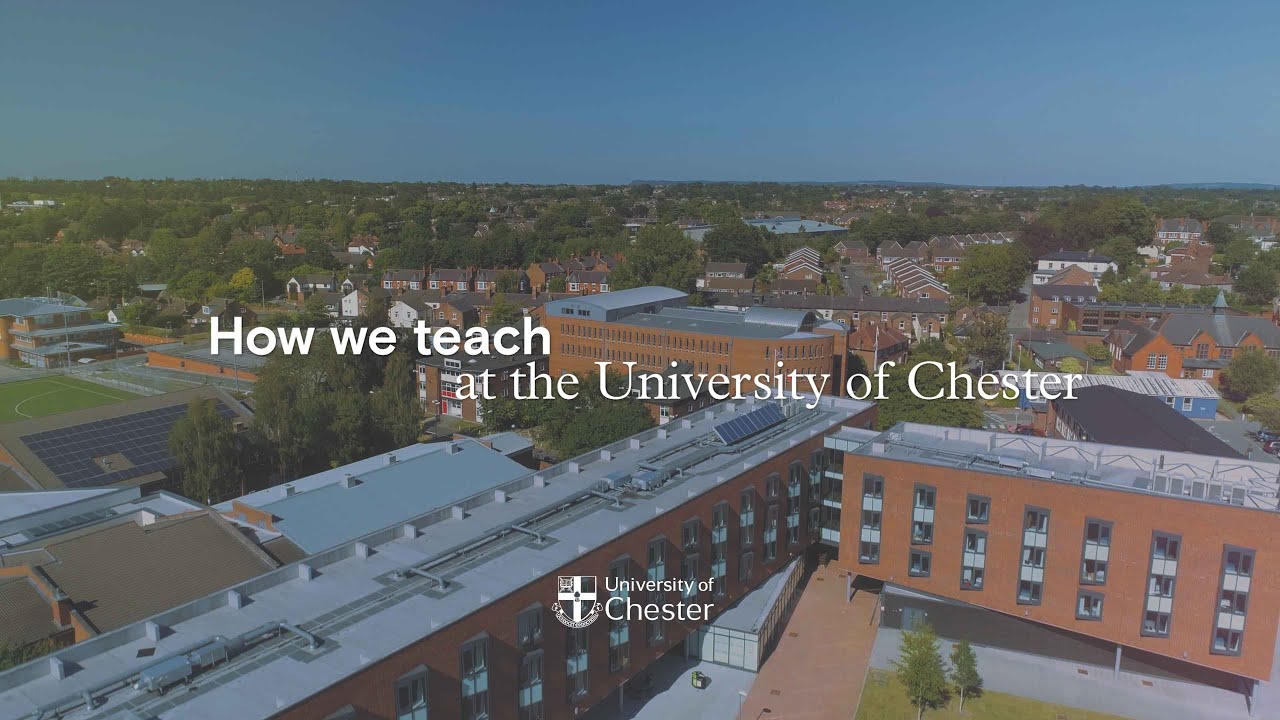
An aerial photograph of Exton Park with the text 'How we teach at the University of Chester'

How we teach at the University of Chester

This course, including the Foundation Year, is delivered in three terms of ten weeks each. In each term, you will study 40 credits usually comprised of either one or two modules, covering a breadth of topics and subject skills.

In Years 1-3 (Levels 4-6), the average number of scheduled contact hours per week typically ranges from five to ten hours. This will vary depending on the module, year of study, number of practical sessions and the complexity of the material being taught. If studied, the Foundation Year will have 12 hours of contact time per week; there may be variations to this depending on the subject matter and any practical sessions.

This course is delivered primarily through in-person learning, supported by online learning materials. You can expect to take part in labs, workshops, lectures and tutorials. Teaching will be delivered by experienced academics and practitioners in the subject. This will be supplemented by occasional guest lecturers and speakers. 

On this course, you should expect to spend an average of 30 to 34 hours per week on independent study, which might include following asynchronous learning material on the University’s VLE, using the University’s library, working with peers and preparing work for assessment. 

There will be a broad range of assessment methods so that you are exposed to the different types of tasks you might encounter in the workplace. These will include coursework in the form of programming projects, software artefacts, portfolios of work, written work (e.g., essays) and presentations. In some modules, you will encounter class tests and practical assessments. We continuously review the assessment methods used to ensure they adequately prepare you for graduate-level employment. 

All teaching is delivered by experienced academics and practitioners, with the fundamental principles of the Chester Future Skills Curriculum at its core - building your subject competence, confidence and key transferable skills to shape you into a world-ready Chester graduate.

Your Future Career

Job Prospects

Our graduates enter a range of roles, both locally and further afield. Typical roles for students completing the course might include software developer, web developer, network engineer and database administrator among many others. A number of our students have entered graduate schemes at multinational companies. 

Progression Options

Careers Service

The University has an award-winning Careers and Employability service which provides a variety of employability-enhancing experiences; through the curriculum, through employer contact, tailored group sessions, individual information, advice and guidance.

Careers and Employability aims to deliver a service which is inclusive, impartial, welcoming, informed and tailored to your personal goals and aspirations, to enable you to develop as an individual and contribute to the business and community in which you will live and work.

We are here to help you plan your future, make the most of your time at University and to enhance your employability. We provide access to part-time jobs, extra-curricular employability-enhancing workshops and offer practical one-to-one help with career planning, including help with CVs, applications and mock interviews. We also deliver group sessions on career planning within each course and we have a wide range of extensive information covering graduate jobs and postgraduate study.

What Our Students Think

Entry Requirements

112 UCAS points

UCAS Points

112

GCE A Level

BCC-BBC

GCSE

Mathematics Grade C/5 or higher

English Language C/4 or higher

BTEC

DMM

International Baccalaureate

28 points

Irish/Scottish Highers

H3 H3 H3 H3 H4

Scottish Highers - BBBB

Access requirements

Access to HE Diploma, to include 45 credits at Level 3, of which 30 must be at Merit or above

T Level

Merit

OCR Cambridge Technicals

DMM

Extra Requirements

Welsh Baccalaureate Advanced and A Level General Studies will be recognised in our offer. We will also consider a combination of A Levels and BTECs/OCRs.

Prior Work/ Voluntary Experience

Applicants who do not meet the UCAS tariff requirements but who have relevent work experience may be considered. Such applicants would normally be invited to submit a portfolio and be invited to interview.

English Language Requirements

IELTS

6.0 (minimum 5.5 in each band)

Prior Work/ Voluntary Experience

Applicants who do not meet the UCAS tariff requirements but who have relevent work experience may be considered. Such applicants would normally be invited to submit a portfolio and be invited to interview.

72 UCAS points

UCAS Points

72

GCE A Level

72 points, including grade D at A Level

GCSE

Mathematics Grade C/5 or higher

English Language C/4 or higher

BTEC

MMP 

International Baccalaureate

24 points

Irish/Scottish Highers

H4 H4 H4 H4 H4

Scottish Highers - CCDD

Access requirements

Pass overall

T Level

Pass (D or E on the core)

OCR Cambridge Technicals

MMP

Extra Requirements

If you are a mature student (21 or over) and have been out of education for a while or do not have experience or qualifications at Level 3 (equivalent to A Levels), then our Foundation Year courses will help you to develop the skills and knowledge you will need to succeed in your chosen degree.

Welsh Baccalaureate Advanced and A Level General Studies will be recognised in our offer. We will also consider a combination of A Levels and BTECs/OCRs.

Prior Work/ Voluntary Experience

Applicants who do not meet the UCAS tariff requirements but who have relevent work experience may be considered. Such applicants would normally be invited to submit a portfolio and be invited to interview.

Fees and Funding

£9,790 per year for a full-time course (2026/27)

The full-time tuition fees for Home students entering in 2026/27 are £9,790 a year, or £1,590 per 20-credit module for part-time study.

£14,950 per year for a full-time course* (2026/27)

The tuition fees for international students studying programmes in 2026/27 are £14,950 per year for a full-time course. This fee is set for each year of study.

For courses with a Foundation Year, the tuition fees for Year 1 are £11,250 and £14,950 for Years 2-4 in 2026/27.

Study a Common First Year

This course shares a common first year with students on Computer Science BSc Hons and the Computer Science and Electronic Engineering pathway.

This means that you’ll learn alongside students studying a similar discipline, helping to broaden your knowledge and exposure to other concepts, perspectives and professions in the first year of your degree.

As you learn and collaborate with students from other courses, you'll not only widen your social and professional network but also learn new skills that will set you up for success in your industry.

In your second and third years, you will progress to studying more specialist modules within artificial intelligence, developing your skills to become a World Ready graduate.

Who You'll Learn From

Andrew Muncey

Senior Lecturer
Andrew Muncey

Dr Stuart Cunningham

Senior Lecturer
Dr Stuart Cunningham

Dr Mike Morgan

Senior Lecturer
Dr Mike Morgan

Dr Helen Southall

Senior Lecturer
Dr Helen Southall

Graham Logan

Senior Lecturer
Graham Logan

Dr Richard Stocker

Senior Lecturer
Dr Richard Stocker

Dr Kiran Sultan

Senior Lecturer
Dr Kiran Sultan

Jules Barnes

Senior Lecturer
Jules Barnes

Enquire about a course