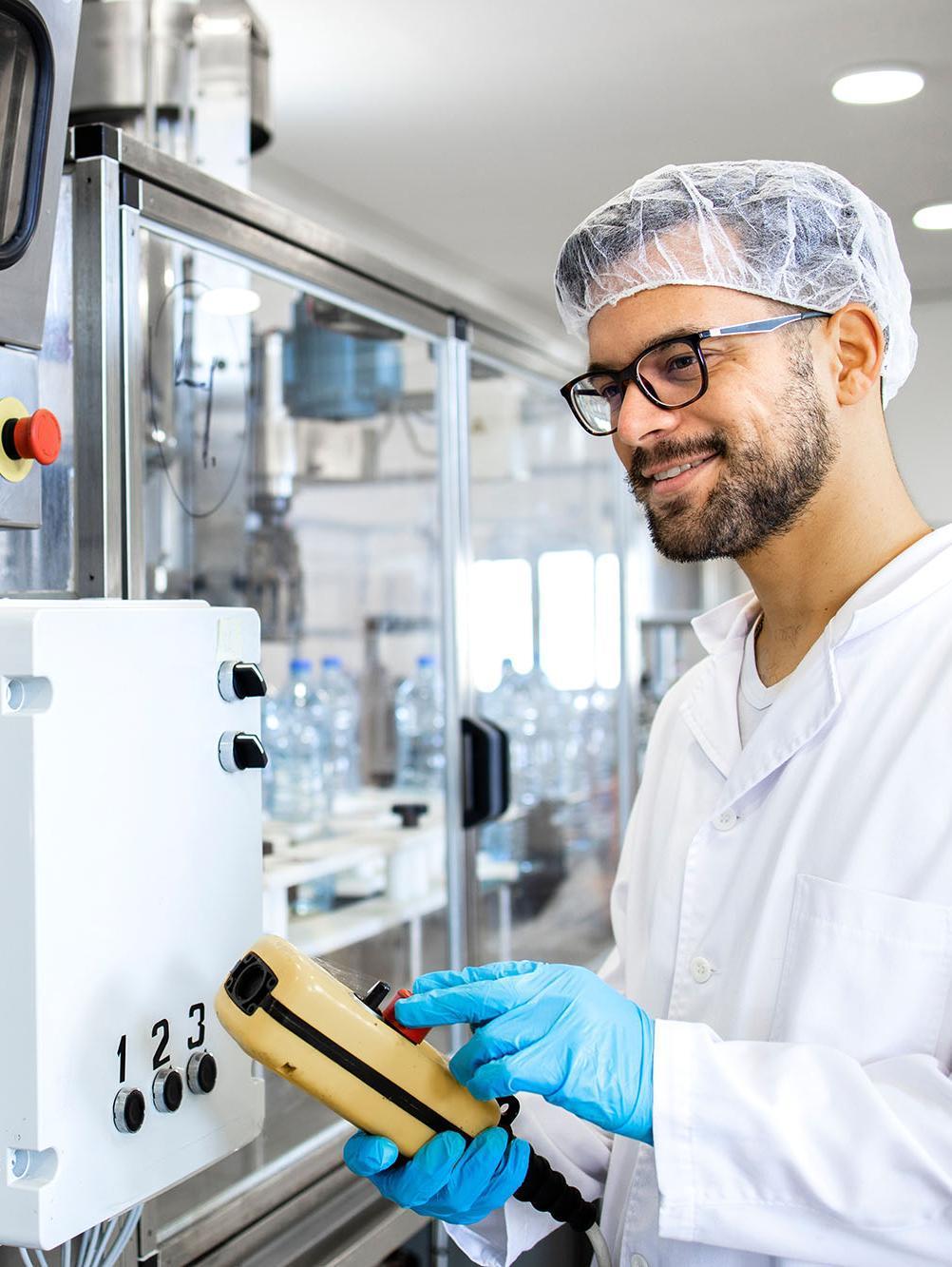



Worker or technologist operating industrial production machine in food processing factory. Worker or technologist operating industrial production machine in food processing factory.

This course aims to develop your skills and knowledge and combine food science, technology and nutrition to meet the industry's challenges.

Population growth, both globally and within the UK, continues to put pressure on all elements of the agri-food supply chain. A fully coordinated approach to food quality, safety, security and sustainability is needed. You will use your specialist skills, combining food science and technology, as well as nutrition and health, to meet the industry's challenges; the objective of the course is to create innovative food products while ensuring they are safe, wholesome and nutritious.

Our MSc in Food Science and Innovation integrates the key elements required to address the future needs of industry and the global population. The course will benefit individuals looking to enhance their careers in the food supply chain. It is also ideal for those interested in new product development, food processing and manufacturing, and the food service industries.


Why You’ll Love It

What You'll Study

This MSc course is built upon a programme of research and development that has been established at the University to support the food and drink sectors. The course consists of the following 20 credit modules leading to a dissertation.

Core Modules

This dynamic module dives into the world of bioactive ingredients and functional foods, equipping students with the skills to drive innovation in food product development. With growing consumer demand for functional, ‘free-from,’ vegan, and clean-label foods, this module explores how bioactive fibres and highly bioavailable omega-3 fatty acids can enhance health-focused products. Students will tackle real-world challenges by developing foods that address societal health concerns, such as reducing disease risks and catering to specific populations like the elderly. Through hands-on experience, students will create and test novel bioactive materials, gaining essential expertise in alternative ingredient development. By blending theory with practical application, this module fosters a key competency in designing functional food solutions that align with industry trends and consumer needs.

This engaging module explores the key challenges shaping food availability today and in the future, from population growth and resource depletion to environmental changes and shifting consumer demands. Students will delve into the entire food supply chain, from production to consumption, examining ways to improve efficiency, sustainability, and safety. A crucial focus is protecting food quality by understanding contaminants, allergens, and adulterants, along with the strategies needed to ensure a secure and nutritious food supply. Through this module, students will develop a key competency in analyzing and addressing real-world food security issues, equipping them with the knowledge to influence industry practices and policy decisions.

This module provides a comprehensive foundation in research methods and data analysis, equipping you with the skills to design, conduct, and interpret scientific research. You’ll explore different research types—analytical, descriptive, experimental, and qualitative—while mastering key concepts like hypotheses, variables, sampling, and measurement reliability. Learn how to collect and analyse data effectively, from experimental designs and surveys to case studies and qualitative research techniques. A strong emphasis on ethical research practices ensures you understand the responsibilities of scientific inquiry. You’ll also gain hands-on experience with SPSS software, learning to establish databases, transform variables, and apply statistical tests like ANOVA, t-tests, and chi-square analyses. By the end of the module, you’ll be able to critically evaluate research, apply statistical techniques, and use data-driven insights to inform decision-making—essential skills for careers in academia, healthcare, and scientific research.

This exciting module explores cutting-edge packaging technologies, essential for preserving food quality, enhancing safety, and improving distribution efficiency. With packaging accounting for 2% of global GDP, the food industry faces increasing pressure to innovate—reducing waste, optimizing business processes, and ensuring sustainability. Students will examine emerging packaging solutions that address these challenges, gaining insight into how technology can enhance food safety and extend shelf life. The module also includes demonstrations of innovative packaging, providing hands-on experience with the latest advancements. By the end, students will develop a key competency in assessing and applying modern packaging strategies to meet industry and consumer needs.

This forward-thinking module delves into the key drivers of food innovation, from evolving consumer demands to sustainability, resource availability, and waste minimization. Students will explore cutting-edge trends in food processing and ingredients, including the role of nanotechnology in food innovation, its regulatory landscape, and intellectual property protection. Case studies of recent breakthroughs will offer real-world insights, while practical experience with innovative processing technologies will equip students with hands-on skills. A special focus on reducing salt, sugar, and fats in food products will highlight industry priorities. Additionally, students will have the opportunity to access an optional industrial placement, enhancing their professional experience. This module fosters a key competency in understanding and applying emerging food technologies, preparing students to drive innovation in the ever-evolving food industry.

This dynamic module equips students with key theoretical and practical skills for evaluating food quality, performance, and consumer acceptability. Through sensory science and physical property analysis, students will explore how ingredients and additives influence food texture, stability, and appeal. Quality assurance and control will be central themes, ensuring products meet industry and consumer standards. The module also highlights opportunities to develop innovative food solutions tailored to specific consumer groups, such as the elderly. Additionally, students will gain essential data collection and evaluation skills, addressing ethical considerations in food research. By the end, they will develop a key competency in applying scientific evaluation methods to drive food innovation and product development.

This module provides an opportunity to conduct independent research, allowing you to contribute to the growing body of knowledge in your field of study. Working closely with a supervisor and research coordinator, you will design and execute a research project that aligns with your academic discipline. This involves identifying a research question, reviewing existing literature, selecting appropriate methodologies, and analysing data to generate meaningful insights. Through this process, you’ll develop critical thinking, problem-solving, and research skills, essential for academic and professional success. The module emphasises independent inquiry and evidence-based analysis, preparing you to engage with real-world challenges in your chosen field. By the end, you’ll have completed a rigorous, well-structured research project, demonstrating your ability to contribute valuable findings to your discipline—an essential competency for further study, professional research, or industry application.

The information listed in this section is an overview of the academic content of the course that will take the form of either core or option modules and should be used as a guide. We review the content of our courses regularly, making changes where necessary to improve your experience and graduate prospects. If during a review process, course content is significantly changed, we will contact you to notify you of these changes if you receive an offer from us.

How You'll Learn

An aerial photograph of Exton Park with the text 'How we teach at the University of Chester'

How we teach at the University of Chester

The MSc Food Science and Innovation course is delivered in person, primarily through seminars, lectures and workshops. You will also have the opportunity to take part in practical laboratory sessions. You will experience an interactive and collaborative learning environment, often working alongside your peers and with staff to develop the key competencies.

The course consists of a series of taught modules, each delivered in a three or four-day block, followed by a period of directed learning and the submission of an assessment as set out in each module. This is designed to help you balance your studies with personal and work commitments.

We use a variety of teaching and learning modes, such as lectures, seminars, group activities, case studies, student presentations, laboratory classes and practical activities. Independent learning following the taught element is a key feature of the course, and is supported through individual tutorials (in person or online) and assessment workshops.

Teaching is delivered by experienced, well-published academics and practitioners, who offer diverse perspectives and use a range of materials and teaching methods to ensure your individual learning needs are met.

The range of assessment methods on the course represents the different types of tasks you are likely to encounter in the workplace. These include assessments in the form of practical lab assessments, lab reports, written work (both long and short form, e.g., reports and reflections), portfolios and presentations. Assessments are also integrated into the learning process, enabling consistent application of knowledge. Course staff regularly review assessment methods to ensure they are relevant and reflect real-world expectations in the context of postgraduate level employment.

Your Future Career

Careers Service

The University has an award-winning Careers and Employability service which provides a variety of employability-enhancing experiences; through the curriculum, through employer contact, tailored group sessions, individual information, advice and guidance.

Careers and Employability aims to deliver a service which is inclusive, impartial, welcoming, informed and tailored to your personal goals and aspirations, to enable you to develop as an individual and contribute to the business and community in which you will live and work.

We are here to help you plan your future, make the most of your time at University and to enhance your employability. We provide access to part-time jobs, extra-curricular employability-enhancing workshops and offer practical one-to-one help with career planning, including help with CVs, applications and mock interviews. We also deliver group sessions on career planning within each course and we have a wide range of extensive information covering graduate jobs .

Entry Requirements

Honours Degree

Applicants should have a 2:1 honour degree (or a 2:2 with one years relevant work experience) in any of the following: Food Science and Technology; Biotechnology, Biochemistry; Nutrition; Biology (with a strong Biochemistry component) or related subjects

Employment Status

Entrants are normally expected to have a good first degree, minimum 2:1 Honours, or a 2:2 degree classification and with a minimum of one year's experience of working in the Food & Drink industry or relevant.

Students from countries outside the UK are expected to have entry qualifications roughly equivalent to UK A Level for undergraduate study and British Bachelor's degree (or equivalent) for postgraduate study. To help you to interpret these equivalents, please select your country/region of residence to see the corresponding entry qualifications, along with information about your local representatives, events, information and contacts.

For more information on our English Language requirements, please visit International Entry Requirements.

IELTS


IELTS - Minimum IELTS 6.5 (no less than 5.5 in each band) or equivalent

Honours Degree

Applicants should have a 2:1 honour degree (or a 2:2 with one years relevant work experience) in any of the following: Food Science and Technology; Biotechnology, Biochemistry; Nutrition; Biology (with a strong Biochemistry component) or related subjects

Employment Status

Entrants are normally expected to have a good first degree, minimum 2:1 Honours, or a 2:2 degree classification and with a minimum of one year's experience of working in the Food & Drink industry or relevant.

Fees and Funding

£9,090 for a full-time course (2026/27)

The tuition fees for home students studying courses in 2026/27 are £9,090 per year.

Guides to the fees for students who wish to commence postgraduate courses are available to view on our Postgraduate Fees page. Here you will also find information about part-time fees and project/placement year fees.

£15,500 (2026/27)

The tuition fees for international students studying courses in 2026/27 are £15,500 per year.

Irish Nationals living in the UK or ROI are treated as Home students for Tuition Fee Purposes.

For more information about International fees for Postgraduate study, go to our International Fees, Scholarship and Finance section.

Who you’ll Learn from

Enquire about a course