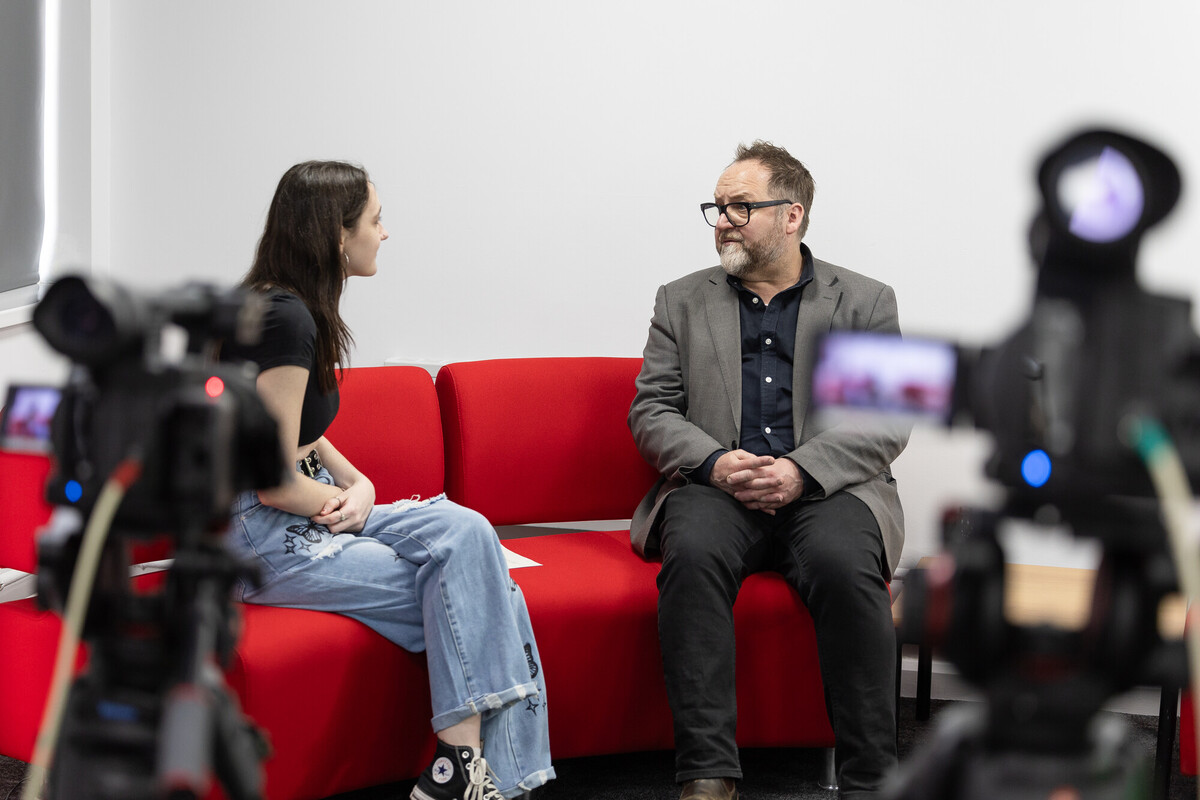



Journalism student interviewing a lecturer on camera in a university media studio, gaining hands-on experience for a BA Journalism degree.

Our Journalism degree equips you with the essential skills and knowledge to succeed in the fast-paced media industry, supporting you to become a dynamic and adaptable journalist.

Stay ahead of the curve and explore the latest trends in journalism, including the impact of technology and sustainability on news reporting and consumption. Master essential skills such as news research and writing, photography, video and audio production, including podcasting, and develop strong written and oral communication skills essential for effective journalism.

Learn from our experienced team of journalists with backgrounds in newspapers, magazines, radio, and television. Our degree will equip you with the skills and knowledge needed to thrive as a journalist or in another creative profession, becoming a force for change in the world.

You’ll leave us fully equipped with the skills and knowledge to understand and address the challenges facing society today, in any number of social fields.


Why You'll Love It

Journalism, Music and Sport journalism courses video

What You'll Study

The Creative Industries, Media and Performance Foundation Year route encourages you to operate as a creative community, developing new skills while learning from each other. You will build knowledge of your chosen area alongside transferrable practical and academic skills to support future employment.

You will have access to a wide range of specialist facilities. For the art, design, and innovation department, this will include painting and sculpture studios, three-dimensional design, printmaking workshops, sewing and fashion workshops, and graphic design suites. 

  • Term 1: Introduction to Creative Spaces
  • Term 2: Creative Practices in Media and Performance
  • Term 3: Originating a Creative Project

This module introduces students to university life and their specialist subject through group interaction, practical workshops and movement around the campus. The key aims are developing confidence and fostering a sense of curiosity to enable students to flourish in the creative industries. Assessment will focus on participation and engagement as well as attainment.

Physical Spaces
An introduction to the physical facilities is integral to the course, comprising a series of standalone introductory workshops, and development of a portfolio/diary/media log of experiences in term 1.

  • Art, Design and Innovation students: drawing/painting/sculpture studios, 3D workshops, printmaking, Apple Mac suites, sewing/fashion workshop, photography studio/darkroom.
  • Communications, Screen and Performance students: performance spaces, black box, white box, TV studio, editing suites, recording studio, and radio station.
  • All students: relevant trips and enrichment in Chester and the surrounding area.

Digital Spaces
An introduction to digital tools and academic skills required for the course. This includes an exploration of university technologies and development of academic skills taught in the context of creative industries subjects.

  • Learning to use and navigate a range of digital spaces specific to your subject
  • Understanding academic conduct and conventions for communicating information
  • Finding and using a range of academic sources relating to your subject

Subject specific academic skills will include:

  • Introductions to Portal, Moodle, Turnitin and Teams.
  • Library sessions locating niche creative industries sources.
  • Stock libraries and other media resources.
  • Portfolios/Showreels: Examining social media and considering appropriate promotion channels in today’s world.
  • Artificial Intelligence: exploring the potential of AI and what not to do.

Creative Spaces in Society
An introduction to opportunities to work and interact as a creative professional.

  • Considering where creative practitioners can be employed. Examining commercial contexts and future industry trends, supported by data on the creative industries.
  • Considering and researching personal career goals and aspirations.
  • Researching a creative practitioner. What would be your dream job?
  • Getting involved as a student. How to foster collaboration and networking opportunities: open mic nights, exhibitions, galleries, film festivals, work placements, and volunteering.

The focus of this module is to further explore and develop practical skills in media and performing arts subjects. Alongside this, students will develop knowledge and understanding in visual, narrative and media theory. A key aim is to ensure that students recognize and understand how academic knowledge can inform practice. Students are encouraged to develop both autonomy and collaboration in their media production or performance work. In this module a series of ‘mini-projects’ act as a pre-curser to a larger project in term 3.

Module Aims

  • To further develop performance or production skills introduced in term 1 and apply them to small creative projects
  • To develop an understanding of narrative, storytelling and media theory in relation to performance and production
  • To recognise the different roles required to develop a performance or production
  • To introduce research and critical thinking skills in relation to performance or production
  • Advancing digital and academic skills introduced during Term 1
  • Developing research and information literacy in relation to your subject
  • Creating an academic poster on a chosen research paper 

Module Content
Exploration of performance and production studio practices, to explore ideas, develop new skills and produce a developmental portfolio/showreel.

Studio Practice
 
A series of practical ‘mini-projects’ exploring aspects of communication in media production and performance. E.g 

  • Language (exploring language in performance, media and music)
  • Sound (exploring sound in performance and audio recording)
  • Visual storytelling (exploring visual narrative in performance, media and music)
  • Theory embedded through practical workshops eg.in scriptwriting, writing a synopsis or writing lyrics

Concepts and Narratives in Media and Performance 

  • Introducing media theory
  • Narrative and storytelling on stage, screen, and in music
  • Applying critical thinking

Study Skills for Media and Performance Students 

  • Advancing digital and academic skills introduced during Term 1
  • Developing research and information literacy in relation to your subject
  • Creating an academic poster on a chosen research paper

This module enables students to take ownership of a personal creative project. A key focus is supporting a student to research and generate an idea. This will include workshop techniques, how to produce a proposal for a creative project and guidance on the planning process. Students will have the autonomy to work within their chosen discipline or area of interest in visual and performing arts, media and journalism. A proposal and research log are key aspects of learning and assessment, with greater focus placed on the learning curve and ambition of the project than the final product.

Module Aims

  • To develop skills in identifying topics of interest and generating ideas for a creative project
  • To develop skills in conducting research and producing a proposal for a creative project
  • To develop critical reflection and self-directed study skillS
  • To familiarise students with the process of tutor supervision for a personal project

Module Content

  • Using research and workshop techniques to generate ideas
  • Using research to inform the development of stages in a creative project
  • Generating a sketchbook/production log showing development of ideas
  • Writing and presenting a proposal for a creative project
  • Applying critical thinking and self-reflection
  • Creation of a final piece of work in a relevant format (eg. script, interview, article, music demo, live performance, monologue, garment, book cover, record cover, photoshoot, product prototype, painting, sculpture)
  • Sessions to include research and planning, practical workshops and studio time, self-directed study, specialist support, and 1-2-1 tutorials with study supervisor

The information listed in this section is an overview of the academic content of the course that will take the form of either core or option modules and should be used as a guide. We review the content of our courses regularly, making changes where necessary to improve your experience and graduate prospects. If during a review process, course content is significantly changed, we will contact you to notify you of these changes if you receive an offer from us.

The Journalism course contains a combination of core and specialist modules at each level of study. In Year 1 (Level 4), students are introduced to industry-embedded practice, including basic storytelling techniques, digital production skills and critical reflection.

Core Modules

This module will introduce you to the skills, knowledge and experiences which are foundational to the theory and practice of journalism. You'll learn to find newsworthy stories and interview the people behind them.

Newswriting is a very specific form, bound by established rules and principles. You'll learn how to write news in exactly the same way professional reporters do.

You'll also be introduced to the core aspects of multimedia production; for example, the basics of video and audio, which you'll develop much further later in your degree,

As well as starting your news storytelling journey, you'll pursue content specific to your pathway and interests, whether that's writing about sport, music, culture, politics, fashion, entertainment -  there are such a huge range of stories waiting to be told.

You'll be taught how to make your content legally safe and ethically secure, helping prepare you for a potential future in professional reporting, so that from the very outset of your practical reporting you are abiding by news industry standards.


Optional Modules

This module is all about you and your fellow students breaking news and telling stories in real time. Getting the news out to set deadlines and real audiences across a variety of media platforms, including the Chester Student Media website and the Chester Student Radio station.

You'll be working on real-time live newsdays, during which you'll be required to source stories, undertake research, interview people in the city (and maybe beyond!).

You'll deploy all the methods of reporting you've acquired in the Introduction to Storytelling module (CS4200). These highly transferable skills include writing for different media platforms, interviewing, photography, as well as basic approaches to audio and video storytelling. You'll also need to put into practice the legal and ethical knowledge you've acquired, to make sure that your published or broadcast content won't land you in any trouble.

This will enable you to gain confidence and experience in multimedia reporting and content production which will prepare you for the wider variety of stories you'll produce, and the more complicated multimedia techniques you'll learn, during your second year, at level five.


Optional Language Modules

This module enables students with A-Level German or equivalent to further develop their grammar, vocabulary and expression and apply these to real world situations.You will work with written and recorded texts on a range of cultural, personal and social topics and will develop your oral and written communication skills at Post-A level.

This module is designed for students that have completed A-Level or equivalent in French. You will further develop your grammar, vocabulary and expression and apply these to real world situations. You will work with written and recorded texts on a range of cultural, personal and social topics and will develop your oral and written communication skills at Post-A level.

This module is designed for students that have completed a A-Level or equivalent in Spanish. You will further develop your grammar, vocabulary and expression and apply these to real world situations. You will work with written and recorded texts on a range of cultural, personal and social topics and will develop oral and written communication skills at Post-A level.

This module is designed for students who have completed GCSE in Chinese or equivalent. You will further develop your grammar, vocabulary and learning conventions for spelling and pronunciation. You will work with written and recorded texts on a range of cultural, personal and social topics and will develop oral and written communication skills at an intermediate level.

This module is designed for students who have completed GCSE or equivalent in French. You will further develop your grammar, vocabulary and learning conventions for spelling and pronunciation. You will work with written and recorded texts on a range of cultural, personal and social topics and will develop oral and written communication skills at an intermediate level.

This module is designed for students that have completed GCSE or equivalent in Spanish. You will further develop your grammar, vocabulary and learning conventions for spelling and pronunciation. You will work with written and recorded texts on a range of cultural, personal and social topics and will develop oral and written communication skills at an intermediate level.

This module provides the opportunity to study a new language from scratch and introduces you to basic grammar, vocabulary and cultural contexts. You will apply the language to practical situations using both oral and written skills. 

The information listed in this section is an overview of the academic content of the course that will take the form of either core or option modules and should be used as a guide. We review the content of our courses regularly, making changes where necessary to improve your experience and graduate prospects. If during a review process, course content is significantly changed, we will contact you to notify you of these changes if you receive an offer from us.

Year 2 (Level 5) builds on these further with more developed applications integrating advanced critical thinking around relevant issues.

Core Modules

Production skills:

  • You'll develop further skills in newswriting, reporting and video production.
  • You'll shoot and edit using broadcast industry-standard hardware and software.
  • You'll get your creative content out to an audience online and on social media.
  • You'll build on what you learned at level four and introduce more specialised skills, telling stories with video, photography and podcasts.
  • You'll learn how to tell your stories, and gain an audience, using television, online and social media platforms.

Feature writing:

  • You'll learn to write engaging features good enough to capture a wide audience of 'real world' readers.
  • You'll take inspiration from the great feature-writers; writing about society, politics, sport, music, culture, and more.
  • You'll put into practice deeper, more immersive storytelling skills.
  • You'll investigate specialist feature-writers, niche genres and audiences.
  • You'll build a portfolio demonstrating your skills in different forms of feature-writing, including profiles, news features, reviews and opinion pieces.
  • You'll learn how to produce exciting photofeatures, capturing the world around you in striking photographs and captions.


This module will examine the historical development of journalism and locate this within the wider social, economic and political context.

Central to the module is an analytical approach which seeks to contextualise the emergence of modern journalistic practice within wider developments in technology.

The emergence of media globalisation, social media and 'citizen journalism' will be examined and placed in historical context, with an emphasis on the international nature of such developments. Particular consideration will be taken of both the profession outside the 'anglosphere' and the developmental role of journalism: a comparative approach will therefore be taken.

Optional Modules

The module provides you with an opportunity to undertake a 140-hour work placement. This placement is complemented by a number of school-delivered sessions designed to develop your employability, professional practice, and understanding of career options. Students learn to reflect on the nature of creativity within their studies, as well as other transferable skills and competencies developed on their programmes, and gain awareness of how this is valued and relevant in modern workplaces. 

This will be a university-level work placement of up to 7 weeks of 140 hours with a placement provider(s) (e.g. an employer from the private, public, or charitable sector). The placement(s) should be relevant to your area of study and wider career goals, and can either be organised by you, or with support from university staff. All work placements within this module must be university-level; this means: Undertaking high-skilled work commensurate with level 5 study (e.g. report writing, attending meetings, delivering presentations, producing spreadsheets, writing content on webpages, social media, marketing services/products etc).

Placement may potentially take place with more than one employer, reflecting the nature of freelance suppliers in the creative industries. To further reflect the diverse nature of employment in the creative industries, some- or all- of your hours may be spent working remotely on activities such as copy-writing, preparation, post-production and presentation.

This module will provide you with the practical and theoretical underpinning of professional practice in your specific subject, enabling you to identify and develop key employability attributes and skills in preparation for your future career.  

You will spend several weeks working collaboratively with other students across the School for the Creative Industries on one major project or several smaller projects in a professional ‘simulated real world’ working environment.  Projects will be contemporary, topical, externally focussed and often involve partnership with outside agencies. The module will provide you with opportunities for immersive learning and the chance to apply your knowledge in real-world contexts. 

This module considers popular music, and more specifically popular music journalism, by interrogating the way it intersects with society more broadly, and the cultural, and contemporary, concerns and contingencies of our society.

This module then draws on the processes of discourse analysis to consider how writers have stated their cases persuasively. In particular, it critically examines how discourses such as romanticism or authenticity - or cultural topics such as  identity, sexuality, race or gender - shape classic and contemporary journalistic accounts that discuss performers, recordings or genres. 

Building on Level 4's introductory approach to concerns of music journalism and music journalists, this module will now drill down to examine particular pieces of music journalism in much more forensic depth, looking for where these seams of cultural concern might lie within these texts.

This makes the module interdisciplinary. It is about popular music journalism, but that cannot be separate from the place of popular music culture in society.

It is also a more theoretical and academic stepping stone for your more in-depth studies at Level 6. For instance, you may find a particular writer, or discourse, that you want to research over the course of a dissertation. Similarly, you may find an intersection - such as that between popular music and gender - that you want to explore over an extended project such as a dissertation or podcast series.

The module, and its assessment, is therefore designed for you to work with music, music journalists, and contemporary cultural matters that interest you.  It thereby builds on your studies at Level 4, and helps prepare you for your more in-depth work at Level 6.

This module enables the students to consider their own work and careers in the context of the historical shape of popular music journalism, from the 1950s and the birth of rock & roll, through to the key changes in popular music, and its perennial accomplice - the music media. 

For instance, in a historical context, the module with move through cultural time periods such as rock & roll and the 1960s counterculture, considering subcultures such as punk and the rave scene. It will also further develop our knowledge of key music titles such as Rolling Stone in the USA, or inkies such as NME in the UK.  It will also involve considerations of popular music on broadcast mediums such as radio and TV, and also how popular music is critiqued and covered in our current digital landscape.

Stepping up from the more introductory nature of Level 4, the module now examines how music journalism has developed over time, by highlighting the historical contingencies that have shaped the role and function of the music critic, by investigating key writers in more depth. 

The module offers you the chance to explore popular music, and popular music media, through these decades, with a focus on the specific and varying demands of live performance, and recorded, music reviews.

Having stimulated reflection on historical perspectives, key writers and different media forms, the module then asks you to bring all of that knowledge into the production of your own music journalism pieces, with a view to publication on Chester Student Media.

Further working with media production software and techniques, this work will also improve your ability to produce music journalism and media artefacts, with a view to your more involved and advanced work at Level 6.

This module will give you the opportunity to consider sports literature in context. Sport has always lent itself to a literary approach and we will consider multiple case studies from biography through to reportage through to fictionalised takes on the world of sport.

These case studies will take a global approach, from Argentina to Japan, and sports as diverse as cycling, football, rugby and golf. 

Literature can shape our perception and understanding of sport and its relationship to wider culture.

The links between sport and society, nation, race, gender and social class is critically important. Sport is a central part of our culture and this module allows you to explore this through the rich history of sports literature.

In this module you will reflect on the role of sports journalists in wider society. Sport, society and culture are increasingly intertwined and we will look at how sports journalism has developed through to the present, and how it is developing in relation to the wider media landscape.

You will also cover aspects of critical theory looking at how sport covers issues such as race, class and gender, as well as the relationship between sports and national identity in various different contexts.

Overall the module seeks to connect the acquisition of practical skills to a wider cognitive and critical approach, focusing on issues such as narrative frameworks, news values, and journalistic discourse.

Optional Language Modules

The module will provide the opportunity to further develop your language skills, building on your previous learning at advanced level. The second half of the module includes a placement abroad or, alternatively, a project on a sustainability issue in a target language country. The first half of the module will prepare you for placements abroad where appropriate as well as a deeper understanding of sustainability in target language contexts. Students of more than one language may take one language in the first half of the module and spend their time abroad developing a different language. 

The module will provide the opportunity to further develop your language skills, building on your previous learning at intermediate level. The first half of the module includes intensive taught sessions in interactive workshop mode which will prepare you for placements abroad or self-directed language development. The second half of the module includes an placement abroad or, alternatively, a project on a business or tourism issue in a target language country. Students of more than one language may take one language in the first half of the module and spend their time abroad developing a different language. 

The module will provide the opportunity to further develop your language skills, building on your previous learning at beginner level. The first half of the module includes intensive taught sessions in interactive workshop mode which will prepare you for placements abroad or self-directed language development. The second half of the module includes a placement abroad or, alternatively, a project on a cultural issue in a target language country. Students of more than one language may take one language in the first half of the module and spend their time abroad developing a different language. 

  • The multiple facets of global citizenship
  • Ethical engagement and practice
  • The United Nations Sustainable Development Goals
  • Cross-cultural issues and sensitivity
  • Intercultural communication
  • Culture shock
  • Cultural adjustment
  • Self- assessment of needs: identification of the range of transferable skills, competencies and attitudes employees need and employers expect graduates to possess-with a strong focus on understanding the intercultural competencies (ICC) needed to live and work abroad.
  • Critical analysis/evaluation of individual requirements in relation to culture/cultural adjustment/culture shock/visas/medical.
  • Critical analysis/evaluation of skills already acquired in relation to key skills related to ICC.
  • Devising strategies to improve one’s own prospects of working abroad in the future.
  • Devising an action plan to address gaps in transferable skills based on organisational analysis and sector opportunities.

Part A:      

Preparation for Experiential Overseas Learning will take place at the University of Chester during level 5 and will include:  

  • The multiple facets of Global citizenship
  • Ethical engagement and practice
  • Cross-cultural issues and sensitivity
  • Intercultural communication

Theories, models and strategies of learning

  • Theories and models Intercultural competence
  • Theories and models of Integration and Multiculturalism
  • Critical thinking skills and models of Reflection
  • Experiential learning models
  • Self-directed experiential learning

Personal and placement-related skills

  • Enhanced independence
  • Improved command of multicultural behaviour
  • Increased knowledge and confidence in their individual facets of personal identity
  • Effective time management and organisational skills
  • Project management – working away from University and independent study
  • Self-management and personal development
  • Team building and team work

Part B:            Overseas

Students will engage in experiential learning activities overseas for at least 150 hours 

Optional International Placement Year

Preparation for the year abroad will take place in Chester during level 5 and will include:

  • Cross-cultural issues and sensitivity
  • Host-country orientation, study methods– economic, political and social reality of the country
  • Orientation specific to exchange – health, education, gender issues
  • The United Nations Sustainable Development Goals
  • Practical matters relating to living and studying in the wider world

Theories, models and strategies of learning

  • Critical thinking skills, experiential learning and models of reflection

Personal and placement-related transversal skills

  • Effective self-motivation and independent resourcefulness
  • Effective time management and organisational skills
  • Project management – working away from University and independent study
  • Self-management and personal development

Whilst abroad:

You will undertake study at one of the University of Chester's partner universities or undertake and approved work placement or virtual placement. If you are a student,  it is expected that you will choose a series of modules at the university abroad which must be agreed by the host institution and the Module Leader. you must supply details of you modules on a learning agreement within 4 weeks of arrival at the host university.

The information listed in this section is an overview of the academic content of the course that will take the form of either core or option modules and should be used as a guide. We review the content of our courses regularly, making changes where necessary to improve your experience and graduate prospects. If during a review process, course content is significantly changed, we will contact you to notify you of these changes if you receive an offer from us.

In Year 3 (Level 6), students will integrate expertise in practice, theory and real-world experiences ensuring they achieve industry-standard competencies and are curious and prepared for employment.

The course contains several optional modules which include areas such as publishing, digital media skills, social media, design, sustainability, and opportunities to explore the broader socio-political and cultural contexts that journalism and storytelling operates within.

Core Modules

This module will extend the student’s experience of journalistic practice developed thus far, and consolidate and deepen any experience gained during their career to date, culminating in the production of exciting and engaging artefacts which may include, magazines, podcasts, short-form documentaries and multimedia - all produced to the standards expected of high-quality, real-world media content.

The mediatized nature of modern conflict and its effects on public opinion is one of the most crucial topics shaping the world. The relationship between social media and objective journalism is key to any understanding of the world and this module will give you the opportunity to explore it further.

The links between the media, the public and political opinion affect all of us, and we will take an international and comparative approach to the topic.

The nature of objectivity, agenda setting and the audience in the post-web world will be examined in conjunction with reflections on the history of propaganda and the communication of ideas. Public crises and global news events, real-time news coverage and other topical developments will be covered, alongside a consideration of their wider political implications.

This self-directed module provides you with an opportunity to undertake an extended project on a chosen and approved topic within your subject discipline.  The project enables you to develop and evidence specialist subject knowledge and understanding, engagement with academic literature and theory and exhibit a range of skills including independent research and project management.

You are encouraged to choose a project topic which reflects your particular interests in your subject area/career aspirations and can be written or practice-based.  In the initial stages of the module, you will engage with a series of sessions focused on research practice including research methodologies and ethical practice.  You will then formatively present your project idea, gaining feedback to hone the focus and title.  You will conduct individual research and will be strongly encouraged to collaborate with others if you are undertaking a practice-based project.

Whether the project outcome is an artefact (eg film, music recording or series of articles/features), a practice-based outcome (eg performance or presentation) or a written dissertation, extensive research needs to be conducted to inform and develop the project topic and offer an appropriate framework for study.  Regular meetings with your supervisor will give you the opportunity to gain ongoing feedback on your research project.

The project culminates in the submission of the written dissertation or practice-based outcome.  Those assessed on a practice-based outcome must also submit an individual contextualising document.  

The specialist, transferable and soft skills developed in this module will help you to prepare for your chosen profession or next step in your 'graduate trajectory'.

The information listed in this section is an overview of the academic content of the course that will take the form of either core or option modules and should be used as a guide. We review the content of our courses regularly, making changes where necessary to improve your experience and graduate prospects. If during a review process, course content is significantly changed, we will contact you to notify you of these changes if you receive an offer from us.

How You'll Learn

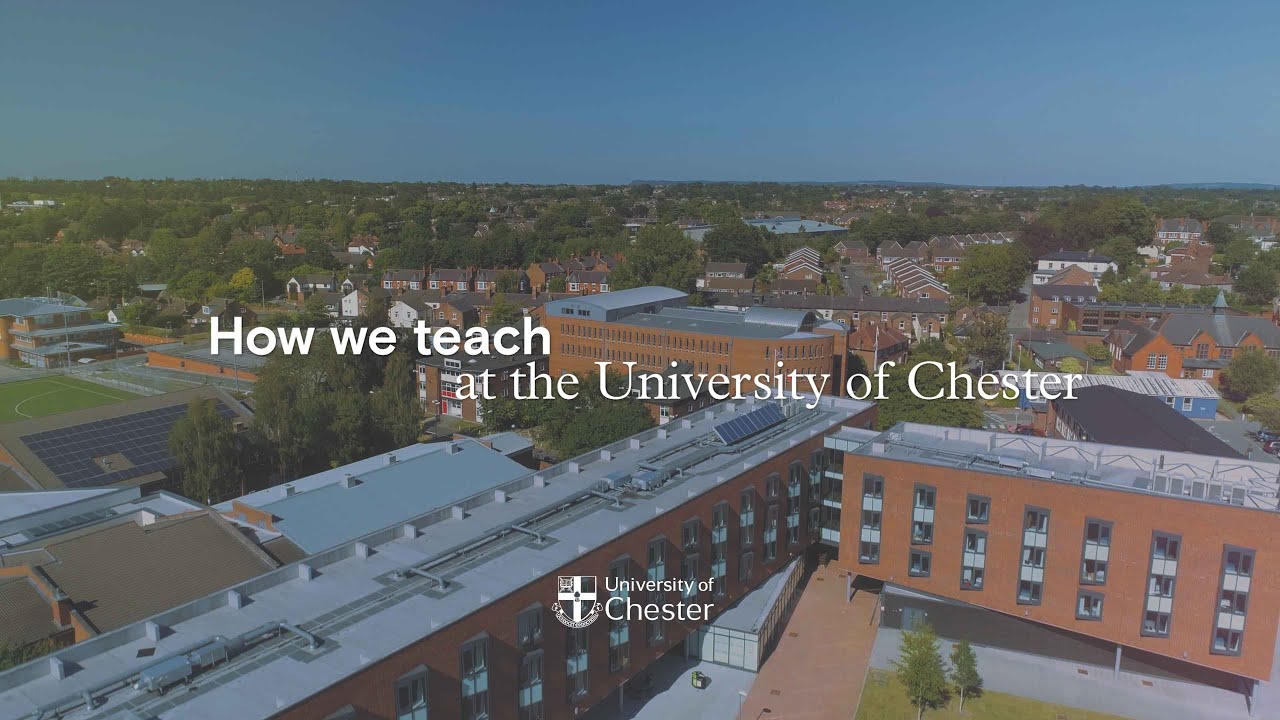
An aerial photograph of Exton Park with the text 'How we teach at the University of Chester'

How we teach at the University of Chester

This course is delivered in three terms of 10 weeks each. By the end of each year the student will have completed 120 credits of learning. Students will gradually gain greater independence in their learning throughout the three years with a view to students achieving positive graduate outcomes. This course is delivered predominantly in person. Students can expect to take part in lectures, workshops, seminars and a range of experiential activities both on and off campus – in the UK and abroad to locations such as Berlin, Amsterdam, Madrid and Prague. Activities on these trips include visits to a range of media, cultural and political institutions.

If studied, the Foundation Year, as with the following years of study, will be taught in three 10-week blocks across an academic year. Each block will comprise of a large 40-credit subject-specific module that includes a breadth of topics and subject skills. You will have on average 12-14 hours of contact time per week during the Foundation Year. There may be variations to this where subject practical or specialist space teaching is included.

Students should expect to undertake about 40 hours per week of study in total which comprises scheduled sessions, independent study including engaging with learning material on the University’s VLE, tutorials with staff, researching and producing stories, using the University’s library and other resources, working with peers and preparing work for assessment.

Teaching will be delivered by experienced academics and practitioners in the subject. This will be supplemented by occasional guest lecturers and speakers.

There will be a broad range of assessment methods so that students are exposed to the different types of tasks they might encounter in the workplace. These will include coursework in the form of portfolios, essays, presentations, digital productions and online tasks. We continuously review the assessment methods used in order that they adequately prepare students for graduate level employment.

All teaching is delivered by experienced academics and practitioners, with the fundamental principles of the Chester Future Skills Curriculum at its core - building your subject competence, confidence, and key transferable skills to shape you into a world-ready Chester graduate.

Your Future Career

Job Prospects

Students have gone on to work for journalistic organisations including international and national news agencies such as Reuters and News Corp, online and print publications such as Newsweek and more. Some have taken a freelance approach, forging careers in niche aspects of journalism such as gaming, lifestyle, and pop culture. Others have gone into roles such as social media management, copy-writing and public relations. 

Careers service

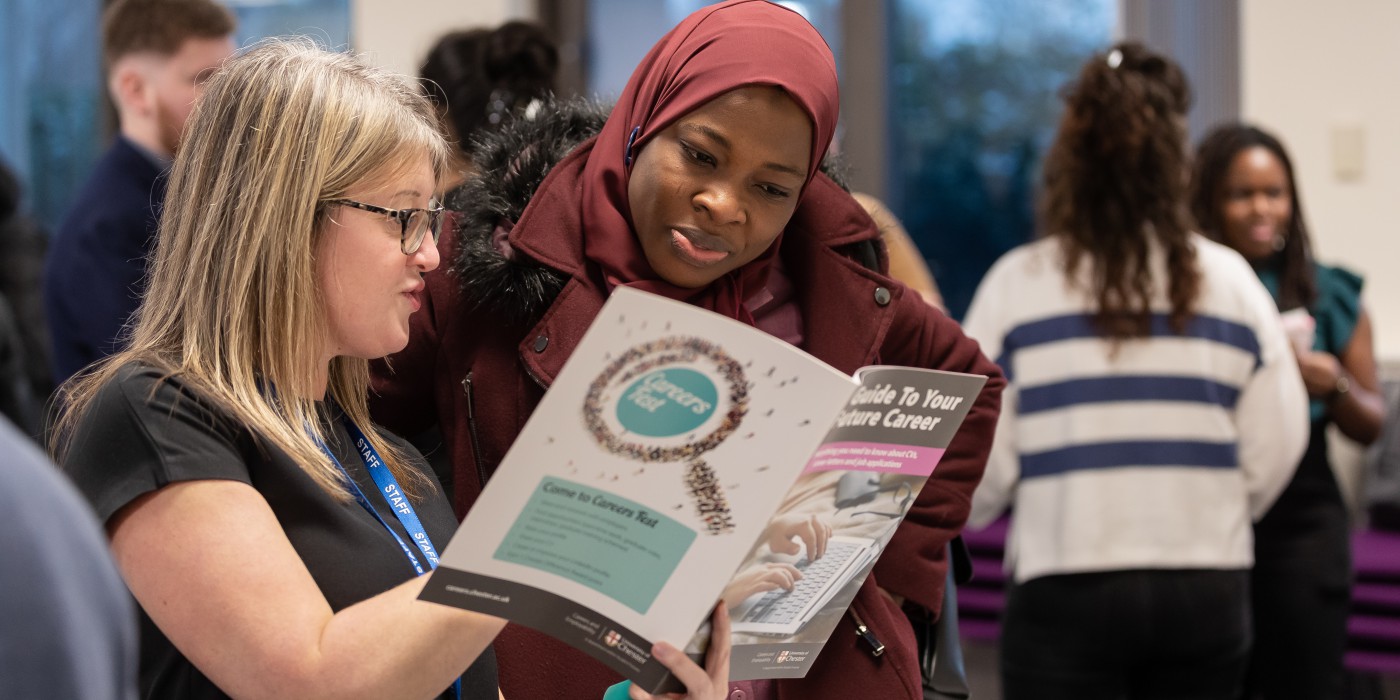
The University has an award-winning Careers and Employability service which provides a variety of employability-enhancing experiences; through the curriculum, through employer contact, tailored group sessions, individual information, advice and guidance.

Careers and Employability aims to deliver a service which is inclusive, impartial, welcoming, informed and tailored to your personal goals and aspirations, to enable you to develop as an individual and contribute to the business and community in which you will live and work.

We are here to help you plan your future, make the most of your time at University and to enhance your employability. We provide access to part-time jobs, extra-curricular employability-enhancing workshops and offer practical one-to-one help with career planning, including help with CVs, applications and mock interviews. We also deliver group sessions on career planning within each course and we have a wide range of extensive information covering graduate jobs and postgraduate study.

What Our Students Think

Study a Common First Year

This course shares a common first year with students on the Music Journalism, Sports Journalism and Creative and Professional Writing courses.

This means that you’ll learn alongside students studying a similar discipline, helping to broaden your knowledge and exposure to other concepts, perspectives and professions in the first year of your degree.

As you learn and collaborate with students from other courses, you'll not only widen your social and professional network but also learn new skills that will set you up for success in your industry.

In your second and third years, you will progress to studying more specialist modules within journalism, developing your skills to become a World Ready graduate.

Entry Requirements

104 UCAS points

UCAS Points

104

GCE A Level

104 UCAS points from GCE A Levels or equivalent. Typical offer - CCC/BCC

BTEC

BTEC Extended Diploma: DMM

International Baccalaureate

26 points

Irish/Scottish Highers

Irish Highers - H3, H3, H3, H4, H4

Scottish Highers - BBBB

Access requirements

Access to HE Diploma, to include 45 credits at level 3, 30 of which must be at Merit or above

T Level

Pass (C or above in the core)

OCR Cambridge Technicals

OCR Cambridge Technical Extended Diploma - DMM

Extra Requirements

Welsh Baccalaureate Advanced and A Level General Studies will be recognised in our offer. We will also consider a combination of A Levels and BTECs/OCRs.

Interview

Applicants will be required to attend an interview/workshop day.

English Language Requirements

IELTS

6.0 (minimum 5.5 in each band)

Interview

Applicants will be required to attend an interview/workshop day.

72 UCAS points

UCAS Points

72

GCE A Level

72 points overall, including grade D in A level

BTEC

BTEC Extended Diploma: MMP

International Baccalaureate

24 points

Irish/Scottish Highers

Irish Highers: H4 H4 H4 H4 H4

Scottish Highers - CCDD

Access requirements

Pass overall

T Level

Pass (D or E on the core)

OCR Cambridge Technicals

OCR Extended Diploma: MMP

Extra Requirements

Welsh Baccalaureate Advanced and A Level General Studies will be recognised in our offer. We will also consider a combination of A Levels and BTECs/OCRs.

Study the final year of an undergraduate degree

If you have successfully completed a Level 5 qualification, e.g. a Higher National Diploma (HND) or Foundation Degree in a relevant subject, then we may be able to consider you for the final year (Level 6) of one of our degrees. Topping up your HND or Foundation Degree will typically take one further year of study and will lead to a full BA (Honours) degree.

To apply for the final year of a degree on a full-time basis you will need to submit an application through UCAS.

For international applicants, please refer to the entry requirements listed on the "Your Country/Region" pages. To be considered for advanced entry into relevant degree programmes, you must have completed a qualification equivalent to a Level 5 or Level 6 in the UK, in a related subject area

Fees and Funding

£9,790 per year for a full-time course (2026/27)

The full-time tuition fees for Home students entering in 2026/27 are £9,790 a year, or £1,590 per 20-credit module for part-time study.

£14,950 per year for a full-time course* (2026/27)

The tuition fees for international students studying programmes in 2026/27 are £14,950 per year for a full-time course. This fee is set for each year of study.

For courses with a Foundation Year, the tuition fees for Year 1 are £11,250 and £14,950 for Years 2-4 in 2026/27.

Tuition fees for Home students for the Foundation Year in 2026/27 will be £5,760 (subject to Parliamentary approval) for the first foundation year of a four-year course. Tuition fees for subsequent years will be charged at the standard undergraduate tuition fee rate for that academic year. Standard undergraduate tuition fees for Home students for the academic year 2027/28 will be £10,050 for full-time students and £7,530 for part-time students (subject to Parliamentary approval). Fees for subsequent years may be subject to increase in line with the Government fee cap

  Foundation (First) Year Second Year onwards per year
Home Students £5,760 full-time fee for the first foundation year (2026/27) £10,050 full-time fee per year from the second year onwards (2027/28)
International Students * £11,250 full-time fee for the first foundation year (2026/27) £14,950 full-time fee per year from the second year onwards (2026/27)

* For courses which accept applications from International Students

Gateway House Facilities

Gateway House, in Chester city centre, is home to our dedicated journalism news suites and our Creative Writing courses.

Who You'll Learn From

Dr Simon Roberts

Senior Lecturer
Dr Simon Gwyn Roberts

Mark Hannaby

Senior Lecturer
Mark Hannaby

Dr Simon Morrison

Senior Lecturer
Dr Simon Morrison

Enquire about a course