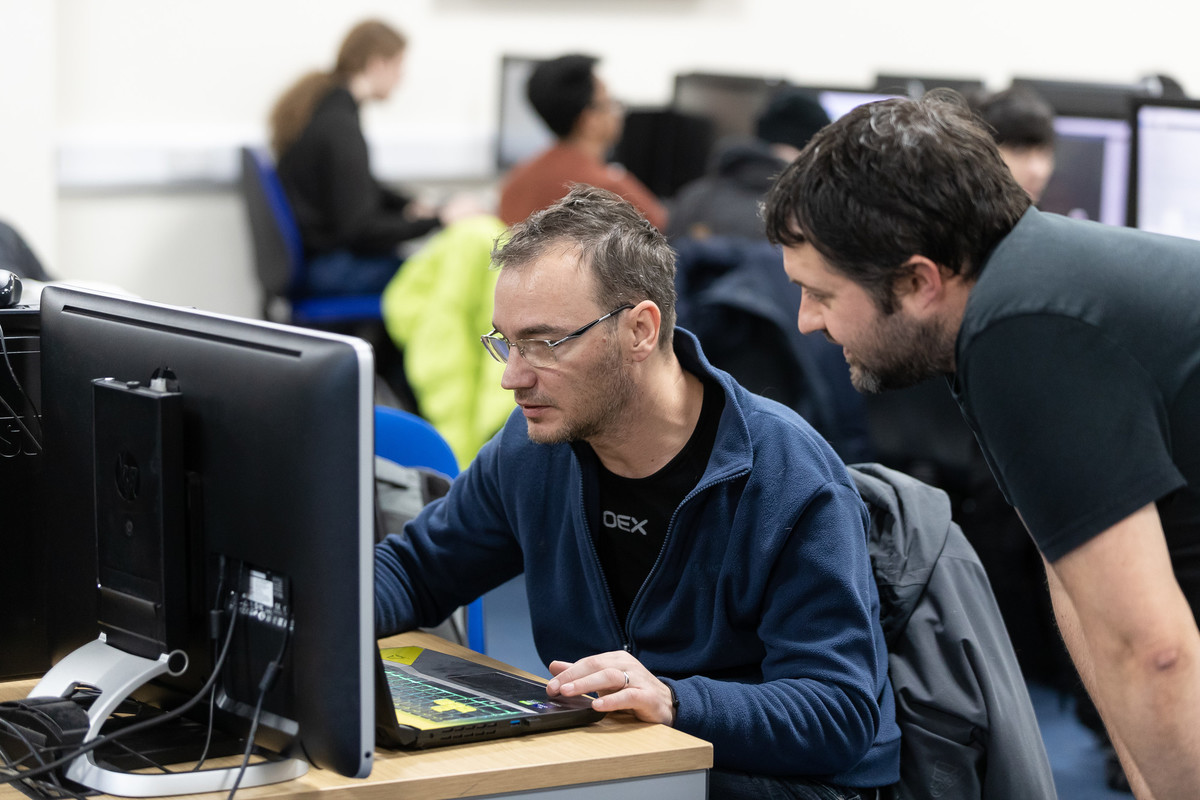
Two people at a computer

This Master’s by Research course provides an ideal opportunity to develop your research skills and expertise in an extended project in an area based within the biological, physical, computing, mathematical or engineering sciences. This will equip you with the professional experience in a laboratory environment, field setting, and/or in computational modelling necessary for a future career in research. 

Students work on a research project in their chosen discipline and grow to become accomplished in the latest scientific developments in their field of research. You will work closely with your supervisory team in order to have the chance to acquire the specialist skills necessary to pursue your chosen career path. Our School's proactive, diverse and inclusive research community provides extensive opportunities for peer learning and research collaboration.

Our research staff ensure that all offered research projects are relevant to current industrial needs, providing highly employable skills to our graduates. We have a strong focus on areas such as sustainability and the environment, health and wellbeing, and culture and society.

You will undertake a taught research methods module as well as get to choose another that is relevant to your research topic from our suite of postgraduate options. Throughout the year you will undertake your research project, finally producing a written thesis.

International Applicants

The University is not currently accepting international MRes applications

Stem Research Projects

Prospective students who have a research topic they wish to pursue as their MRes project should use the search function to find relevant information.


Why You'll Love It

What You'll Study

In addition to the core module, you will also choose Research and Analytical Skills, Research Methods and ICT for Mathematics or Research Methods, AND one other option module.

Core Modules

On this module you will be supported in the design and and undertaking of an original research project. You will develop skills in research design, project management and the application of specialist research techniques relevant to your subject area. The research project subject will be agreed with an appropriate supervisor and the research project Module Leader. The agreed research project will be carried out and assessed within this module.

Option Modules

In this module, you will be introduced to scientific research. You will explore various types of research (descriptive, analytical & experimental), including pure versus applied ways of problem-solving. You will learn about the building blocks of scientific research: scientific language, ethical considerations and experimental design. You will also learn how research is funded. You will cover the following topics:

  1. Research and data collection methods with an emphasis on experimental research (developing hypotheses, variables, controls, sample selection, design, validity)
  2. The nature of the knowledge base and how research is communicated.
  3. Advanced literature searching.
  4. Critical appraisal of literature - primary and secondary literature
  5. Developing a research project: identifying a topic area, devising specific questions, discovering what is already known (reviewing the literature), identifying gaps in knowledge, determining feasible ways to answer the questions.
  6. Data analysis for research.

Programming and computational techniques are all pervasive in today's society: the increasing use of AI techniques, the applications of data science to interrogate and understand all aspects of our lives, communicating with your bank using the next generation of quantum-secure algorithms and using mathematical computer simulations to model real-world phenomena.  As a result, possessing proficient computer and programming skills is indispensable not only in academic and scientific research but also for future-focused business and industry.

This module is designed with dual objectives. Firstly to provide an in-depth introduction to algorithms and the process of translating these into computer programs, using state-of-the-art software tools, for example Python. This will provide you with a solid foundational understanding to tackle any future computational and programming challenges. Secondly, you will develop important research and writing skills. You will learn to use LaTeX, an industry-standard typesetting system for produce professional scientific documents.

  • Introduction to algorithms and how to translate them into computer programs.
  • Introduction to computer programming software, for example Python.
  • Learn about basic programming concepts including algorithms, loops, conditional statements and functions.  Also learn about more advanced scientific functions.
  • Introduction to numerical algorithms from a variety of mathematical areas.
  • Introduction to mathematical and scientific typesetting with LaTeX and associated editors.
  • Incorporating graphs, figures, tables and bibliographic information in reports and articles, using LaTeX.
  • Referencing methodologies in the Mathematical Sciences.
  • Introduction to online search tools and research techniques.
  • Developing scientific communication skills.

An essential skill for postgraduate students is the ability to investigate topics with the objective of identifying facts , theories, ideas, methodologies, etc., that could inform the development of new insight for further research.  A major aspect of this is critical analysis of information. The module aims to develop critical reasoning in students and an understanding of other researchers’ work.  Students will learn how to use current research literature and relevant sources to gain new insight for a new research.  They will learn how to support their research report with relevant facts, theories, ideas, etc.  They will develop their ability to understand approaches and methodologies adopted in existing research toward writing a literature review and handling full research projects in their subject area.

The learning content also includes:

  • Time management, library skills and literature search
  • Evaluation of information sources
  • Ethical issues in science, technology and engineering research (including intellectual property and plagiarism)
  • Writing for research: styles and rules for presentation (including referencing standards)
  • Choosing a research area and evaluating source material
  • Hypothesis formation
  • Design and application of questionnaires & interviews
  • Quantitative and statistical tools for researchers (e.g. R, Python, SPSS)

In this module, you will unlock an advanced understanding of the amazing potential of stem cell research and regenerative medicine to transform clinical conditions. You will explore innovative topics such as cutting-edge cell lines, intricate 3D organoids, dynamic explant cultures, and the incredible diversity of invertebrate models—from vibrant fish to agile amphibians and even birds and mammals!

This module promises theoretical insights and hands-on experiences that will ignite your passion for the field. You will engage with various models (fish, amphibians, avians, mammals), shaping the future of medicine and science and setting the stage for an exciting career or advanced study. Get ready for a journey that will challenge your intellect and fuel your curiosity as you learn to harness the power of stem cells!

In this module, you will embark on a learning journey through the forefront of molecular medicine! You will learn about transformative methodologies like CAR-T therapy, RNA interference (RNAi), CRISPR gene editing, monoclonal antibodies, and small-molecule inhibitors. You will explore fascinating developmental biology and reproductive medicine applications, featuring insightful talks from experts.

Not only will you enhance your knowledge, but you will also develop essential skills in experimental design and critical assessment. Participate in a hands-on CRISPR gRNA design workshop, where you'll sharpen your technical skills and engage in a practical laboratory experience focused on bacterial transformation used within academia and industry. This is not just a course—it's a gateway to the future of medicine! Get ready to be inspired and informed!

In this module, you will learn about developmental processes that are key to the amazing phenomenon of tissue regeneration. Through hands-on laboratory sessions, you will have the thrilling opportunity to work with cutting-edge vertebrate or invertebrate models, delving into the fascinating role of signalling pathways in development and regeneration.

Prepare to be inspired as you learn how insights from human development are paving the way for groundbreaking medical advancements. Engage with experts from the Shrewsbury Assisted Conception Unit, who will share their exciting insights into tissue engineering and fertility treatments, which are impacting people's lives.

You will also unleash your creativity in the Bioreactors workshop, where cutting-edge technology meets innovative thinking in tissue engineering. With a rich mix of workshops, lectures, and hands-on laboratory experiences, you will come away with a profound understanding of developmental processes. Get ready for an adventure that combines science, innovation, and real-world applications!

How You'll Learn

An aerial photograph of Exton Park with the text 'How we teach at the University of Chester'

How we teach at the University of Chester

This course is designed to be research focused, both in terms of the production of an extended hands-on research project, and through research-focused modules. Each year consists of four ten-week terms, with you effectively studying 40 credits per term across your module choices and your project. The course blends in-person and, where applicable, online learning. Here you will learn from a team of experienced academics, and research professionals.

Your learning will be supported through:

  • Engaging Lectures and Interactive Seminars: Knowledge-rich sessions will keep you updated with exciting novel research progress and short in-class group tasks will get you inspired to think like a research scientist.
  • Research-based learning is at the heart of this course, helping provide you with the skills necessary to empower you to become a capable and confident research scientist or engineer, and an expert in your field! Expect to immerse yourself in your project, supported by an expert academic supervisor, and direct your project.
  • Employability Skills: Beyond academic knowledge, this course is designed to equip you with the essential skills that will set you apart in the job market and help you thrive in any workplace or research qualification position. You’ll develop expertise in areas like problem-solving, teamwork, communication, creativity, and self-management. You'll also cultivate a spirit of curiosity, ensuring you're not just prepared for your career, but ready to make a lasting impact in your scientific field.
  • Student Support and Experience: Throughout the course, you will receive continuous support and feedback, and be encouraged to reflect on, learn from, and act on constructive feedback through your module tutors, supervisor, PAT, and the rest of the academic family within the Faculty.

Your Future Career

Careers service

The University has an award-winning Careers and Employability service which provides a variety of employability-enhancing experiences; through the curriculum, through employer contact, tailored group sessions, individual information, advice and guidance.

Careers and Employability aims to deliver a service which is inclusive, impartial, welcoming, informed and tailored to your personal goals and aspirations, to enable you to develop as an individual and contribute to the business and community in which you will live and work.

We are here to help you plan your future, make the most of your time at University and to enhance your employability. We provide access to part-time jobs, extra-curricular employability-enhancing workshops and offer practical one-to-one help with career planning, including help with CVs, applications and mock interviews. We also deliver group sessions on career planning within each course and we have a wide range of extensive information covering graduate jobs and postgraduate study.

Entry Requirements

Applicants should normally possess an upper second class honours degree in any relevant discipline with additional emphasis placed upon the student's preparedness for study and performance at interview which will inform the selection process. A lower second class degree may be mitigated by substantial relevant work experience. 

Decisions concerning the allocation of credit, either for admission or advanced standing, will be the responsibility of a Credit Allocation Panel. Credit value will be given for appropriate certificated or experiential learning completed within the previous five years and through which an applicant can demonstrate prior achievement of learning outcomes related to one or more programme modules. A student seeking advanced standing must apply before enrolment.

Each student will be interviewed as required in all Chester Research Degrees and the Interview record form will be completed and submitted to Postgraduate Research Admissions with the completed application.

Fees and Funding

TBCper year full time (2026/27)

The tuition fees for home students studying the MRes in Applied Science in 2026/27 are TBC.

Your course will involve additional costs not covered by your tuition fees. This may include books, printing, photocopying, educational stationery and related materials, specialist clothing, travel to placements, optional field trips and software. Compulsory field trips are covered by your tuition fees. 

An additional annual bench fee of £3,000 (pro-rata), will usually be added to Home Laboratory based/high-cost subject courses to cover the cost of consumables and specialist materials and equipment. A bench fee may be payable in respect of certain high-cost subjects for other routes. Details of any bench fee will be made clear in the interview and offer of admission. International Lab based courses do not usually attract an additional bench fee as the higher lab-based fee is expected to cover the cost of consumables and specialist materials and equipment.

The University of Chester supports fair access for students who may need additional support through a range of bursaries and scholarships. 

Full details, as well as terms and conditions for all bursaries and scholarships can be found on the Fees and Finance section of our website.

Who You'll Learn From

Dr Simon Hodgson

Senior Lecturer
Dr Simon Hodgson

Enquire about a course