Smart stadiums are getting smarter. But are they accessible to everyone?
Sports stadiums are investing heavily in mobile ticketing, venue apps, connected services and data-driven systems. But a venue can be technologically advanced and still make a disabled visitor do far too much work simply to attend an event.
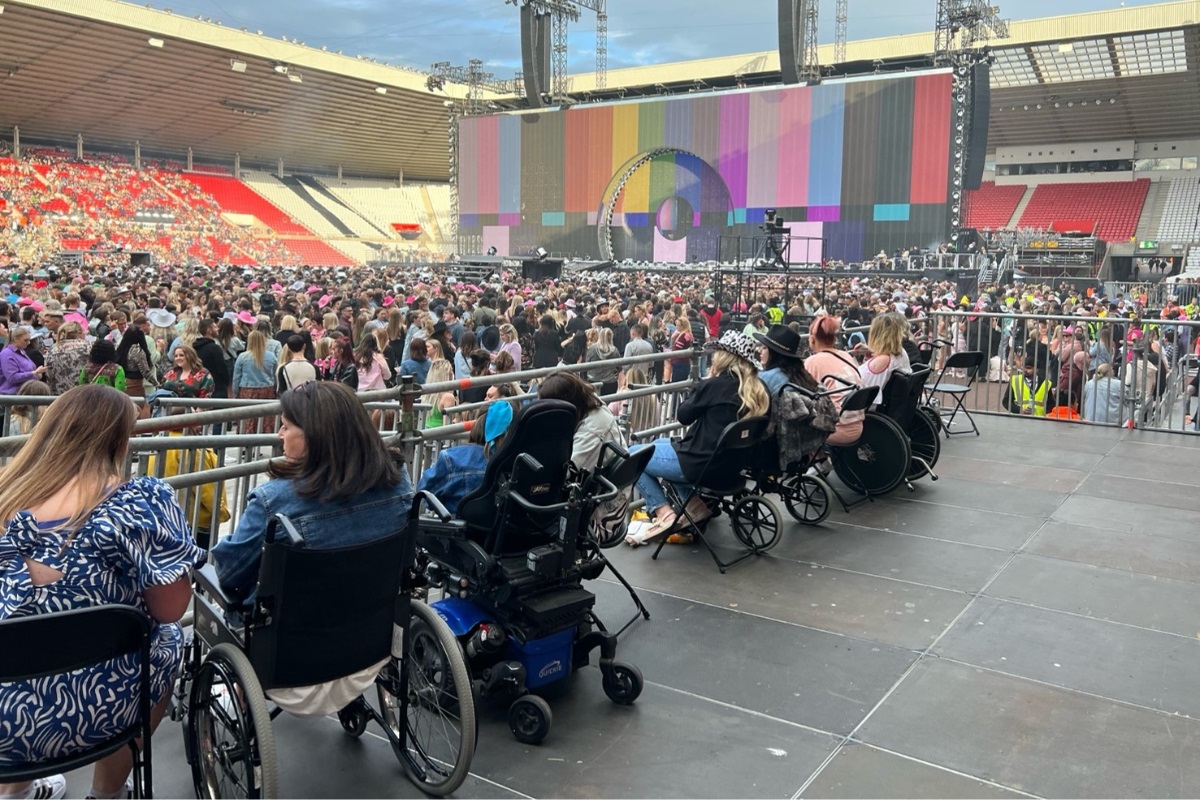
That is the central challenge emerging from my research with Dr Alyssa Eve Brown (University of Sunderland) into the experiences of persons with disabilities (PWDs) attending live music events in English sports stadiums. The next stage of the smart stadium should not simply be more digital: it should be more inclusive.
Accessibility starts before the turnstile
We often think about stadium accessibility in physical terms: ramps, lifts, accessible toilets, viewing platforms and step-free entrances. These remain essential, but the event journey begins long before somebody reaches the venue.
Our study drew on informal conversations with eventgoers across 10 large-scale concerts at seven English sports stadiums between 2023 and 2025. Participants described the additional planning involved in working out where to enter, which routes were genuinely step-free, where facilities were located and whether the information they found online could be trusted.
Some used Street View, online photographs, venue maps and content shared by other attendees to piece together their own understanding of the stadium. One participant captured the problem particularly clearly: “I feel like I have to do the venue’s job before I even leave the house”.
That matters because poor information is not a minor inconvenience. Uncertainty can create anxiety, use up limited energy and, in some cases, influence whether somebody decides that attending is worth the effort at all.
A smart venue should know more than where the toilets are
Many stadium technologies are designed around convenience for an assumed average visitor. Apps can store tickets, direct people to food and drink, provide event information and support cashless transactions. Yet accessibility information can remain fragmented, difficult to find or detached from the systems everyone else is expected to use.
The opportunity is not necessarily to build a separate ‘disabled app’. In fact, participants told us the opposite. They wanted mainstream digital systems to work for them too.
Imagine opening a stadium app and selecting a route based not simply on the shortest distance, but on step-free access, walking tolerance or current crowd density. Imagine being able to see an accessible entrance, viewing area or toilet before travelling, through a visual or virtual walkthrough. Or receiving an alert that a lift is unavailable or a route has become congested, with an alternative offered immediately.
These are not futuristic ideas for technology’s sake. They respond to practical problems that disabled attendees are already solving themselves.
Real-time information can be an accessibility service
Stadium concerts are particularly complex because the venue is temporarily reconfigured. Floor seating, production areas, barriers and crowd-management arrangements can change familiar routes and facilities. A route that worked at a football match may not work in the same way for a concert.
This means accessibility cannot be treated as a static checklist. It changes during the event.
Participants described arriving at lifts that were unexpectedly unavailable, encountering blocked routes or discovering that conditions inside the stadium did not match the information they had found beforehand. For somebody managing fatigue, pain, sensory overload or anxiety, discovering a problem only after reaching it can have a disproportionate effect on the rest of the evening.
Real-time accessibility information should therefore be considered part of the venue’s core operational infrastructure. If stadiums can use digital systems to manage queues, payments, tickets and crowd flows, those same systems can be designed to communicate changing access conditions.
Technology should reduce the work of access, not transfer it
There is an important warning here - that digitisation is not automatically inclusion.
An app that is difficult to navigate, incompatible with assistive technology, dependent on unreliable connectivity or packed with inaccessible information can create another barrier. A ‘smart’ stadium can simply shift more responsibility onto the visitor: download this app, find this page, check this map, monitor this update and work out an alternative if something fails.
The principle should be straightforward: technology should reduce the work required to access an event, not transfer more of that work to the person who already faces barriers.
Digital systems should also complement rather than replace people. Knowledgeable staff, clear signage and responsive customer service remain vital. The strongest model is an integrated one in which physical design, digital information and human support reinforce each other.
Design with disabled audiences, not simply for them
The most important lesson for venue operators and technology providers is that lived experience is a form of design knowledge.
Disabled attendees already understand where systems break down because they encounter those gaps repeatedly. Their workarounds reveal what stadium systems are failing to provide: reliable information, predictability, flexibility and confidence.
As stadiums continue to invest in smart technologies, accessibility should be built into procurement, app development, venue mapping and operational planning from the beginning. Testing should involve people with different mobility, sensory, cognitive and communication needs, and it should examine the whole journey rather than a single feature.
This is also an opportunity for the live events industry. Better accessibility does not have to mean adding more isolated services. It can mean designing better mainstream systems that recognise that audiences move through venues in different ways.
What should change next?
The future of the smart stadium should be judged not only by how quickly somebody can enter, buy something or find their seat, but by how confidently different people can plan, navigate, adapt and participate.
For venue operators, event organisers and technology partners, that means moving accessibility upstream: from a problem addressed after systems have been designed to a principle shaping those systems from the outset.
The key takeaway: a stadium is not truly smart if disabled visitors still have to build their own system around it.
And the opportunity is clear: digital technology can make live events more autonomous, predictable and inclusive, but only when accessibility is treated as infrastructure rather than an add-on.
About the author
Dr Leon Davis is a Senior Lecturer in Management at the University of Chester. His research spans sport and live events, with particular interests in fan experience, ethics, accessibility and inclusion, and gender.
He has examined audiences and organisational practices across a range of live sport, music and event settings, with much of his work conducted in-situ at live events. He has published research across sport management, event management, and sociology, exploring issues including fan cultures, disability and accessibility, gender and representation, and the changing experience of live events. His work seeks to connect academic research with the practical challenges facing venues, event organisations and the wider sport and events industries.