Open Access (OA)
Open Access (OA) is when research outputs are freely available without financial, legal or technical barriers to access. Anyone can read, download, copy and distribute the outputs, often under a Creative Commons licence. This generates greater equality in access to information and knowledge, as there is no requirement to pay or have an institutional subscription.
Benefits of OA
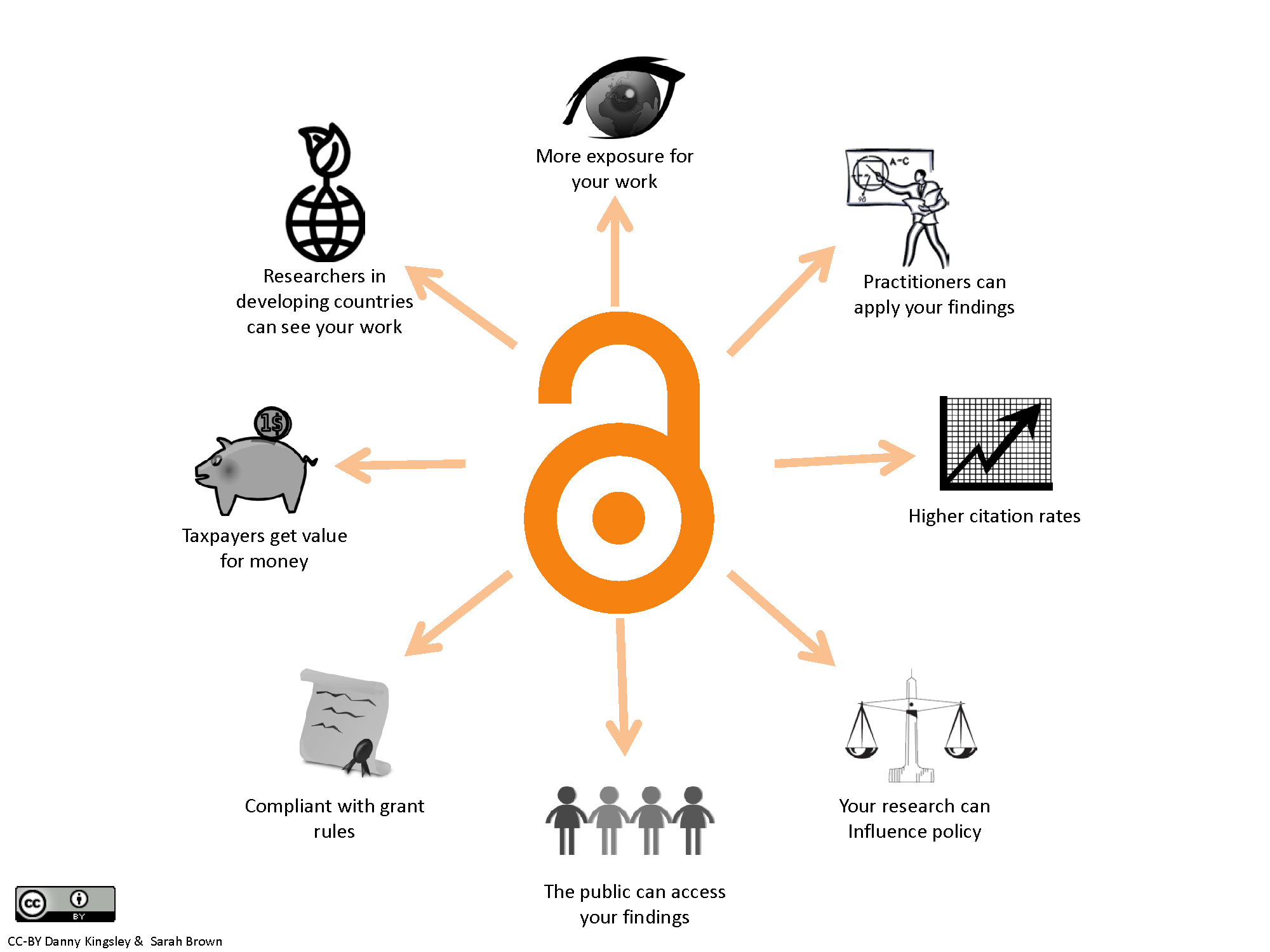
Benefits for authors
- More people can find, read, use and cite your work, leading to enhanced reach and impact.
- Improved reputational standing due to a higher number of citations typically received by openly available publications.
- More opportunities to form new research collaborations.
- Compliance with institutional and funder policies requiring research to be open.
Benefits for readers
- Wider access to research, especially for readers outside academia.
- No requirement to log in or authenticate.
- No requirement to pay for access, thereby benefitting smaller institutions and those in developing countries.
- Enhanced knowledge sharing due to the ease with which results can be disseminated.
Types of OA
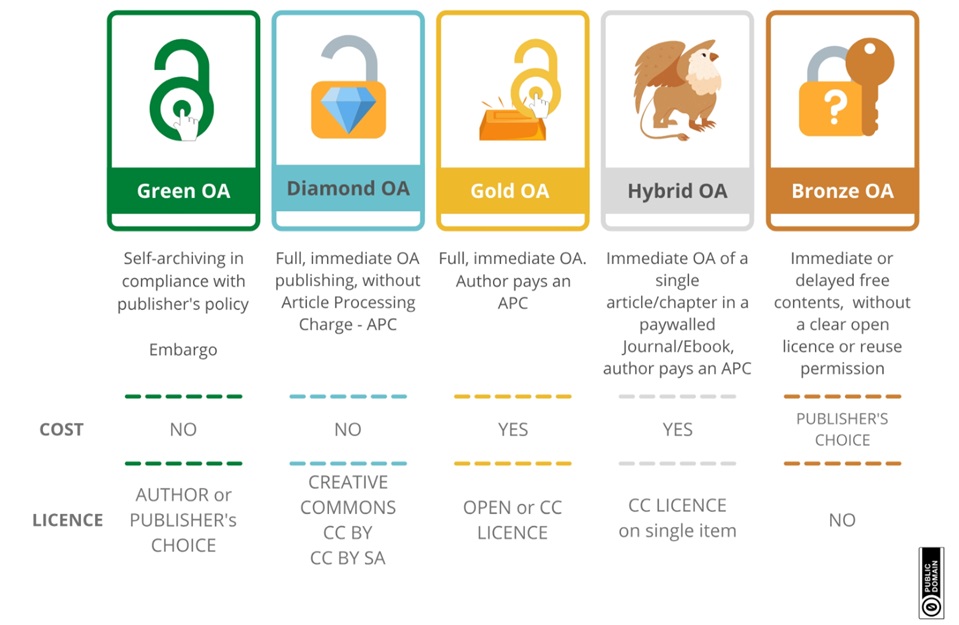
The four main types of OA are Gold, Green, Diamond (or Platinum) and Bronze.
Creative Commons licences
Creative Commons licences are open research licences and enable authors to grant the public permission to use their work under copyright law. They ensure that authors can disseminate their work widely whilst having control over its use because they retain the copyright.
Each Creative Commons licence is made up of a combination of four elements. These are listed below:
- Attribution (BY) - The author must be acknowledged.
- Non-Commercial (NC) - The work can only be shared non-commercially.
- No Derivatives (ND) - The work cannot be changed or remixed.
- Share Alike (SA) - New creations must be re-shared under the same rules.
Licences may include different combinations of the above elements, but attribution must be included as a minimum.
You can find out more about all licences via the Creative Commons website.
Support for Gold OA Transformative Agreements
Transformative Agreements (TAs), also referred to as ‘Transitional’ or ‘Read and Publish’ agreements, are contracts negotiated with publishers. Institutions pay a fee to enable authors to publish journal articles Gold OA and users to access content at no cost. To use these agreements, the following conditions need to be met:
- You must be a student or member of staff affiliated with the University of Chester
- You must be the Corresponding Author of the article
- The journal must be covered by an agreement (contact LIS Research Support if you are not sure)
- The article must be an eligible article type. Specific article types may be determined by the publisher, but, generally speaking, research and review articles are considered eligible.
OA Policies Funders and beyond
Many funders have an OA policy requiring authors to publish their research OA on, or shortly after, publication. The OA policies of all funding bodies can be found on the Open Policy Finder database. If your research is externally funded, check the OA policy of your funder before planning publications. Failure to comply may put any future funding at risk and damage your reputation as an individual and the University as an institution.
Get in touch with LIS Research Support (researchsupport.lis@chester.ac.uk) if you are having trouble interpreting a policy or need any advice.
UKRI OA Policy
Any researcher funded by Research England, Innovate UK and the seven research councils will need to comply with the UKRI Open Access policy, which applies to:
- 'Short-form publications’ (articles and conference papers with an International Standard Serial Number (ISSN)) submitted for publication on or after 1 April 2022
- 'Long-form publications’ (monographs, book chapters and edited collections) published on or after 1 January 2024.
Please note that articles must include a Data Access Statement even if no data are associated with the article, or the data are inaccessible.
Other funder OA policies
If you are funded by the following funders, please refer to their OA policies (linked below).
Wellcome Trust
Versus Arthritis
Blood Cancer UK
British Heart Foundation
Cancer Research UK
Parkinson’s UK
Bill and Melinda Gates Foundation
World Health Organisation
For any queries or guidance about your funder’s OA policy, please contact LIS Research Support (researchsupport.lis@chester.ac.uk).
Research Excellence Framework (REF) OA Policy
The Research Excellence Framework (REF) was implemented to evaluate the quality and impact of research conducted by UK Higher Education Institutions.
An OA requirement was introduced for REF 2021 and continues for REF 2029. The REF 2021 OA policy applies to journal articles and conference papers with an International Standard Serial Number (ISSN) published on or before 31st December 2025.
The updated REF 2029 OA policy applies to journal articles and conference papers with an ISSN published from 1st January 2026.
The REF OA requirements for journal articles and conference papers with an ISSN are summarised in the table below. Full details can be found on the REF Section 5 - Open Access Policy page.
Where a paper does not meet the OA requirements, a limited number of policy exceptions are available.
University of Chester OA Policy
The University’s OA Policy applies to anyone affiliated with the University of Chester who authors or co-authors journal articles and conference papers with an International Standard Serial Number (ISSN). While other publication types are not explicitly covered, authors are strongly encouraged to make all their research OA whenever possible.
The policy states that all journal articles and conference papers must be deposited to the University’s repository, ChesterRep, within 10 weeks of acceptance for publication. For rules on depositing other output types, please refer to the Repository Policy.
By following this Policy in full, you will ensure that any external OA requirements, such as those from funding bodies and the REF, are met.