





Student analysing financial charts on laptop and phone, studying market trends for Finance and Banking BSc Hons degree.

On the Finance with Banking degree, aligned with the Chartered Banker Institute (CBI), you will join a community of like-minded peers, challenge your perspectives, and immerse yourself in the fast-paced world of banking. This degree is designed to equip you for a successful career in the Banking and Financial Services industry, ensuring you gain expertise in cutting-edge financial technologies and the ability to adapt to emerging risk management strategies.

The course modules are structured to broaden your understanding of the financial sector, with a focus on banking. You will explore contemporary issues and challenges in the industry, learn the importance of staying ahead of regulatory changes, appreciate the ethical considerations of the profession, and gain a solid grasp of risk management strategies. Additionally, you’ll examine the technological innovations that are shaping the future of banking in an increasingly competitive market.

With a focus on the many roles and functions within banking, the Finance with Banking degree provides you with hands-on experience across a range of specialisations. This will help you develop the knowledge and skills necessary to pursue a variety of career paths in the sector, significantly enhancing your future employability.

In year one, you'll study at Exton Park, enjoying new Business teaching spaces and the full benefits of the University's central campus. In your second and third years, you'll move to Queen's Park, home to our award-winning Business School.


Why You'll Love It

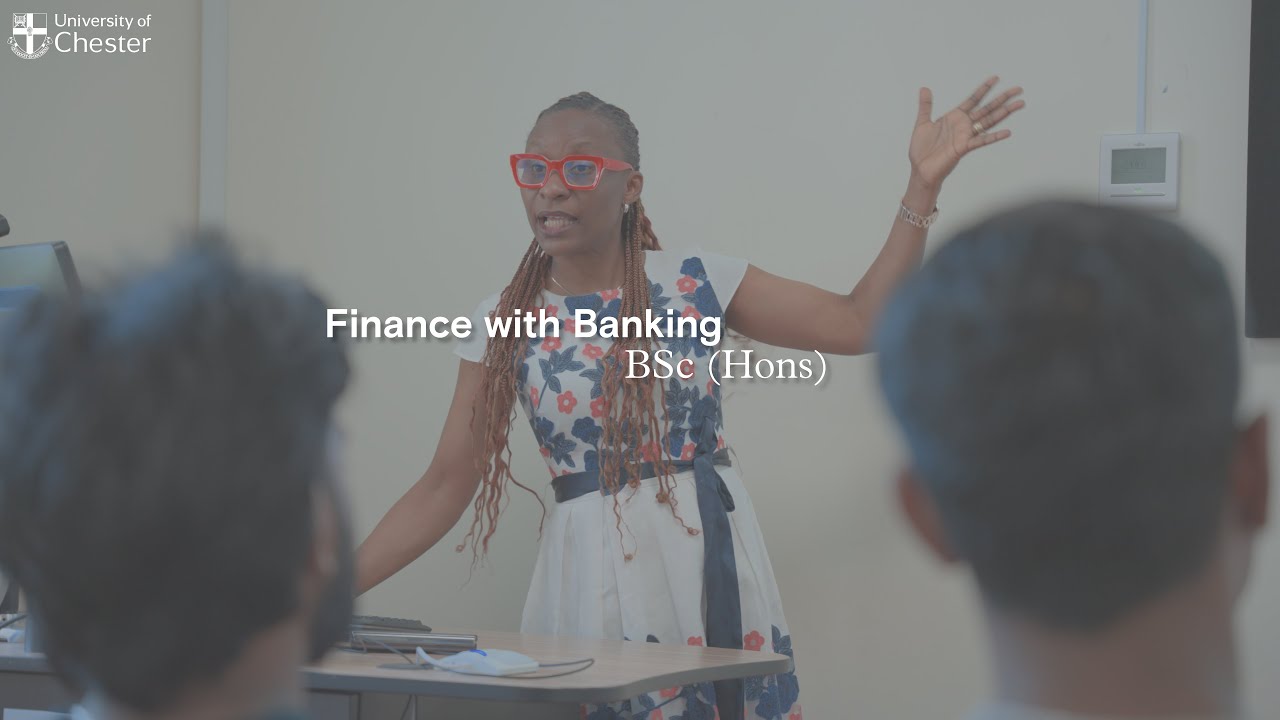
Finance with Banking YouTube video

Study Finance with Banking BSc (Hons) | University of Chester

What You'll Study

The Business and Management Foundation Year area provides a comprehensive suite of topics directly related with business environments. You will be introduced to core areas such as business functions, leadership, management, ethics, marketing, organisational structures, and finance. The Foundation Year ensures you are able to engage with the fundamentals of how businesses operate.

Students will be introduced to key business functions and principles alongside operational and strategic practices in the modern world of business. Business maths skills are developed in conjunction with Excel functionalities.

Indicative content:

  • Introduction to organisations, organisational structures and behaviour
  • Leadership and management styles
  • Motivation in business
  • Business ethics and corporate social responsibility
  • Introduction to strategy
  • Influences on business
  • Introduction to entrepreneurship
  • Budgeting and calculation of expenses
  • Preparation of financial statements
  • Presenting and understanding graphical information
  • Introduction to statistics
  • Percentages, ratios, and proportions
  • Learning to use and navigate a range of digital spaces specific to your subject
  • Understanding academic conduct and conventions for communicating information
  • Finding and using a range of academic sources relating to your subject

Students will develop their skills and knowledge of business management with a focus on business functions. Students will continue to develop and use their mathematical skills to model and solve real-life problems. They will look at the application of maths across different business sectors

  • Developing of understanding of organisations and organisational structures
  • Introduction to business functions (including human resources management, operations, customer service, marketing & finance)
  • Analysing business performance
  • Working with large data sets
  • Further statistics
  • Market share, size and growth
  • Introduction to the 4Ps - price, product, place, promotion
  • Operational management
  • Advancing digital and academic skills introduced during Term 1
  • Developing research and information literacy in relation to your subject
  • Creating an academic poster on a chosen research paper

This module is an introduction to global business and globalization. Students will explore international business environments and their socio-political contexts. There will be an examination of international trade from an historical perspective and an overview of the emergence of corporate social responsibility and ethical considerations and practices.

Indicative content:

  • Definition and scope of global business
  • Overview of globalization and its impact on trade and commerce
  • Characteristics of global markets and multinational corporations
  • Political and economic systems in case study countries
  • Cultural differences and their impact on business practices
  • Global trade agreements and organizations
  • Fundamentals of international trade
  • Introduction to trade barriers: tariffs, quotas, and embargoes
  • Corporate social responsibility in a global context
  • Ethical challenges in international business
  • Case study impact of global crises (pandemics, economic recessions)
  • Geopolitical risks and opportunities
  • Emerging markets and trends in global business

The information listed in this section is an overview of the academic content of the course that will take the form of either core or option modules and should be used as a guide. We review the content of our courses regularly, making changes where necessary to improve your experience and graduate prospects. If during a review process, course content is significantly changed, we will contact you to notify you of these changes if you receive an offer from us.

The BSc Finance with Banking course contains core modules in both subjects at each level of study.

In your first year (Level 4), you are introduced to the basics of finance, and business economics in a beginner or post-A-level set. You will begin to gain key academic and employability skills with a focus on financial accounting, numerical reasoning and data analysis.

Core Modules

The module will equip students with a basic grasp of the underlying principles and concepts of personal and corporate finance, capital markets and risk management.

Key indicative topics covered are:

  1. Introduction to Finance
  2. Time Value of Money (TVM)
  3. Financial Statements and Analysis
  4. Basics of Investment
  5. Corporate Finance Fundamentals
  6. Financial Markets and Institutions
  7. Personal Finance
  8. Introduction to Risk Management
  9. Behavioural Finance (Optional but Emerging)
  10. Global Finance and Economic Concepts

The aim of this module is to equip you with the appropriate foundation in economic theory to enable you understand the environment within which business functions. Its focus is on the economic decision-making by individuals and businesses. You will be taught to consider the impact of government policies and actions on businesses. Some emphasis will also be placed on looking beyond national policies and its influence on wider economic and political groupings of states.

Indictive Contents are:

• Micro economic concepts: Market systems and competitive process, demand and supply, price elasticity, pricing, government intervention, market structures, perfect competition, monopoly, economic profit and accounting profit, agency theory, consumer behaviour, and output and costs.


• Macroeconomic concepts: national income circular flow of model, trade cycle, public finance  government policy, balance of payments, exchange rate policies, globalisation and economic development, and trade organisations.

This module is part-accredited by CIMA. It will equip you with the  essential skills to analyse, interpret, and present data effectively within a professional setting. It focuses on developing numerical literacy, critical thinking, and problem-solving abilities. This module has the intention of enabling you address workplace challenges with evidence-based decisions in organisations. 

Core areas of interest covered within this module include basic statistical analysis, investment decisions, financial reasoning, application of numerical tools, data presentation and interpretation, personal management scheduling, professional writing development plans, career awareness and action planning in real-world scenarios.

The module also emphasises effective communication using essays, reports and quantitative information and fosters ethical considerations in professional environment. The intention is to bridge theoretical knowledge and practical applications to prepare you to use data to enhance the quality of decision making within the organisation.

This module seeks to equip students with the underlying principles and concepts of finance and accounting. It also develops students' understanding of the methods of financial reporting and performance analysis used in business. Furthermore, it introduces students to the process of using financial information to assist in managerial decision making within the business environment.

By the end of studying this module, students should be able to achieve the following learning outcomes:-

1. Examine financial information to assess business performance,
2. Understand and apply accounting and financial information to assist managerial decision making.
3. Evaluate and apply accounting and financial concepts to business reporting.
4. Deploy accounting and financial knowledge and related numerical calculations to "real world" business issues.

Indictive contents are as follows:-

  • Preparation of simple financial statements-Income statements, Balance Sheets and Cash Flow statements.
  • Financial Adjustments-depreciation, accruals and prepayments.
  • Accounting conventions including rules and standards.
  • Analysis and interpretation of financial statements-profitability, liquidity, working capital, capital gearing and investment ratios.
  • Budgets-cash v profit, budgetary planning & control.
  • Product costing-including absorption costing and activity based costing.
  • Decision making analysis including cost-volume profit analysis, breakeven analysis and contribution costing.
  • Investment appraisal-including payback (PB), accounting rate of return (ARR),net present value (NPV) and internal rate of return (IRR).

Optional Modules

The module explores a number of key themes to introduce students to the concepts of people management and organisations and supports students to develop core skills for managing people and working in teams.  

  • The development of management and organisations as subjects - changing theories of management and leadership perspectives.
  • People in organisations – indicative content: motivation, culture, personality, identity, how people work in groups and effective teamworking, learning in an organisational context.
  • Managing people in organisations - indicative content: organisation and job design, talent management, goal setting, communication, perception and the psychological contract, job satisfaction, stress.
  • Skills for managing people in teams and organisations - indicative content: team formation, team working and leading, managing performance, giving feedback, managing conflict.

Optional Language Modules

This module enables students with A-Level German or equivalent to further develop their grammar, vocabulary and expression and apply these to real world situations.You will work with written and recorded texts on a range of cultural, personal and social topics and will develop your oral and written communication skills at Post-A level.

This module is designed for students that have completed A-Level or equivalent in French. You will further develop your grammar, vocabulary and expression and apply these to real world situations. You will work with written and recorded texts on a range of cultural, personal and social topics and will develop your oral and written communication skills at Post-A level.

This module is designed for students that have completed a A-Level or equivalent in Spanish. You will further develop your grammar, vocabulary and expression and apply these to real world situations. You will work with written and recorded texts on a range of cultural, personal and social topics and will develop oral and written communication skills at Post-A level.

This module is designed for students who have completed GCSE in Chinese or equivalent. You will further develop your grammar, vocabulary and learning conventions for spelling and pronunciation. You will work with written and recorded texts on a range of cultural, personal and social topics and will develop oral and written communication skills at an intermediate level.

This module is designed for students who have completed GCSE or equivalent in French. You will further develop your grammar, vocabulary and learning conventions for spelling and pronunciation. You will work with written and recorded texts on a range of cultural, personal and social topics and will develop oral and written communication skills at an intermediate level.

This module is designed for students that have completed GCSE or equivalent in Spanish. You will further develop your grammar, vocabulary and learning conventions for spelling and pronunciation. You will work with written and recorded texts on a range of cultural, personal and social topics and will develop oral and written communication skills at an intermediate level.

This module provides the opportunity to study a new language from scratch and introduces you to basic grammar, vocabulary and cultural contexts. You will apply the language to practical situations using both oral and written skills. 

The information listed in this section is an overview of the academic content of the course that will take the form of either core or option modules and should be used as a guide. We review the content of our courses regularly, making changes where necessary to improve your experience and graduate prospects. If during a review process, course content is significantly changed, we will contact you to notify you of these changes if you receive an offer from us.

Year 2 (Level 5) builds upon this foundation with more learning that integrates technical, environmental and social considerations, covering financial markets, financial decisions, and corporate finance.

The Banking modules at level 5 will focus on the history of banking, types and products within the sector as well as regulations guiding the banking practice. You will develop an understanding of sustainable business practices, ethics and credit risk management strategies which will build your professional acumen.

You will also be provided opportunities to apply knowledge, skills and understanding within real industries and organisations, as well as opportunities to engage in entrepreneurship projects.

Core Modules

This module seeks to: 

  1. Provide students with an analytical framework for understanding complex global financial markets
  2. Explore the key drivers of financial market activity (in debt, equity and FX markets)
  3. Analyse available risk management strategies for market participants.  
  4. Understand the role of central banks and other market regulators. 

It will cover topics such as, but not limited to:

  1. The importance of financial markets in the economy through the efficient allocation of capital 
  2. Financial intermediation and the evaluation of key driving factors shaping the financial markets
  3. Critical evaluation of risk management strategies (liquidity, interest rate and credit risk) within financial institutions and the effect these have on profitability
  4. Monetary policy, and the links to economics and financial markets. 
  5. Regulation of financial markets and institutions and management of financial crises.

The intention of this module is to equip you with the skills and knowledge expected of a financial manager in any organisation. Specifically, the unique functions of making an investment, financing and dividend decisions for the organisation. As a result, this module is part of the jigsaw which will broaden your knowledge of the financial strategy of an organisation. It also worth noting that this is an accredited module, implying that it is recognised by professional bodies when seeking an exemption. Again, there is an expectation that this module will equip you with key concepts required for some of your modules to be taken in the final year (Level 6). The indicative contents to be covered to achieve the above objectives include the following:

  • Financial management function - the nature and purpose of financial management, financial objectives and the relationship with corporate strategy. Organisational objectives including not-for-for profit organisations will also be covered under this theme.
  • Financial management environment, that is, the economic environment of the business including the nature and role of financial markets and institutions. 
  • Working capital management, this will focus on the nature, elements and importance of working capital, management of inventories, funding strategies, account receivables, account payable and cash.
  • Investment appraisal, that is, the evaluation of investment opportunities in the context of inflation and taxation, adjustment for risk and uncertainty. Decisions relating to lease or buy, replacement and capital rationing will be covered in this area.
  • Business finance, this will include, sources of and raising business finance, the estimation of cost of capital, capital structure theories and their practical considerations in the context of the impact on the statement of financial positions of organisations.
  • Business valuations, the focus will be on  the nature and purpose of valuations of business and financial assets. Models used for the valuation of shares, debt and other financial assets will be covered. Also, the theories underpinning the operations of financial markets such as the Efficient market Hypothesis (EMH) and the practical implications will be adequate attention within this topic.

These contents have been mapped to relevant subject benchmarks to ensure that  this course makes you competitive upon graduation. Your understanding of the operations within accounting, finance and banking will be significantly enhanced after covering this content. Your enhanced confidence within this subject area will help the quality of financial decision making at the work place.

This module aims to gain understating of credit risk and sustainability in the banking context. It includes understanding of financial difficulties for customers and clients leading to collections and recoveries and losses, and demonstrates the importance of policies and procedures and the PRA requirements on capital adequacy and liquidity for banks. It also covers the growing importance of the societal purpose and practices of sustainability in the banking industry including description of how the types of sustainability today change the way we operate in banking and identifying the key performances indicators in banking that reflect sustainability.

Students will be able to achieve the following learning outcomes by the end of this module:-

1. Understand how credit arrears are formed and the wider impact on the profit and loss account
2. Critically evaluate the regulatory framework within the banking sector and understand how losses, capital adequacy and liquidity have been determined to ensure compliance with PRA regulations.
3. Understand the importance of sustainability in banking including culture, conduct and ethics. 
4. Analyse the relationships between businesses and stakeholders with regards to sustainable practice
5. Interpret the principles and types of sustainability and assess how sustainability is measured within banking organisations.

Indictive contents:-

  • Financial analysis of credit losses.
  • Understanding arrears and losses.
  • Collections and recoveries practices.
  • Policies and procedures.
  • Financial conduct authority policies and regulations in banking and finance including PRA, capital adequacy and stress testing.
  • Why sustainable finance, ethics and conduct are important in banking.
  • Business and its stakeholders.
  • Principles of sustainability.
  • The types of sustainability (human, social, economic, environmental).
  • Finance practices and KPIs reflecting sustainability.
  • Industry case studies.

This module seeks to develop knowledge and understanding of the banking sector in the UK by guiding students through the history of banking, banking technology evolution, key services and products banks offer, and the key functions of the bank that would support the delivery of these services. It seeks to provide the foundations as to how banks make money and how the banking sector is regulated in an ever changing economic context, espousing on the role of the key regulators, adaptation of banking structure to allow for monitoring and control, demonstrate the importance bank's compliance and consequences of non-compliance.

The topics cover will be, but not limited to:

  • History of the banking sector
  • How banks are structured
  • Banking services offered to customers and clients
  • The Trust Concept - How Banks make money and other functions of banking
  • Governance and supervision of banks
  • The role of the FCA (Financial Conduct Authority) and how it monitors conduct
  • Liquidity and capital adequacy; role of the Bank of England and how the PRA (Prudential Regulation Authority) keeps banking safe
  • The role of the FOS (Financial Ombudsman Service) in finance dispute resolution
  • Structure of banks to ensure compliance, and the importance of accounting and data
  • Regulatory developments and trends

Optional Modules

This module is designed to enhance student’s professional skills in a real-world job setting and is structured to bridge theory and practice, featuring engagement with industry through guest lectures, business networking and practical case study applications. It will enhance student’s practical skills and broaden their professional networks, aligning with the university's goal of preparing students for impactful graduate careers.

It will provide learners with hands-on experience of real-world scenarios in the finance sector and help them understand business expectations on them as professionals, build confidence, and prepare them for the world of work.   

The module will also enhance students’ knowledge of the graduate employment market focussing them on developing their employability skills and build a comprehensive toolkit of skills and knowledge to enable them to stand out from the crowd and achieve success in finding graduate employment.  

This module provides a structured, university-level work placement for 5 weeks as one continuous block / period with a placement provider (i.e. a local employer from the private, public, or charitable sector). It is designed to enhance your professional skills in a real-world job setting.  

The placement can either be organised by you or with support from university staff.  

All work placements within this module must be university-level; this means:  

  • Undertaking high-skilled work commensurate with level 5 study (e.g. report writing, attending meetings, delivering presentations, producing spreadsheets, writing content on webpages, social media, marketing services/products etc)  
  • Physically placed (albeit part of it can be hybrid) within an employer setting in one continuous block / period for 5 weeks for a minimum of 140-147 hours over the course of the entire work placement 
  • Where applicable, your existing part-time employer can be approached/used as the placement provider, if the high-skilled work criterion above is fulfilled for the full duration of the placement.   
  • All quality assurances/agreements provided by the University are adhered to, by you and the employer.  

The work placement context may not necessarily, reflect your degree discipline per se, but rather, it will give you an enriched experience to enhance your professional skills in a real-world job setting. 

Optional Language Modules

The module will provide the opportunity to further develop your language skills, building on your previous learning at advanced level. The second half of the module includes a placement abroad or, alternatively, a project on a sustainability issue in a target language country. The first half of the module will prepare you for placements abroad where appropriate as well as a deeper understanding of sustainability in target language contexts. Students of more than one language may take one language in the first half of the module and spend their time abroad developing a different language. 

The module will provide the opportunity to further develop your language skills, building on your previous learning at intermediate level. The first half of the module includes intensive taught sessions in interactive workshop mode which will prepare you for placements abroad or self-directed language development. The second half of the module includes an placement abroad or, alternatively, a project on a business or tourism issue in a target language country. Students of more than one language may take one language in the first half of the module and spend their time abroad developing a different language. 

The module will provide the opportunity to further develop your language skills, building on your previous learning at beginner level. The first half of the module includes intensive taught sessions in interactive workshop mode which will prepare you for placements abroad or self-directed language development. The second half of the module includes a placement abroad or, alternatively, a project on a cultural issue in a target language country. Students of more than one language may take one language in the first half of the module and spend their time abroad developing a different language. 

  • The multiple facets of global citizenship
  • Ethical engagement and practice
  • The United Nations Sustainable Development Goals
  • Cross-cultural issues and sensitivity
  • Intercultural communication
  • Culture shock
  • Cultural adjustment
  • Self- assessment of needs: identification of the range of transferable skills, competencies and attitudes employees need and employers expect graduates to possess-with a strong focus on understanding the intercultural competencies (ICC) needed to live and work abroad.
  • Critical analysis/evaluation of individual requirements in relation to culture/cultural adjustment/culture shock/visas/medical.
  • Critical analysis/evaluation of skills already acquired in relation to key skills related to ICC.
  • Devising strategies to improve one’s own prospects of working abroad in the future.
  • Devising an action plan to address gaps in transferable skills based on organisational analysis and sector opportunities.

Part A:      

Preparation for Experiential Overseas Learning will take place at the University of Chester during level 5 and will include:  

  • The multiple facets of Global citizenship
  • Ethical engagement and practice
  • Cross-cultural issues and sensitivity
  • Intercultural communication

Theories, models and strategies of learning

  • Theories and models Intercultural competence
  • Theories and models of Integration and Multiculturalism
  • Critical thinking skills and models of Reflection
  • Experiential learning models
  • Self-directed experiential learning

Personal and placement-related skills

  • Enhanced independence
  • Improved command of multicultural behaviour
  • Increased knowledge and confidence in their individual facets of personal identity
  • Effective time management and organisational skills
  • Project management – working away from University and independent study
  • Self-management and personal development
  • Team building and team work

Part B:            Overseas

Students will engage in experiential learning activities overseas for at least 150 hours 

Optional Placement Year

The traditional academic programme structure is not applicable in relation to this experiential learning intern-ship opportunity. The experiential content is freely structured and determined by negotiation between the student, placement supervisor and host organisation. It is generally informed by the aims and learning outcomes and by the objective of optimising added value for both the host organisation and the student experience. 

A placement conference will enable peer to peer sharing of experiential learning permit feedback and allow an analysis of the range of skills and benefits derived from the placement, it will also further develop the construction of learning logs and the portfolio.  For those unable to attend, for whatever reason, online via Teams will permit engagement and feedback.  In addition, the conference will provide an opportunity to acquire an overview of final year options and dissertation and/or project research.

For those students where costs or other geographical/logistical difficulties render visits, conference attendance or participation via teleconferencing prohibitive, there will be an augmented portfolio of activities to substitute the conference activities.

All students will engage in the drawing up of a learning agreement on acceptance of the placement that will cover a contact plan and agreed learning outcomes with their designated academic tutor and placement coordinator.

Optional International Placement Year

Preparation for the year abroad will take place in Chester during level 5 and will include:

  • Cross-cultural issues and sensitivity
  • Host-country orientation, study methods– economic, political and social reality of the country
  • Orientation specific to exchange – health, education, gender issues
  • The United Nations Sustainable Development Goals
  • Practical matters relating to living and studying in the wider world

Theories, models and strategies of learning

  • Critical thinking skills, experiential learning and models of reflection

Personal and placement-related transversal skills

  • Effective self-motivation and independent resourcefulness
  • Effective time management and organisational skills
  • Project management – working away from University and independent study
  • Self-management and personal development

Whilst abroad:

You will undertake study at one of the University of Chester's partner universities or undertake and approved work placement or virtual placement. If you are a student,  it is expected that you will choose a series of modules at the university abroad which must be agreed by the host institution and the Module Leader. you must supply details of you modules on a learning agreement within 4 weeks of arrival at the host university.

The information listed in this section is an overview of the academic content of the course that will take the form of either core or option modules and should be used as a guide. We review the content of our courses regularly, making changes where necessary to improve your experience and graduate prospects. If during a review process, course content is significantly changed, we will contact you to notify you of these changes if you receive an offer from us.

In your final year (Level 6), you will tackle larger-scale projects, with modules that focus on financial data extraction and analysis and the ability to provide business intelligence from financial data. For the Banking aspects, you will have an overview of banking specialisations, with modules covering Commercial Banking and Investment Banking.

Core Modules

This module is going to focus on primary, secondary and mixed data and how using data analysis can support decision making. It will equip students with essential skills to analyse, interpret, and present data effectively in professional settings. Equip students with the relevant practical skills through the application of advanced Ms Excel techniques and SPSS usage, to analyse variables to address decisions. Provide students with the critical skills required to collect and analyse data; and its presentation by means of relevant methods. 

Data - databases (such as FAME, Yahoo Finance and Investing.com), types of financial data with emphasis on big data, ethics in data handling, annual reports and other source. Data in SPSS - Entering data into SPSS, measuring and setting variables. 

Data mining - Data Visualisation Techniques in Excel-creation of dashboards using pivot tables, lookups and logical statements, use financial ratios to conduct performance analysis of companies with data on available databases.

Data Collection - Exploring techniques and tools for primary data collection and methods to analyse for understanding and presentation. Transferring and exporting collected data into Excel and SPSS for data analysis. 

Financial Statistics in Excel - use the 'Analysis ToolPak' -  and SPSS, descriptive statistics (mean, median, mode, standard deviation and variance), Anova (single factor, 'with and without' replication), correlations, regressions, T-Test, and Excel solver (for linear programming).

Financial Markets - market sensitivity (beta estimation), portfolio diversification (variance and covariance matrix), market reaction to announcement (event study-single and multiple events), market efficiency (use time series models such auto-regression and moving average concepts).

The module aims to develop students' ability to apply financial models and related advanced analytical techniques to inform business decisions and to evaluate possible decision outcomes in a competitive business environment.

This module will include topics such as, but not limited to:

  • Principles of business and financial planning
  • Introduction to financial modelling for business finance
  • Techniques of quantitative and qualitative financial analysis
  • Decision Making under risk and uncertainty
  • Analysing and interpreting the financial performance

This module seeks:

  • To provide the foundations of knowledge to understand the role of investment and wealth management companies 
  • To understand the key services and products that are offered and how there is an increased focused on sustainability in the investment market
  • To assess the effectiveness of the portfolio management techniques and approaches that are taken with portfolios

The topic to be covered are as follows, but not limited to:

  • The role of Investment Banking in the global economy 
  • The main investment banking activities
  • Wealth Management 
  • ESG investing
  • Fund management 
  • Alternative investments
  • Performance evaluation techniques
  • Risk and portfolio design

This module seek to provide a critical and extensive knowledge and understanding of the business and corporate banking environment, enabling the student to synthesise issues through the application of principles and techniques and to make informed professional judgements.

This module will include topics such as, but not limited to:

  • Critical examination of the environment in which the bank's business and corporate customers operate.
  • Analysis of the finance function of business and corporate customers including strategy and liquidity management.
  • Appraisal of financing structure and evaluation of suitable finance options.
  • Critical analysis and evaluation of investment projects.
  • Interest rate and currency exposure management.
  • Critical analysis of corporate banking customer financial plans.
  • Appraisal of customer relationships.

Optional Modules

This is a dissertation module for Finance students. The prerequisite will be  Data Analysis for Decision Making. 

The module is designed to enable students to develop and apply business research and analytical skills that will enhance their employability and rapid progression to management positions in the workplace. It requires them to: 

  • Undertake a research project that is 'scoped and framed' within a required degree programme of study.
  • Design and conduct appropriate in-depth research in an elected area of study.
  • Acquire, consolidate and apply theoretical knowledge, methodologies, and research approaches in a ‘real world’ environment.
  • Develop and utilise skills in critical investigation; analysis and synthesis of evidence; reflection and autonomous learning.

This is a self-directed module which enables and empowers students to initiate and develop their own project concept appropriate to their discipline of study.

Students within their final year of studies are very focussed on their ultimate work aspirations, and this module aids them to gain 'graduate trajectory' and enable them to better move into their chosen profession / industry as seamlessly as possible upon graduation.  

After the initial lectures setting out the style and scope of the module and opportunities, students decide on the content of their project and assessment (co-creation), and pitch this to staff by way of an initial project proposal.

Students then receive tutorial support and supervision throughout the year and agree the form that their final assessment will take. Students are encouraged to work with other stakeholders (internally or externally) where appropriate in the developing the project or work.

The information listed in this section is an overview of the academic content of the course that will take the form of either core or option modules and should be used as a guide. We review the content of our courses regularly, making changes where necessary to improve your experience and graduate prospects. If during a review process, course content is significantly changed, we will contact you to notify you of these changes if you receive an offer from us.

How You'll Learn

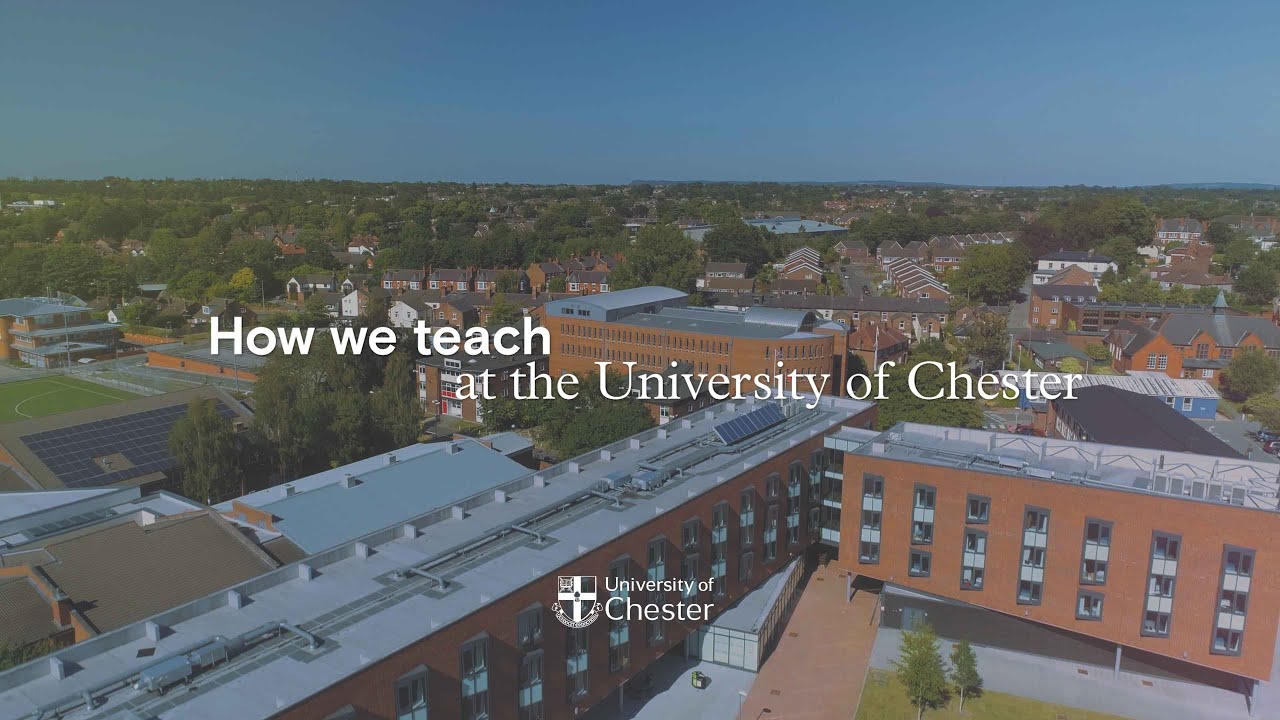
An aerial photograph of Exton Park with the text 'How we teach at the University of Chester'

How we teach at the University of Chester

This course is delivered in three terms of ten weeks each. In each term, you will study 40 credits comprised of either one or two modules. Scheduled contact hours range between approximately 8 and 12 hours per week depending upon the level of study and the complexity of the material being taught.

If studied, the Foundation Year, as with the following years of study, will be taught in three 10-week blocks across an academic year. Each block will comprise of a large 40-credit subject-specific module that includes a breadth of topics and subject skills. You will have on average 12-14 hours of contact time per week during the Foundation Year. There may be variations to this where subject practical or specialist space teaching is included.

This course is delivered through a mix of in-person, workshops and peer-led seminars.

You should expect to spend an average of 20 – 25 hours per week on independent study which might include following asynchronous learning material on the University’s VLE, tutorial time with staff, using the University’s library, working with peers and preparing work for assessment.

There will be a broad range of assessment methods so that you are exposed to the different types of tasks you might encounter in the workplace. These will include coursework in the form of reports, portfolios of work, presentations (such as pitches and debates, peer assessment), reflective reviews, multiple-choice questions, and evaluation reports. In some modules, you will encounter written exams, class tests and practical assessments.

All teaching is delivered by experienced academics and practitioners, with the fundamental principles of the Chester Future Skills Curriculum at its core - building your subject competence, confidence, and key transferable skills to shape you into a world-ready Chester graduate.

Your Future Career

Progression Options

  • Accounting MSc 
  • Banking and Finance MSc 
  • International Business MSc 
  • International Finance MSc 
  • Management MSc / PGDip , MSc / PGDip / PGCert 
  • Master of Business Administration MBA

Careers service

The University has an award-winning Careers and Employability service which provides a variety of employability-enhancing experiences; through the curriculum, through employer contact, tailored group sessions, individual information, advice and guidance.

Careers and Employability aims to deliver a service which is inclusive, impartial, welcoming, informed and tailored to your personal goals and aspirations, to enable you to develop as an individual and contribute to the business and community in which you will live and work.

We are here to help you plan your future, make the most of your time at University and to enhance your employability. We provide access to part-time jobs, extra-curricular employability-enhancing workshops and offer practical one-to-one help with career planning, including help with CVs, applications and mock interviews. We also deliver group sessions on career planning within each course and we have a wide range of extensive information covering graduate jobs and postgraduate study.

What Our Students Think

Entry Requirements

112 UCAS points

UCAS Points

112 points

GCE A Level

Typical offer – BCC-BBC

GCSE

Grade C4 (or above) in Mathematics

BTEC

DMM

International Baccalaureate

28 points

Irish/Scottish Highers

H3, H3, H3, H3, H4

Scottish Highers - BBBB

Access requirements

To include 45 credits at level 3, 30 of which must be at Merit

T Level

Merit

OCR Cambridge Technicals

DMM

Extra Requirements

Welsh Baccalaureate Advanced and A level General Studies will be recognised in our offer. We will also consider a combination of A Levels and BTECs/OCRs.

English Language Requirements

IELTS

6.0 (minimum 5.5 in each band)

72 UCAS points

UCAS Points

72 points

GCE A Level

72 points overall, including grade D in A level

BTEC

MMP

International Baccalaureate

24 points

Irish/Scottish Highers

H4 H4 H4 H4 H4

Scottish Highers - CCDD

Access requirements

Pass overall

T Level

Pass (D or E on the core)

OCR Cambridge Technicals

MMP

Extra Requirements

Welsh Baccalaureate Advanced and A level General Studies will be recognised in our offer. We will also consider a combination of A Levels and BTECs/OCRs.

If you are a mature student (21 or over) and have been out of education for a while or do not have experience or qualifications at Level 3 (equivalent to A Levels), then our Foundation Year courses will help you to develop the skills and knowledge you will need to succeed in your chosen degree.

Fees and Funding

£9,790 per year for a full-time course (2026/27)

The full-time tuition fees for Home students entering in 2026/27 are £9,790 a year, or £1,590 per 20-credit module for part-time study.

£14,950 per year for a full-time course* (2026/27)

The tuition fees for international students studying programmes in 2026/27 are £14,950 per year for a full-time course. This fee is set for each year of study.

For courses with a Foundation Year, the tuition fees for Year 1 are £11,250 and £14,950 for Years 2-4 in 2026/27.

Tuition fees for Home students for the Foundation Year in 2026/27 will be £5,760 (subject to Parliamentary approval) for the first foundation year of a four-year course. Tuition fees for subsequent years will be charged at the standard undergraduate tuition fee rate for that academic year. Standard undergraduate tuition fees for Home students for the academic year 2027/28 will be £10,050 for full-time students and £7,530 for part-time students (subject to Parliamentary approval). Fees for subsequent years may be subject to increase in line with the Government fee cap

  Foundation (First) Year Second Year onwards per year
Home Students £5,760 full-time fee for the first foundation year (2026/27) £10,050 full-time fee per year from the second year onwards (2027/28)
International Students * £11,250 full-time fee for the first foundation year (2026/27) £14,950 full-time fee per year from the second year onwards (2026/27)

* For courses which accept applications from International Students

Who You'll Learn From

Langton Mburayi

Programme Leader for Business Finance
Langton Mburayi

Dr Ahmed Kholeif

Programme Leader MSc International Finance
Dr Ahmed Kholeif

Lewis Jones

Lecturer
Lewis Jones

Michael Smith

Senior Lecturer
Michael Smith

Enquire about a course