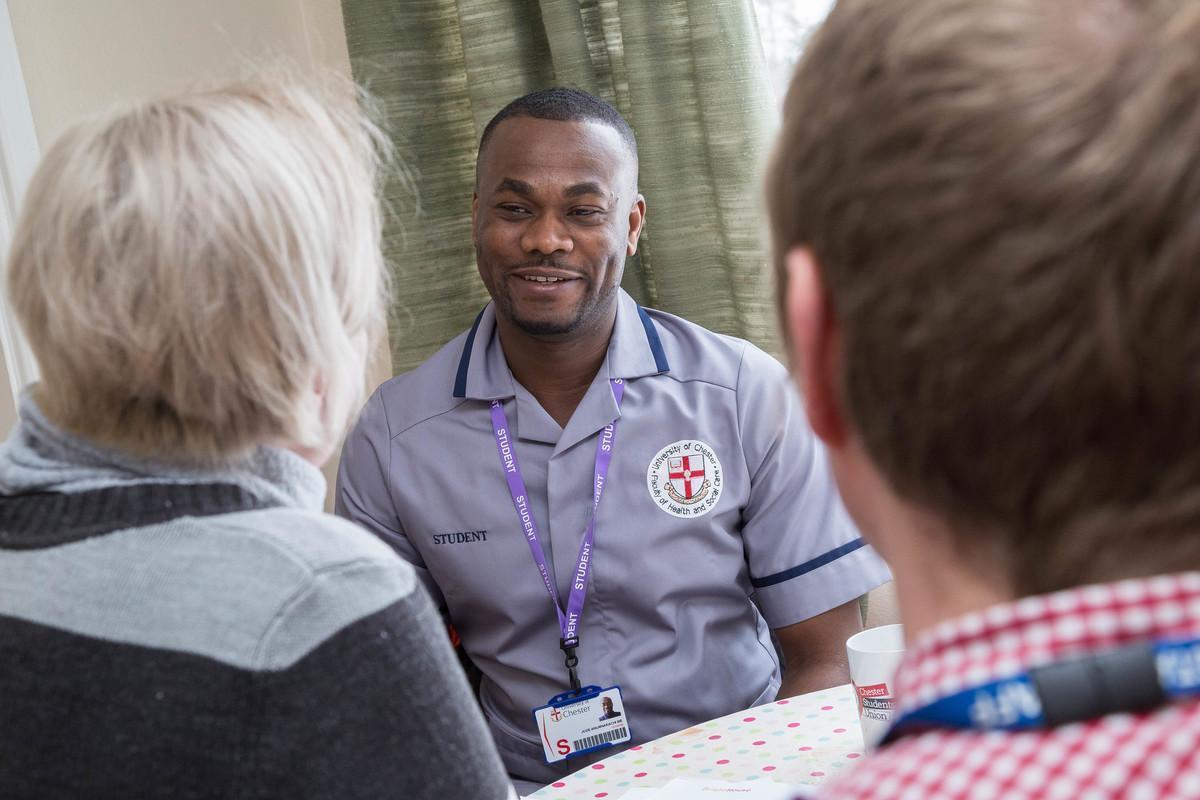





Mental health nursing degree student smiling and talking with two people, showing supportive and compassionate care.

Make a unique contribution to the health and wellbeing of those experiencing, or at risk of developing mental health problems on this pre-registration nursing course.

Mental health nursing is a specialist professional course that enables you to make a unique contribution to the health and wellbeing of people of all ages who experience, or may be at risk of developing, mental health issues. However, as a nurse for the future, the Nursing and Midwifery Council expect you to provide care for people from all fields of nursing, so we will enhance your knowledge and skills in relation to caring for adults (including older people), children and those with learning disabilities.

This is a dynamic, interactive professional course which places the needs of service patients and their families, and Mental Health Nursing practice, at its centre. The Programme Team are committed to supporting students to realise their potential to become compassionate, competent and autonomous Mental Health Nurses, who are able to meet current and future healthcare demands.

The NHS Learning Support Fund provides additional funding for eligible healthcare students studying nursing. Further details can be found on the NHS Learning Support Fund page on our website.

Nursing and midwifery courses require clinical placements and strict safeguarding, so students must be at least 18 at the course start to meet professional standards and fully take part in all required activities.

Accreditations

Nursing and Midwifery Council Winner at the Student Nursing Times Award 2023

Why You'll Love It

Nursing at the University of Chester video

Nursing at the University of Chester

What You'll Study

The Professional Studies Foundation Year route is designed to provide you with the knowledge and skills you will need to be successful at university and whilst on a professional and vocational course.

You will study a range of topics relating to your profession and the environment in which you will eventually work. Areas of focus include person-centred care, mental health, children’s development, communication in a professional setting, social inequality, and how to apply psychology in the real world.

Teaching and learning is tailored and designed with specific modules that relate to the profession you are preparing to join. You will also be introduced to the professional codes and standards that you must uphold such as, the Nursing and Midwifery Code, Social Work England, College of Policing, and national Safeguarding guidance.

  • Term 1: Exploring Professional Practice
  • Term 2: The Human Body, Health and Disease
  • Term 3: Psychology, Wellbeing and Society

Modules

This module is designed to enable you to explore your future career and provide an environment where you can begin to focus on the professional values, skills and knowledge needed to succeed in your field.

We will explore the history of your chosen profession, the changing nature of the role, and the social and political context surrounding this. You will have the opportunity to consider the professional codes, values and expectations that relate to your career as well as the various roles you can undertake within your field. 

You will also reflect on your own skill set and consider your personal and professional development needs.

Indicative content:

  • How to be a professional practice student: representing your profession 
  • Investigate the historic and socio-political context of your chosen profession (Nursing, Midwifery, Education or Social Work)
  • The importance of professional values and codes of practice/conduct
  • The nature and scope of inter-professional working
  • Core roles and responsibilities within your career and inter-professional working
  • Theories of professional practice
  • Equal opportunities, inclusion, diversity and professional practice
  • Interpersonal communication skills; development of self-awareness and of own communication skills.
  • Using models of reflection. 
  • Safeguarding of children and vulnerable adults 
  • Personal and professional development knowledge and skills
  • Your profession and the public 
  • Learning to use and navigate a range of digital spaces specific to your subject
  • Understanding academic conduct and conventions for communicating information

The module will explore how perceptions, personal circumstances and technology can shape our health. You will investigate areas such as technology, health promotion and inequality and how these can impact individual health experiences and outcomes, as well as considering models of health that inform belief systems.

You will also examine the role of biological concepts in the way our bodies’ function. The relationship between diseases and physiological processes within the context of organ systems will be examined.  

Indicative content:

  • Defining health in relation to the individual, society and social change
  • The importance of the biomedical, social and biopsychosocial models of health 
  • Investigate factors that influence health outcomes
  • The role and importance of health promotion in society
  • Individual health behaviour theories and applications
  • The future of health and healthcare 
  • The structure of a generalised human cell and organelles
  • Cellular transport processes including diffusion and osmosis
  • Specialised cells and tissues in the human body
  • The role of hormones and enzymes
  • Human body systems
  • Homeostasis
  • The role of genetics in human health and disease
  • Micro-organisms as a cause of infectious disease
  • The biological basis of routine investigations
  • Advancing digital and academic skills introduced during Term 1
  • Developing research and information literacy in relation to your subject
  • Creating an academic poster on a chosen research paper

This module will explore how psychology and related disciplines can be applied to real world contexts. We will explore the history of psychology and related disciplines. You will explore key perspectives that include; social psychology, biological psychology, humanism and developmental psychology.

You will also investigate the following; mental health, bereavement support, and improving patient outcomes with Psychology. You will consider how this knowledge can support and inform your professional practice. You will also examine notions of wellbeing , stress and resilience to prepare you for professional practice.

Indicative content: 

  • The role of social structures and socialisation in society
  • The role and historical context of Psychology and related disciplines 
  • The social Psychology of human interaction and behaviour
  • Development psychology from childhood and through the lifespan
  • Brain structure and functions
  • Neurodiversity and brain differences - what makes us unique. 
  • An introduction to mental health
  • Humanism and its importance in professional practice
  • Cognitive Psychology and its importance in professional practice  
  • Stress, resilience and stress management
  • What is wellbeing and how this can be applied to professional practice
  • Supporting patient outcomes with Psychology 
  • Leadership and motivation in nursing practice 

The information listed in this section is an overview of the academic content of the course that will take the form of either core or option modules and should be used as a guide. We review the content of our courses regularly, making changes where necessary to improve your experience and graduate prospects. If during a review process, course content is significantly changed, we will contact you to notify you of these changes if you receive an offer from us.

Modules

This module is designed to equip you with a foundational understanding of human anatomy and physiology, highlighting their connection to the biological principles underlying pharmacology. Learners will also explore how this knowledge is applied in practical, real-world healthcare settings.

Indicative content 

  1. Introduction to the human body across the age continuum; characteristics of life; concept of integration and homeostasis. Levels of structural organisation; systems and cross-system concepts, organs, tissues, cells and chemicals. Geographical navigation of the body; anatomical position and directional terms.   Overview of relevant disciplines. Overview of the biological basis of routine investigations.  

  2. Basic principles of pharmacology and their application; concept of keeping an ongoing personal formulary diary.

  3. The internal environment, fluid and electrolyte balance;  homeostatic control; common disorders; principles of restoring fluid and electrolyte imbalance homeostasis.

  4. Human body systems:

    - Integumentary system and cross-system concepts; human microbiome; inflammation, introduction to wound healing; introduction to the physiology of pain; principles of pharmacology/ topical route; common disorders and commonly prescribed medicines.

    - Nervous system and cross-system concepts; mental health/learning disability; common disorders; principles of pharmacology and commonly prescribed medicines.

    - Endocrine system and cross-system concepts; common disorders and commonly prescribed medicines.

    - Cardiovascular system and cross-system concepts; blood; common disorders and commonly prescribed medicines.

    - Lymphatic system and immunity; cross-system concepts; common disorders and commonly prescribed medicines.

    - Respiratory system and cross-system concepts; common disorders and commonly prescribed medicines.

    - Gastro Intestinal system and cross-system concepts; common disorders and commonly prescribed medicines.

    - Muscular Skeletal system and cross-system concepts; common disorders and commonly prescribed medicines.

    - Urinary system and cross-system concepts; common disorders and commonly prescribed medicines.

    - Reproductive system and cross-system concepts; genetics/ genomics; common disorders and commonly prescribed  medicines.

This module introduces the concept of holistic, person-centred care across the lifespan. You will develop an understanding of human development and recognize the importance of effective communication with service users, their families, and the multidisciplinary team (MDT) across diverse healthcare settings

Indicative content 

The cross field content of this module is designed to enable students to meet the needs of service users and carers from all four fields of practice and as such the delivery will include application to all service user groups.

  1. Define person centred care & holistic care across all fields of nursing; historical context of person centred care; models of person centred care; and factors that influence delivery of person centred care.
  2. Public health and influences on health and social care - socio-economic, psychosocial, epidemiology. Health inequalities - addressing vulnerability and abuse; lifestyle; environment including urban and rural perspectives.  
  3. Human development across the lifespan; physical & psychological development; theories of development; developments of self-esteem; ACEs (adverse childhood experiences); identification of vulnerable groups; safeguarding.

This module will introduce you to the principles of evidence-based practice and its role in delivering high-quality, safe, and effective care. It will also examine how socio-economic and environmental factors influence health and well-being across the lifespan

Indicative content 

The cross field content of this module is designed to enable students to meet the needs of service users and carers from all four fields of practice and as such the delivery will include application to all service user groups.

  1. Effective verbal and non-verbal communication strategies; communication tools; active listening skills. Individualised person centred care; family centred care; develop and maintain appropriate relationships with service users, families, carers and MDT. Resilience and coping; role modelling; use of the arts & humanities to enhance communication; mental capacity; advocacy; empowerment.
  2. Barriers to providing person centred care; safeguarding; cross cultural perspectives, diversity & cultural competence; social policy, environment including urban and rural perspectives.
  3. Types, range and strength of evidence used in nursing to provide high quality and safe care, for instance art in health; research, ethics and governance; evidence based practice; links to theory and practice; quality of care; policy.

To prepare the student to become an effective nurse for the 21st century

This cross field module will integrate learning-to-learn and reflection into a series of linked sessions leading to personal and professional development, including the following:

  1. The context of nursing as a profession, past, present and future, including enhancing resilience, personal awareness, well-being and self- care strategies.
  2. Professional identity, social values and multi-professional working in order to provide creative and collaborative solutions to enhance practice.
  3. Preparation for lifelong learning in theory and practice, including active listening, note-taking, note-making, effective reading, portfolio writing including reflection to develop awareness of self and others, academic integrity.
  4. The use of current practice guidelines, contemporary evidence and political drivers to inform decision making, urban and rural practice differences.
  5. How the Code, ethical and legal frameworks underpin the nursing profession in the 21st century.


This module will engage you in a diverse range of practice-based learning opportunities across a variety of clinical fields. It introduces both cross-field and field-specific nursing skills, enabling you to develop a comprehensive understanding of professional practice and demonstrate the essential competencies required in for nursing practice. 

Indicative content 

The cross field content of this module is designed to enable students to meet the needs of service users and carers from all four fields of practice and as such the delivery will include application to all service user groups in theory and practice: 

  1. Becoming a professional: NMC code, models of practice learning, legal and ethical frameworks, duty of candour. Self-care including reflective practice, reasonable adjustments in practice plan (RAPP), emotional intelligence, resilience, healthy lifestyle choices and clinical supervision. Advocacy and challenging discrimination. Record keeping, confidentiality, privacy and dignity.
  2. Safeguarding and escalating concerns. Capacity and consent. Interpreting routine investigations. Holistic assessment across the lifespan. Risk assessments, reasonable adjustments for service users. Developing person centred care plans, the nursing process.
  3. Working in partnership with service users, relatives, carers and other professionals. Lived experience connectors. Role modelling. Working with cognitive, behavioural, mental or physical challenges. Communication strategies across the lifespan. Supporting the activities of daily living across the lifespan including sleep, hygiene, nutrition and hydration and skin integrity. Prioritisation of care. Medication administration and management.
  4. Technology for health including manual and electronic recording devices. Team working and data sharing. Evaluation of care. First aid and basic life support (BLS), mental health first aid (MHFA), moving and handling techniques and equipment. Principles of infection prevention and control. Use of personal protective equipment (PPE), barrier and reverser barrier nursing and decontamination practice. Promoting healthy lifestyles in others. Obtaining clinical specimens and interpreting findings.
  5. Risk assessment and improvement tools across the fields and life span. Managing a safe environment.
  6. Integrated approaches to care, rural and urban perspectives. Promoting independence and recognising challenges for safe nursing care including socio-economic, physical, psychological and socio-cultural differences. Handing of effectively including written, verbal and digital techniques.
  7. Medicines management, application in practice of knowledge of pharmacology. Preparation and administration of medications. Accurate documentation for medicines management. Medicines calculations. Recognising and escalating concerns of harm from medication administration and error.


The information listed in this section is an overview of the academic content of the course that will take the form of either core or option modules and should be used as a guide. We review the content of our courses regularly, making changes where necessary to improve your experience and graduate prospects. If during a review process, course content is significantly changed, we will contact you to notify you of these changes if you receive an offer from us.

Modules

This module will facilitate you to explore the principles of evidence-based practice in detail. You will consider the value of interprofessional collaboration, and foundational research skills. It explores how integrating research evidence, clinical expertise, and patient values improves healthcare outcomes, and prepares students to contribute to service improvement through collaborative, research-informed approaches.

Indicative content 

  1. Problem solving within an interprofessional context, including evidence-based decision-making, hierarchies of knowledge and service user perspectives.
  2. Interprofessional learning and collaboration: Remit, roles and responsibilities; sharing knowledge in health and social care.
  3. Research: literature searching across evidence bases, research appraisal and critical thinking, ethics and governance.
  4. Service improvement and innovation methodologies: audit, quality assurance, evaluation, continuous improvement, clinical governance, service user co-production.
  5. Drivers influencing interprofessional health and social care: organisational and national policy, socio-political and economic drivers.

This module aims to explore health promotion and prevention of ill health in your chosen field of practice. The aim is to demonstrate understanding of enhanced communication to empower and enable service users, and work effectively across the MDT / range of settings.

This module will focus on field specific nursing conditions with increasing complexity and service users with co-morbidities. The module will explore identification and management of risk and factors which influence this.

To provide students with practice learning opportunities which provide a range of experiences across fields. The module will build on cross field and field specific skills for nursing. The learner will actively participate in and work towards increasing confidence and competence is able to provide care.

To provide students with practice learning opportunities which provide a range of experiences across fields. The module will build on cross field and field specific skills for nursing. The learner will actively participate in and work towards increasing confidence and competence is able to provide care with minimal guidance.

This module aims to facilitate learners to apply knowledge of human anatomy and physiology, principles of pharmacology and how these are applied in field specific nursing practice.

The information listed in this section is an overview of the academic content of the course that will take the form of either core or option modules and should be used as a guide. We review the content of our courses regularly, making changes where necessary to improve your experience and graduate prospects. If during a review process, course content is significantly changed, we will contact you to notify you of these changes if you receive an offer from us.

Modules

This module will enable you to critically examine the complexities of human anatomy, physiology, and pharmacology in preparation for professional registration and readiness to prescribe

Indicative content 

  1. Revision of anatomy and physiology, relevant pathophysiology, homeostasis across field specific nursing and beyond.
  2. Consolidate understanding of pharmacological principles in order to become prescribing ready, completion of personal formulary. Use of BNF. Application of how illness affects pharmacology, adverse drug reactions, polypharmacy, Drug Interactions - Pharmacokinetic and Pharmaco-dynamic Interactions, prescribing errors and management of field specific issues which includes the individual variation for people of all ages.
  3. Understanding the role of the nurse prescriber, developing consultation skills apply knowledge of pharmacology to the care of people, the role of generic, unlicensed, and off-label prescribing and the potential risks associated with these approaches to prescribing. and consideration to the psychosocial impact. Knowledge of how prescriptions can be generated, consent, concordance, adherence and duty of care in prescribing with consideration to the psychosocial impact. Influences on prescribing including organisational and pharmaceutical companies. Preparation to progress to a prescribing qualification following registration.

This module will support you in your transition to professional registration by fostering leadership and teaching skills essential for delivering safe, effective, and forward-thinking care in 21st-century nursing

Indicative content 

The cross field content of this module is designed to enable students to meet the needs of service users and carers from all four fields of practice and as such the delivery will include examples and application to all service user groups. 

  1. Continuing professional development and accountability: the role of practice supervisor, practice assessor, academic assessor and practice clinical supervision, delegation, action planning for personal development and principles of lifelong learning.
  2. Supporting learning: preparation for a teaching role; learning and teaching strategies; peer supervision; skills of teaching and facilitation; Inter-professional Learning (IPL), coaching.  
  3. Developing leadership through an examination of effective leadership traits, intelligent kindness, compassionate leadership, role modelling and reflection. Consideration of delegation and team working.
  4. Nurturing the future generation of nurses through compassion, empathy, prevention of burnout, time management, self awareness.

This module aims to develop your understanding of the processes involved in creating a service improvement proposal, with the goal of enhancing care delivery in 21st-century healthcare settings and supporting your transition to professional registration.

Indicative content 

The cross field content of this module is designed to enable students to meet the needs of service users and carers from all four fields of practice and as such the delivery will include examples and application to all service user groups. 

  1. Continuing professional development: Understanding the political drivers for 21st century healthcare, decision making strategies, types of power used in managing teams.
  2. Supporting innovation: preparing the culture for innovation; change theories and models; quality and governance.  
  3. Developing leadership potential: Leadership theory and styles, positive and negative leadership traits, using emotional intelligence.
  4. Development of service improvement artefact.
  5. Developing a business case for innovation, using evidence to support innovation, pitching and rationalising innovation. 

To provide students with practice learning opportunities which provide a range of experiences across fields. The module will build on cross field and field specific skills for nursing. The learner will actively participate in and work towards increasing confidence and competence is able to provide care with minimal guidance.

The information listed in this section is an overview of the academic content of the course that will take the form of either core or option modules and should be used as a guide. We review the content of our courses regularly, making changes where necessary to improve your experience and graduate prospects. If during a review process, course content is significantly changed, we will contact you to notify you of these changes if you receive an offer from us.

How You'll Learn

An aerial photograph of Exton Park with the text 'How we teach at the University of Chester'

How we teach at the University of Chester

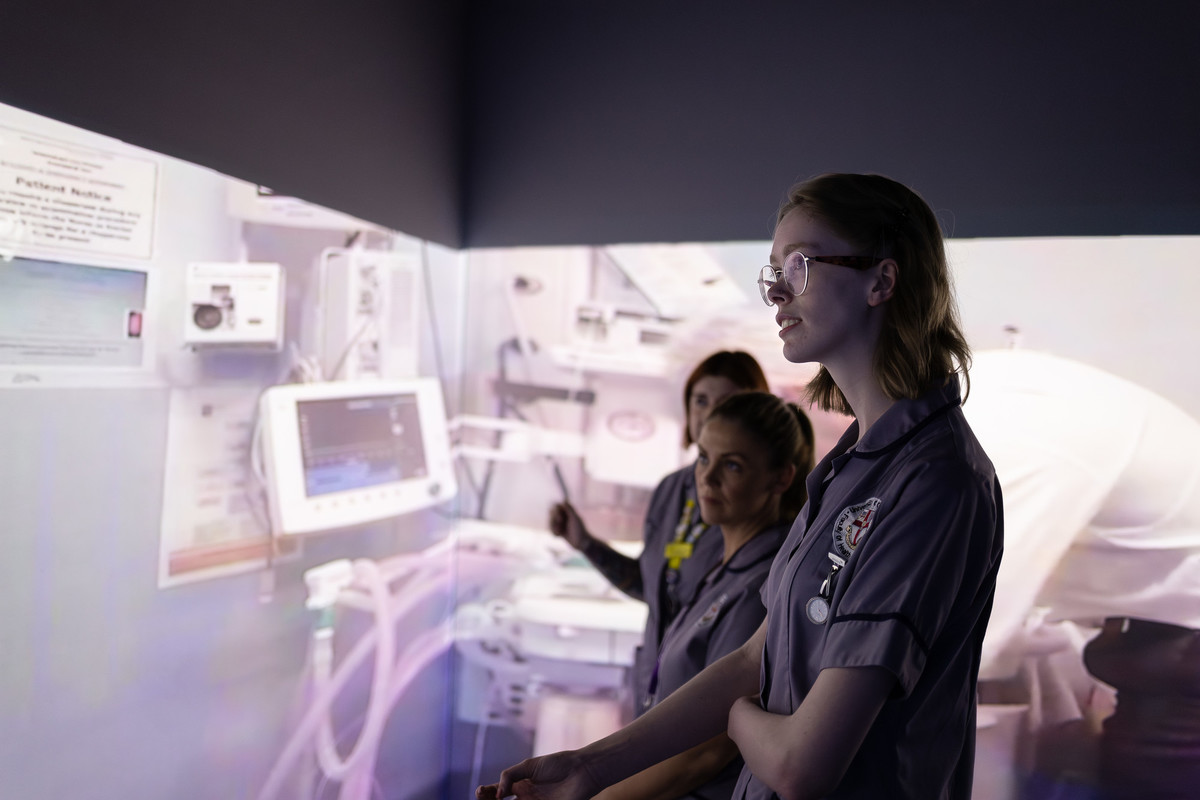
You will develop your knowledge and skills of nursing care through lectures, seminars, tutorials, e-learning, practice-based workshops, practice clinical skills within our state-of-the-art simulation suites along with self and guided independent study.

You will be assessed through a variety of methods including written essays, a written exam, oral assessment such as presentations and practical assessment within clinical practice placements.

If studied, the Foundation Year, as with the following years of study, will be taught in three 10-week blocks across an academic year. Each block will comprise 40 credits of leaning that include a breadth of topics and practice skills. You will have on average 12-14 hours of contact time per week during the Foundation Year. There may be variations to this where subject practical or specialist space teaching is included.

This course comprises 50% teaching within university and 50% within clinical practice placements. You will be allocated a range of practice placements to facilitate a wide experience of healthcare across both hospital and community care settings.

Your Future Career

Job Prospects

Successful graduates are registered with Nursing and Midwifery Council as a Mental Health Nurse.

Once registered, graduates have an opportunity to work in both the private and public sector including hospital or community-based roles along with research and teaching.

In addition to working within the UK, registered graduates can explore working abroad.

Careers Service

The University has an award-winning Careers and Employability service which provides a variety of employability-enhancing experiences; through the curriculum, through employer contact, tailored group sessions, individual information, advice and guidance.

Careers and Employability aims to deliver a service which is inclusive, impartial, welcoming, informed and tailored to your personal goals and aspirations, to enable you to develop as an individual and contribute to the business and community in which you will live and work.

We are here to help you plan your future, make the most of your time at University and to enhance your employability. We provide access to part-time jobs, extra-curricular employability-enhancing workshops and offer practical one-to-one help with career planning, including help with CVs, applications and mock interviews. We also deliver group sessions on career planning within each course and we have a wide range of extensive information covering graduate jobs and postgraduate study.

What Our Students Think

Beyond The Classroom

On this course, you’ll spend time out on placement where you’ll apply what you have learnt to real scenarios in healthcare settings, giving you genuine experience and insight that will prepare you for your future nursing career.


Entry Requirements

104UCAS points

UCAS

104 UCAS points

GCE A Level

Typical offer - BCC

BTEC

BTEC National Extended Diploma: DMM

BTEC Diploma: D*D*

T Level

T Level (Health): Merit

Irish / Scottish Highers

Irish Highers: H3 H3 H3 H3 H4

Scottish Highers: BBBB

International Baccalaureate

26 points

Access requirements

Access to HE Diploma, to include 45 credits at Level 3, 30 of which must be at Merit or Distinction

OCR

OCR Extended Diploma: DMM

Extra Information / General Entry Requirements

Welsh Baccalaureate Advanced and A Level General Studies will be recognised in our offer. We will also consider a combination of A Levels and BTECs/OCRs.

FETAC Level 5 (Major Award) with all eight subjects at Merit. Applicants must also have GCSE Grade 4/C or above in English and Maths or recognised Level 2 equivalent.

Please note that applicants must also have evidence of recent study within the last five years.

Safeguarding / Suitability

All successful candidates who receive an offer of a place for this course and choose the University of Chester as their Firm choice will be required to undergo checks with regards to their suitability to practice. A couple of months prior to admission to this course, the University will contact you to request that you complete a self-declaration form detailing any relevant convictions or other information that you believe may have an impact upon your ability to undertake work with children or vulnerable adults. You will also receive instructions on how to complete an online application for a Disclosure and Barring Service (DBS) check through the University as a registered body – there will be a charge for this.

Please note that the University does not accept previous DBS checks from other registered bodies or the update service.

For details about the cost of the DBS and for further information please visit our DBS web pages.

104UCAS points

UCAS  

104 UCAS points  

GCE A Level  

Typical offer - BCC

BTEC  

BTEC National Extended Diploma: DMM; BTEC Diploma: D*D* 

T Level  

T Level Health - Merit 

Irish / Scottish Highers  

Irish Highers: H3 H3 H3 H3 H4 

Scottish Highers: BBBB 

International Baccalaureate  

26 points  

Access requirements  

 Access to HE Diploma, to include 45 credits at Level 3, 30 of which must be at Merit or Distinction  

OCR  

OCR Extended Diploma: DMM 

Extra Information / General Entry Requirements  

Welsh Baccalaureate Advanced and A Level General Studies will be recognised in our offer. We will also consider a combination of A Levels and BTECs/OCRs. FETAC Level 5 (Major Award) with all eight subjects at Merit. Applicants must also have GCSE Grade 4/C or above in English and Maths or recognised Level 2 equivalent. Please note that applicants must also have evidence of recent study within the last five years. 

Safeguarding / Suitability  

All successful candidates who receive an offer of a place for this course and choose the University of Chester as their Firm choice will be required to undergo checks about their suitability to practice. A couple of months before admission to this course, the University will contact you to request that you complete a self-declaration form detailing any relevant convictions or other information that you believe may have an impact on your ability to undertake work with children or vulnerable adults. You will also receive instructions on how to complete an online application for a Disclosure and Barring Service (DBS) check through the University as a registered body – there will be a charge for this. Please note that the University does not accept previous DBS checks from other registered bodies or the update service. For details about the cost of the DBS and further information please visit our DBS web pages. 

If you have an international qualification, please visit the relevant Country Page for more information

English Language Requirements 

Please note, that applicants whose first language is not English must demonstrate they can meet the following English language criteria for this programme: 

  • IELTS 6.0 overall (with no less than 5.5 in each band)
  • OET with 4 C grades
  • Degree completed in the UK with a 2:2

72UCAS points

UCAS

72 UCAS points

GCE A Level

72 UCAS points from GCE A Levels to include D in one subject

BTEC

BTEC National Extended Diploma: MMP BTEC Diploma: DM

T Level

T Level Health – Pass (D or E on the core)

Irish / Scottish Highers

Irish Highers: H4 H4 H4 H4 H4 Scottish Highers: CCDD

International Baccalaureate

24 points

Access requirements

Access to HE Diploma – Pass overall

OCR

OCR Extended Diploma: MMP

Extra Information / General Entry Requirements

Welsh Baccalaureate Advanced and A Level General Studies will be recognised in our offer. We will also consider a combination of A Levels and BTECs/OCRs. Applicants must also have GCSE Grade 4/C or above in English and Maths or recognised Level 2 equivalent. Please note that applicants must also have evidence of recent study within the last five years.

Safeguarding /Suitability

All successful candidates who receive an offer of a place for this course and choose the University of Chester as their Firm choice will be required to undergo checks with regards to their suitability to practice. A couple of months prior to admission to this course, the University will contact you to request that you complete a self-declaration form detailing any relevant convictions or other information that you believe may have an impact upon your ability to undertake work with children or vulnerable adults. You will also receive instructions on how to complete an online application for a Disclosure and Barring Service (DBS) check through the University as a registered body – there will be a charge for this.

Please note that the University does not accept previous DBS checks from other registered bodies or the update service. For details about the cost of the DBS and for further information please visit our DBS web pages.


Fees and Funding

£9,535per year for a full-time course (2025/26)

Fees for the 2026/27 academic year are subject to Parliamentary approval and have not yet been confirmed.

Our full-time undergraduate tuition fees for Home students entering University in 2025/26 are £9,535 a year, or £1,590 per 20-credit module for part-time study.

You can find more information about undergraduate fees on our Fees and Finance pages.

Students from the UK, Isle of Man, Guernsey, Jersey and the Republic of Ireland are treated as Home students for tuition fee purposes.

Students from countries in the European Economic Area and the EU will pay International Tuition Fees.

Students who have been granted Settled Status may be eligible for Home Fee Status and if eligible will be able to apply for Tuition Fee Loans and Maintenance Loans.

Students who have been granted Pre-settled Status may be eligible for Home Fee Status and if eligible will be able to apply for Tuition Fee Loans.

£14,450*per year for a full-time course (2025/26)

The tuition fees for international students studying Undergraduate programmes in 2025/26 are £14,450 per year for a full-time course. This fee is set for each year of study.

The University of Chester offers generous international and merit-based scholarships, providing a significant reduction to the published headline tuition fee. You will automatically be considered for these scholarships when your application is reviewed, and any award given will be stated on your offer letter.

For courses with a Foundation Year, the tuition fees for Year 1 are £10,750 and £14,200 for Years 2-4 in 2025/26.

For more information, go to our International Fees, Scholarship and Finance section.

Irish Nationals living in the UK or ROI are treated as Home students for Tuition Fee Purposes. 

Please note! International students are not eligible for government funding to support travel costs for work placements, so these extra costs should be factored into financial plans.

Your course will involve additional costs not covered by your tuition fees. This may include books, printing, photocopying, educational stationery and related materials, specialist clothing, travel to placements, optional field trips and software. Compulsory field trips are covered by your tuition fees. 

If you are living away from home during your time at university, you will need to cover costs such as accommodation, food, travel and bills.

Course specific additional costs

A satisfactory Disclosure and Barring Service Check (DBS) and occupational health clearance are required prior to admission onto the course.

For details about the cost of the DBS and for further information please visit: www.chester.ac.uk/dbs 

The University of Chester supports fair access for students who may need additional support through a range of bursaries and scholarships. 

Full details, as well as terms and conditions for all bursaries and scholarships can be found on the Fees and Finance section of our website.

Medical staff and students walking down a corridor.

Clinical Skills and Simulation Facilities Tour

Who You'll Learn From

Yankita Sharma

Senior Lecturer
Blank profile picture placeholder

Neil Hosker

Senior Lecturer
Blank profile picture placeholder

Jo Lowndes

Deputy Head
Jo Lowndes

Vicky Perrin

Senior Lecturer
Blank profile picture placeholder

Phil Coombs

Senior Lecturer
Blank profile picture placeholder

Sonia Boulton

Senior Lecturer
Blank profile picture placeholder

Andrea Jones

Senior Lecturer
Andrea Jones

Yvette Heatley

Senior Lecturer
Blank profile picture placeholder

Michael Doughty

Senior Lecturer
Blank profile picture placeholder

Kristen Vine

Senior Lecturer
Blank profile picture placeholder

Enquire about a course