Chester Lives in Cheshire Life
“As I am now at Chester, ‘tis proper to say something of it, being a city well worth describing: Chester has four things very remarkable in it. 1. Its walls which are very firm, beautiful and in good repair. 2. The castle, which is also kept up, and has a garrison always in it. 3. The Cathedral. 4. The River Dee, and 5. the bridge over it” (Daniel Defoe-  author of Robinson Crusoe - c1724, A tour thro' the whole island of Great Britain).

“Chester has the most complete city walls, the oldest racecourse and the largest Roman Amphitheatre in Britain, plus a 1000 year old Cathedral with Europe's finest example of medieval carvings - and of course the one and only 700 year old Rows galleries where shopping is a double delight” (Visit Cheshire).

These celebrations of Cheshire’s historic cathedral city – 300 years apart - are symbolic of its central role in the county, and therefore apt that it has been given significant coverage in Cheshire Life, one of the UK’s longest running and most successful regional magazines. Launched in May 1934, back copies of Cheshire Life provide a unique snapshot of the evolution of modern Chester, from ‘Salmon Netting on the Dee: The centuries old industry centred at Handbridge’ (May 1935) through to ‘Chester Food Tour: The city that’s good enough to eat’ (November 2024).

As part of our Cheshire Life digitisation project, in partnership with Cheshire Archive and Local Studies, and Cheshire Life, here we preview a sample of pages depicting Chester scenes, feature articles and adverts since the 1930s. The tensions between old and new, Roman remains and modernity, rural and urban, city centre and suburbs, and wealth and hardship, are epitomised by the ways Chester has been represented in the magazine for the past nine decades.

To what extent the sense of place portrayed in these samples accords with your experiences of the city may depend on your relationship with Chester – as a tourist, student or born and bred Cestrian. We’d be interested to hear your views.
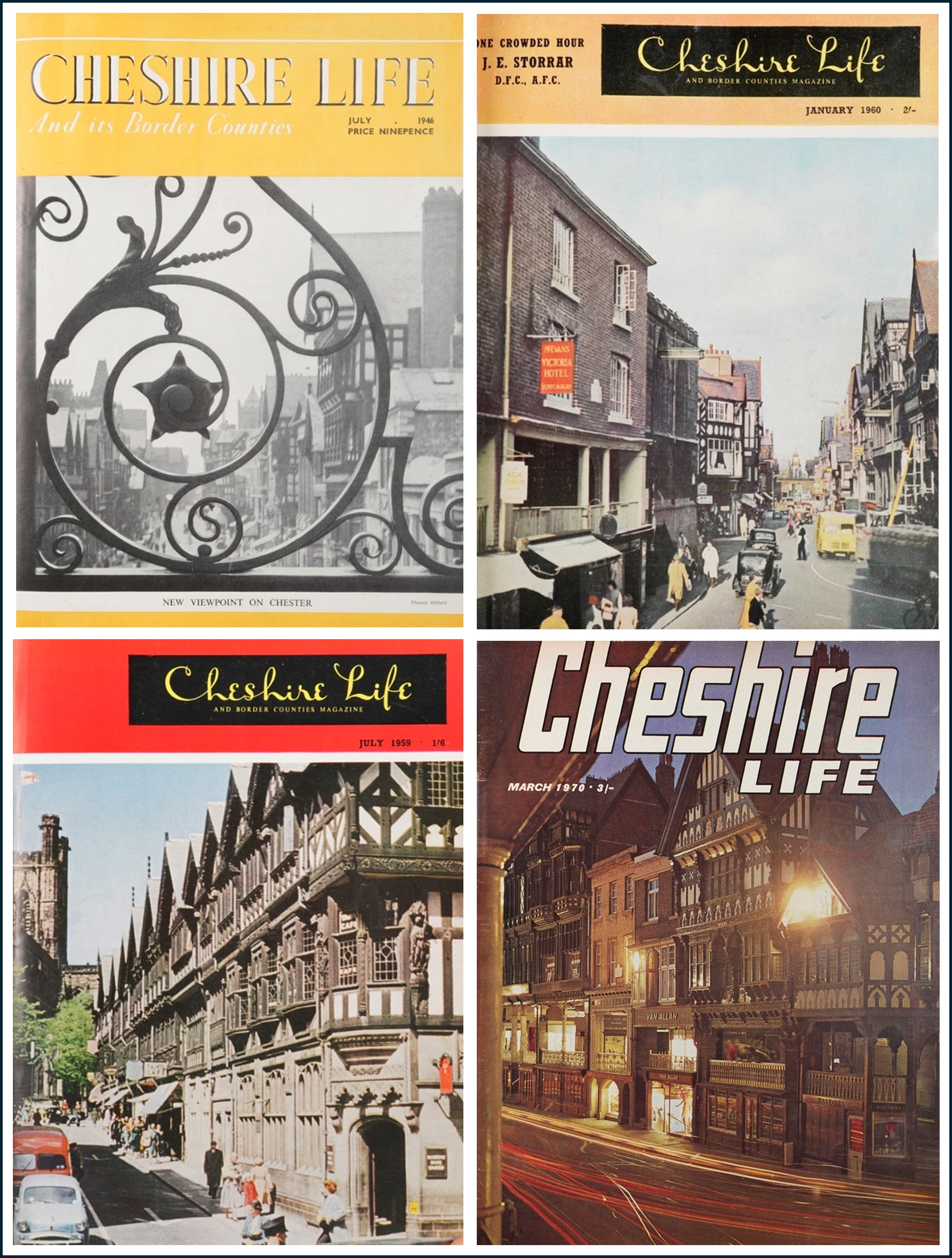
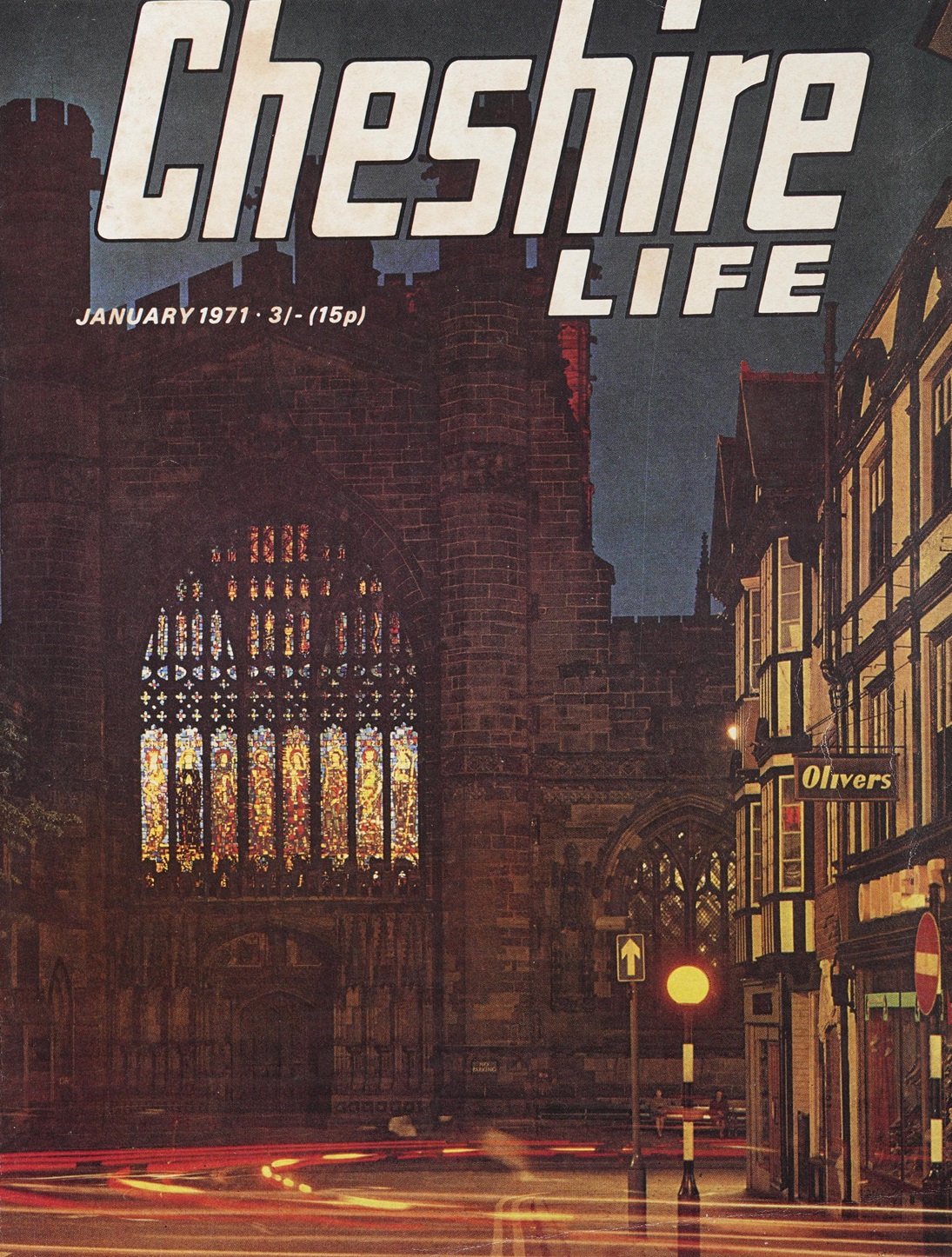
Chester city centre covers. Photographs of Chester city centre featured many times on the covers of Cheshire Life, especially in the mid-20th Century at a time of rapid change. These images from July 1946, July 1959, January 1960, and March 1970 provide a fascinating snapshot of Chester’s relatively unchanging architecture against a backdrop of rapidly evolving fashion, transport, page design and cost - from ninepence (4p) (or 7.5p in decimal currency) to 3 shillings (36d) (15p).
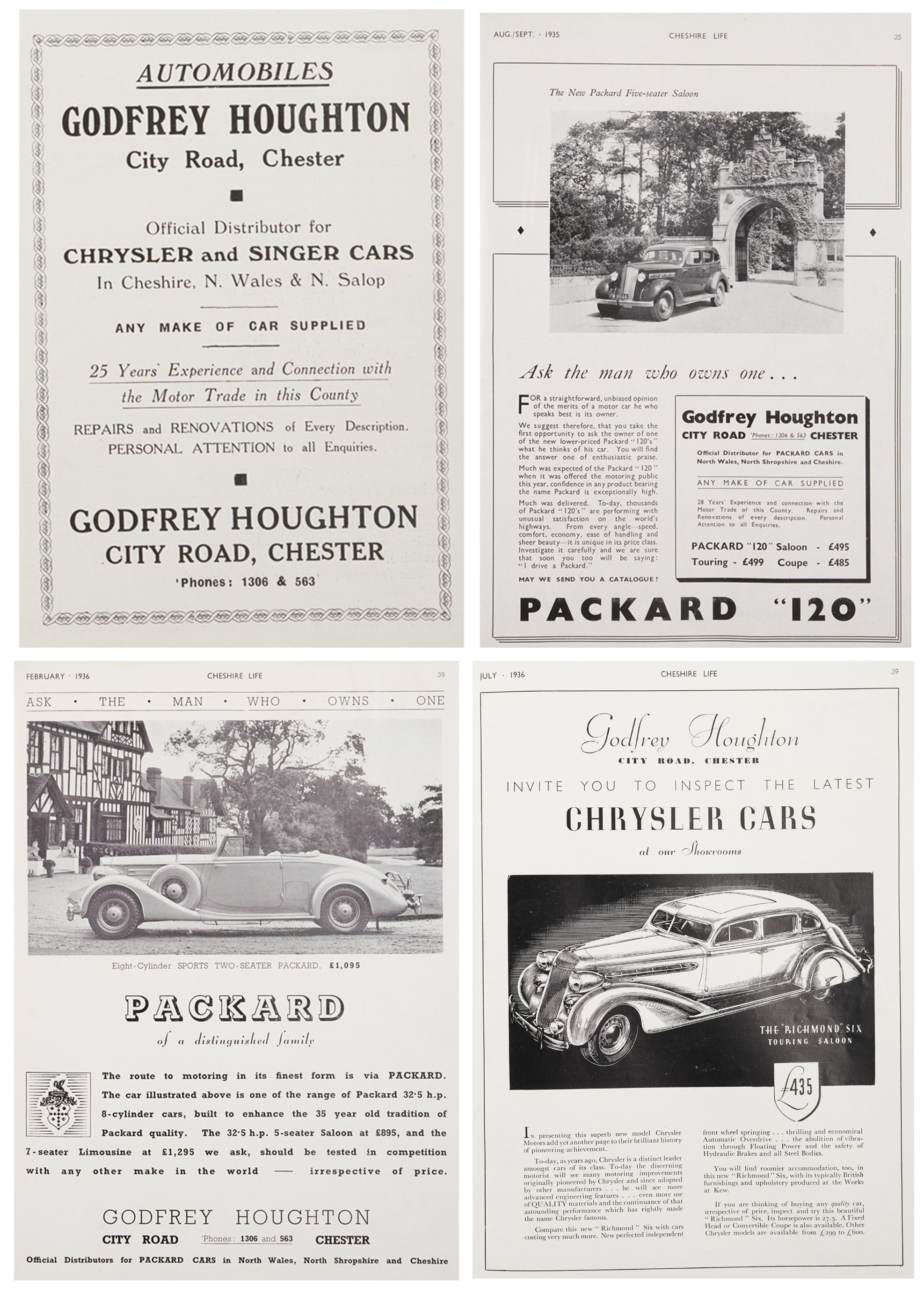
Godfrey Houghton cars. Godfrey Houghton car distributors, based on Chester’s City Road near the railway station, were regular advertisers in early editions of Cheshire Life. These four adverts from April 1935 to Aug/Sept 1936 show how luxury cars were marketed as a prestige accessory (to men) in the pre-war period, with photographs of the cars against classy rural backdrops. The 7-seater Packard Limousine would set you back £1,295 in 1936, the equivalent of around £78,000 in today’s prices.
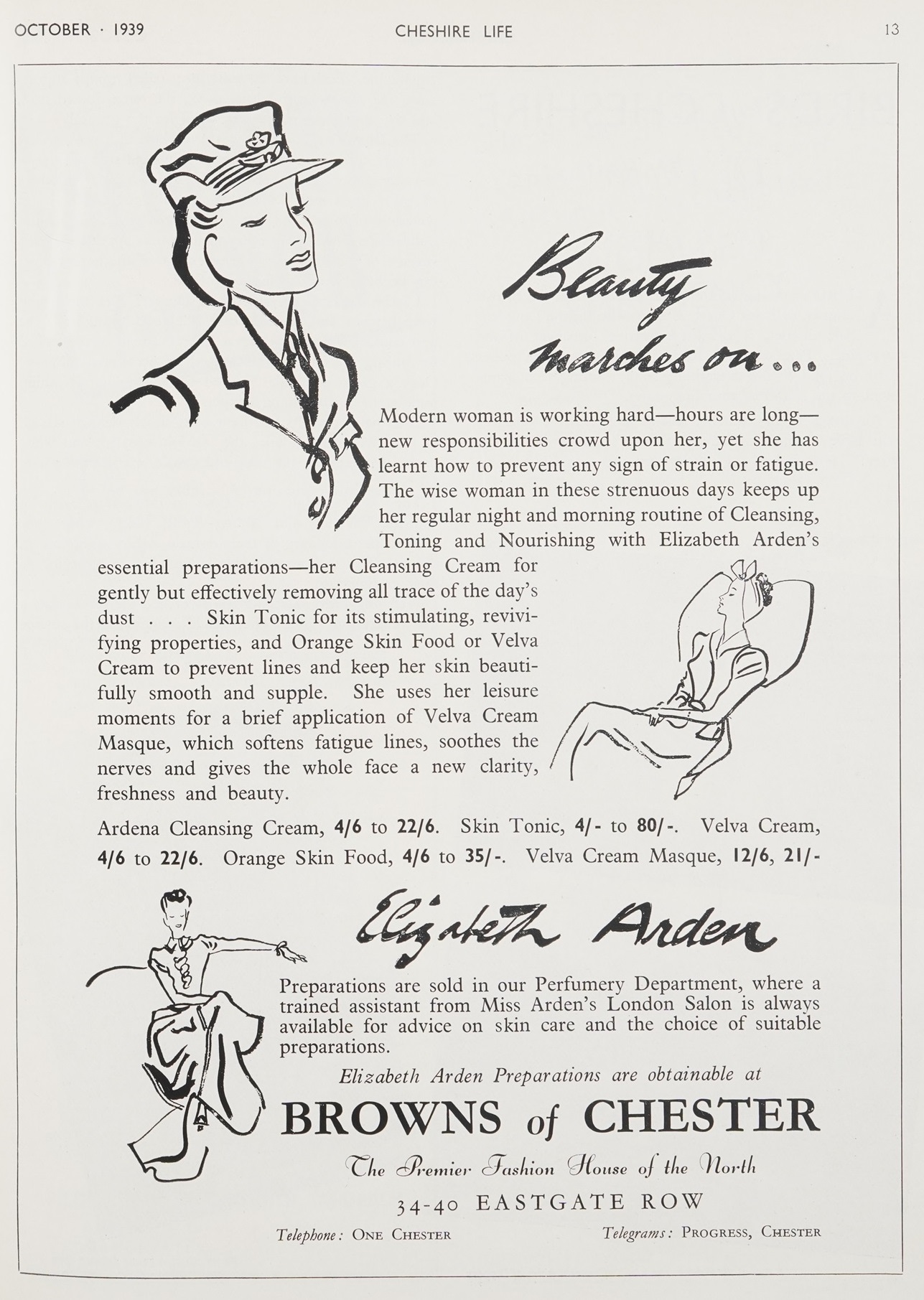
Browns of Chester. Browns of Chester used clever advertising techniques to market cosmetics products to women. They regularly featured in Cheshire Life, promoting a range of products by pioneering businesswoman Elizabeth Arden, directly addressing their readership in a range of novel ways, giving the impression they were in touch with the needs of the ‘ordinary’ person. A range of adverts from July to December 1939 show how they regularly adapted their focus to take into account the seasonal trends (e.g. ‘Summer is over and a new season lies ahead’) and the onset of World War II. This advert from October 1939 markets its skincare products to the “modern” and “wise” woman who may simultaneously need to contribute to the war effort whilst hiding “any sign of strain or fatigue”. This dual approach is encapsulated by the images of women in uniform, day wear and evening wear, neatly summarized by the heading, “Beauty marches on…”.
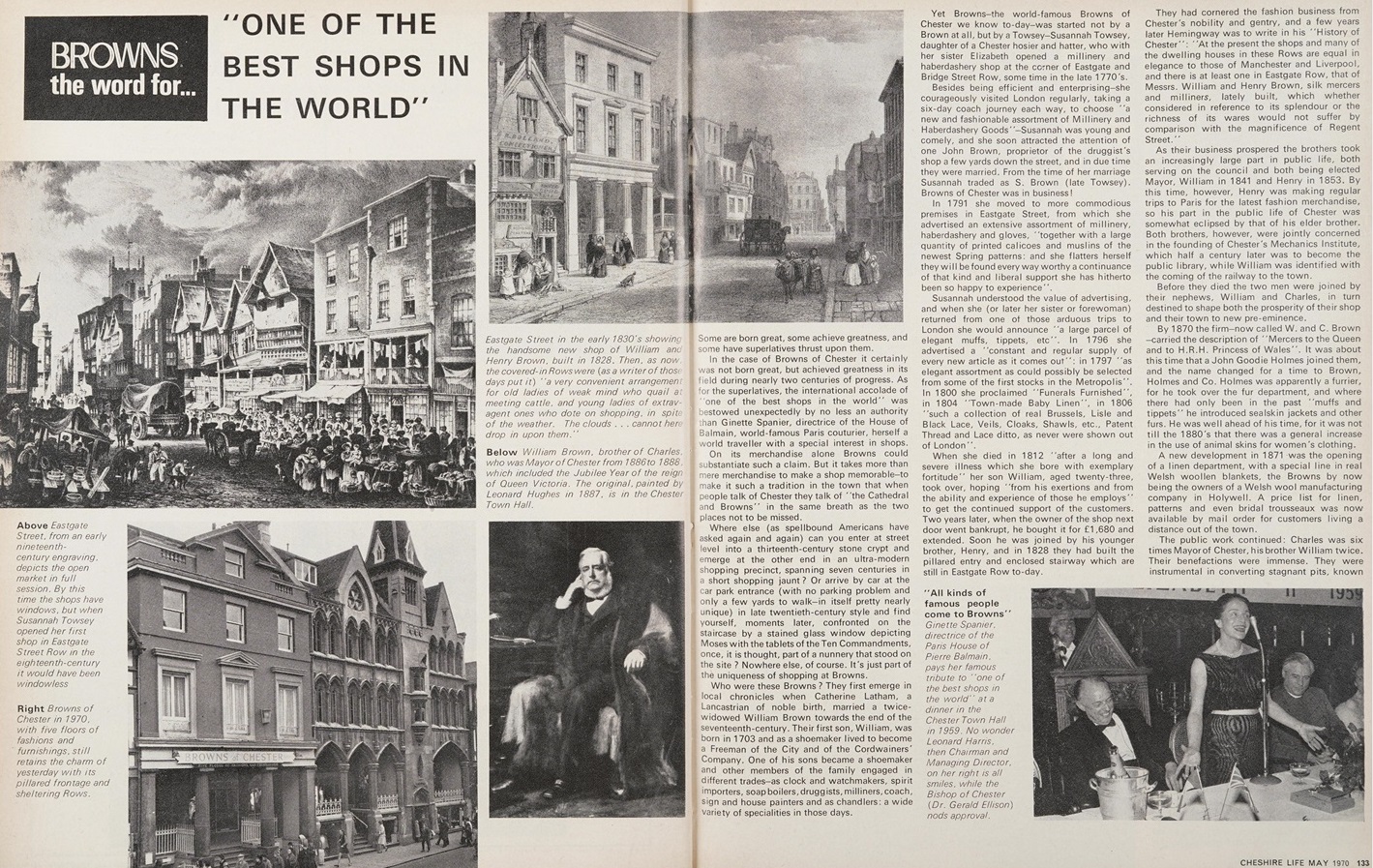
Browns of Chester feature. This celebration of Browns of Chester from May 1970 introduced a multi-paged advertising feature showcasing the range of products available to customers at the tail-end of the post-war consumer boom (see gallery for some examples). Dubbed “one of the best shops in the world” by the director of Paris’s House of Balmain, Ginette Spanier, the legendary store - established in 1780 on Eastgate Street - was also known as the “Harrods of the North” and sadly, finally closed its doors in 2021.
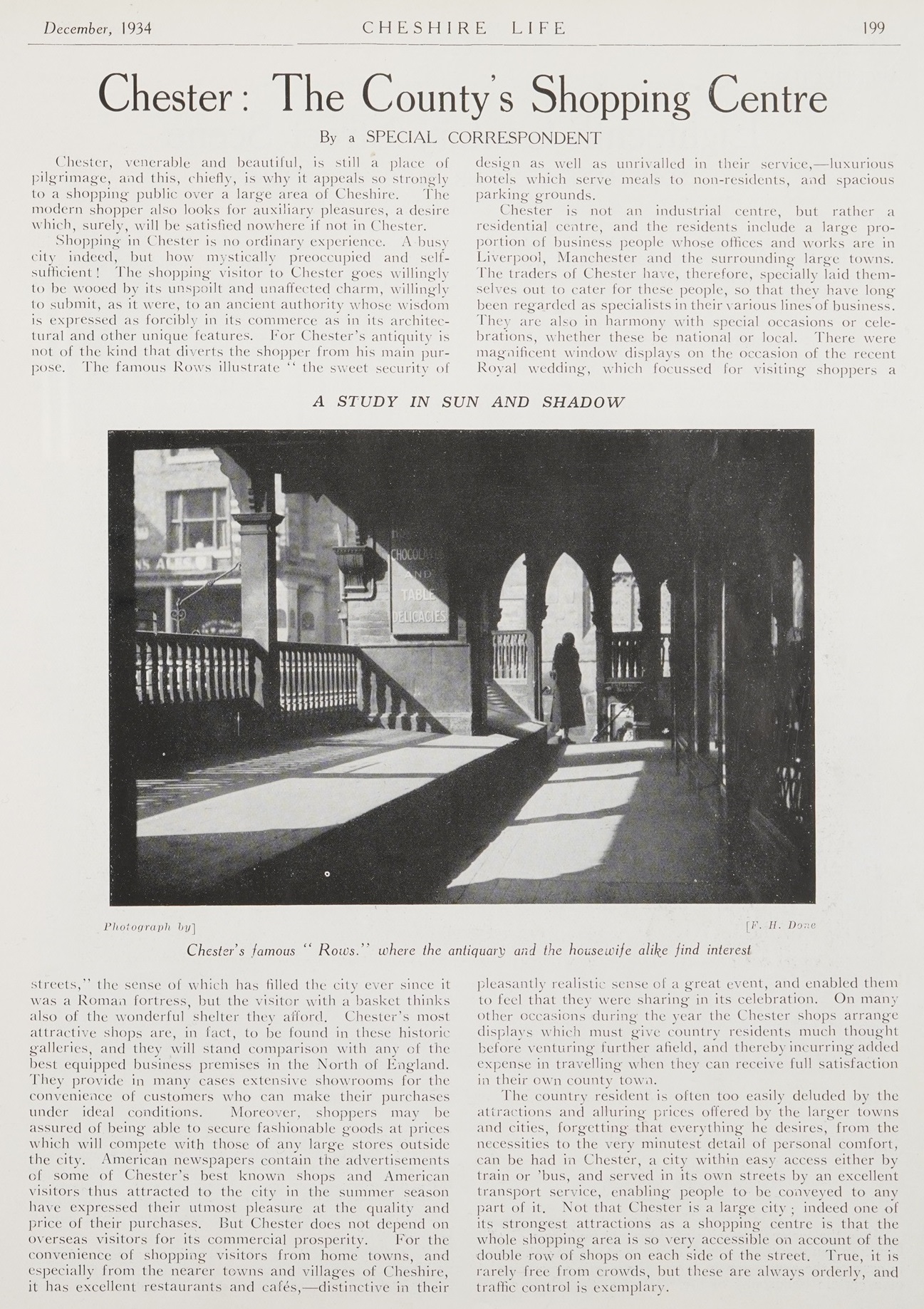
Chester: The county’s shopping centre. “Chester, venerable and beautiful, is still a place of pilgrimage, and this, chiefly, is why it appeals so strongly to a shopping public over a large area of Cheshire.” The opening sentence of this homage to Chester’s shopping experience in the December 1934 issue of Cheshire Life is typical of the way the city centre has been promoted over the decades. The rather flowery and archaic language is complemented by the moody film noir style photograph of The Rows – ‘A Study in Sun and Shadow’ – where, according to the caption “the antiquary and the housewife alike find interest”. The feature typically represents the city as straddling both tradition (Roman heritage) and modernity (shops and eating places). It is also characterised by its accessibility and its contrast with the larger, neighbouring industrial cities such as Manchester and Liverpool.
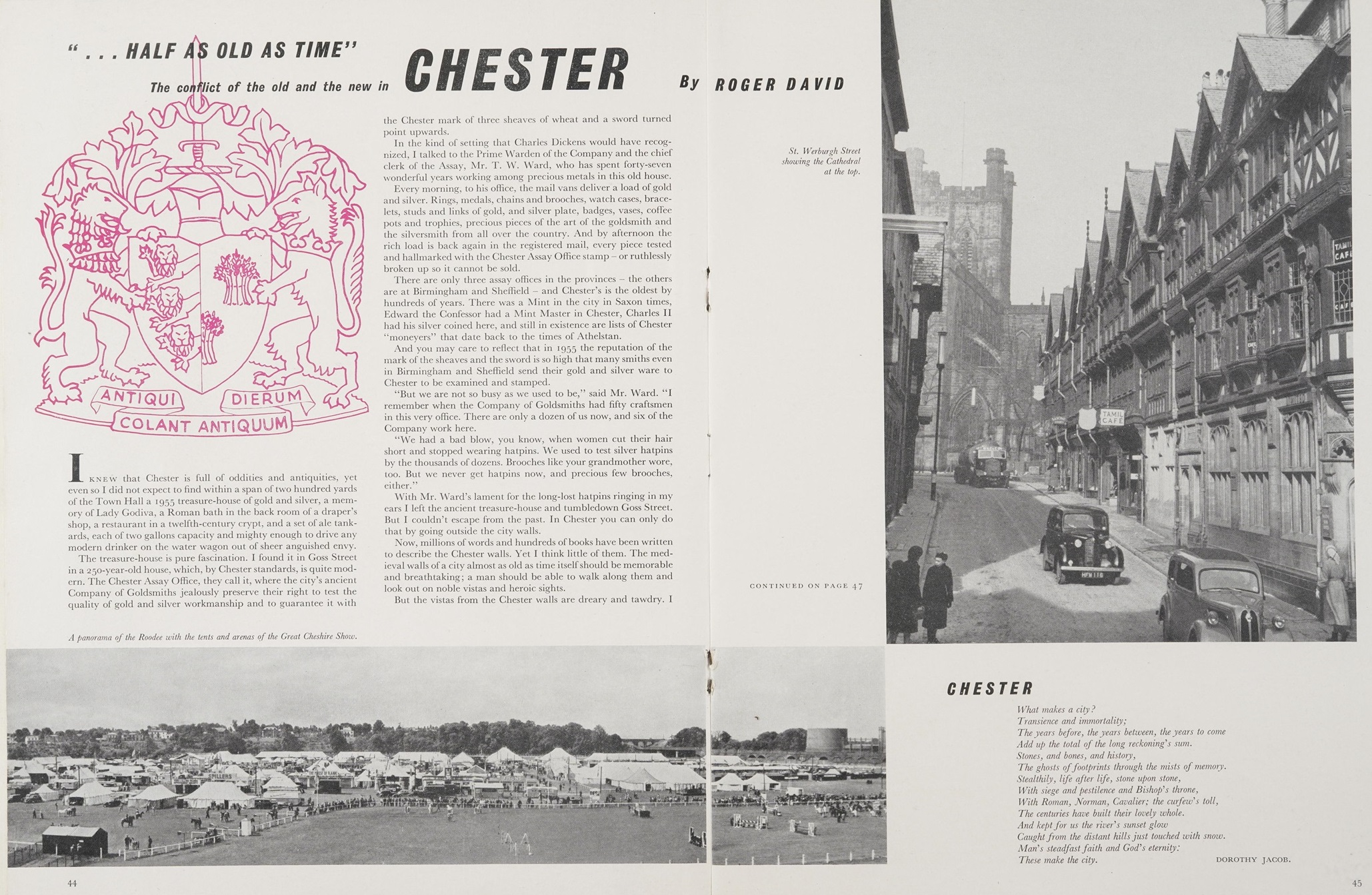
Chester - Conflict of the old and new (April 1955). This five-page appraisal of Chester written by Roger David features some stunning photographs of The Rows, The Roodee, The Walls and parts of the city centre. However, his elegant prose presents a balanced view of the “conflict between the old and the new”. Clearly determined to avoid the cliched style of the standard tourist brochure, David’s honest appraisal of his travels around the city is refreshing, in a publication which largely exudes uncritical positivity about county life.
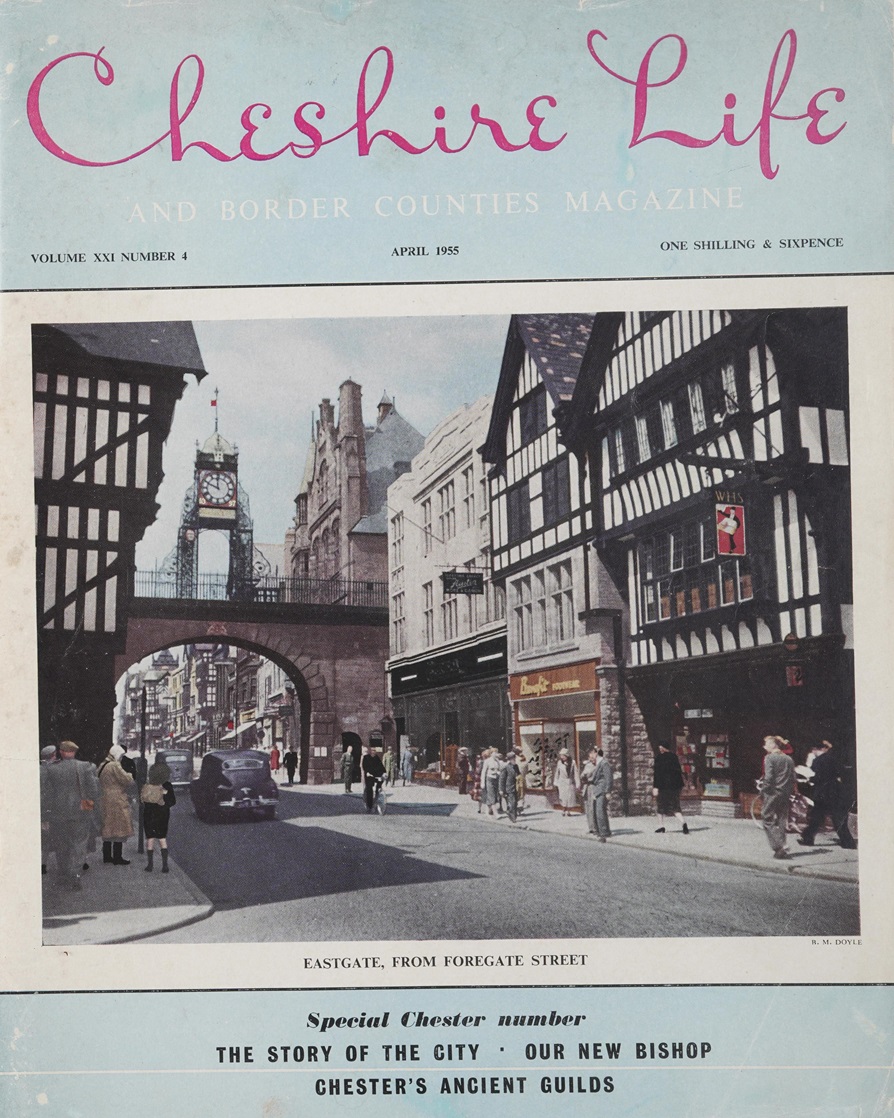
April 1955 cover – special edition. This special edition on Chester from April 1955, just about to celebrate its 21st anniversary, featured a classic view of the Eastgate Clock as viewed from Foregate Street. The inside pages included a report on the Chester River Race, and features on the new Lord Bishop of Chester - the Right Reverend Gerald Alexander Ellison, Chester, ancient guilds and the ‘freemen of the city’, and a contemporary evaluation of the city which pulls no punches (see ‘Conflict of the old and the new’).
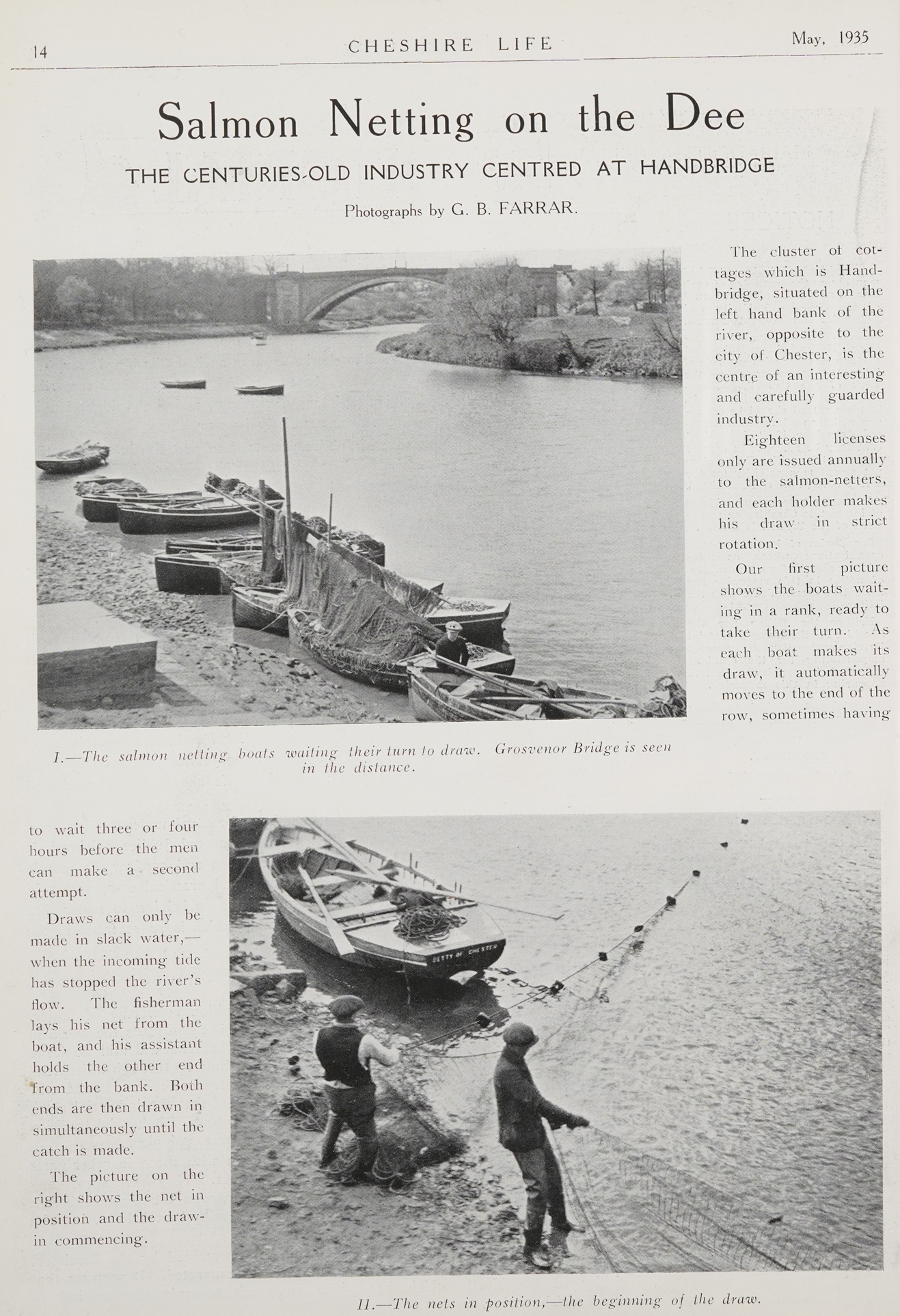
Salmon netting on the Dee at Handbridge. An image-based article from May 1935 featuring photographs from a centuries-old “carefully guarded industry”. At the time of writing only 18 licences were issued annually to the salmon netters with each holder making their draw in strict rotation. The first image shows the boats waiting in rank, ready to take their turn.
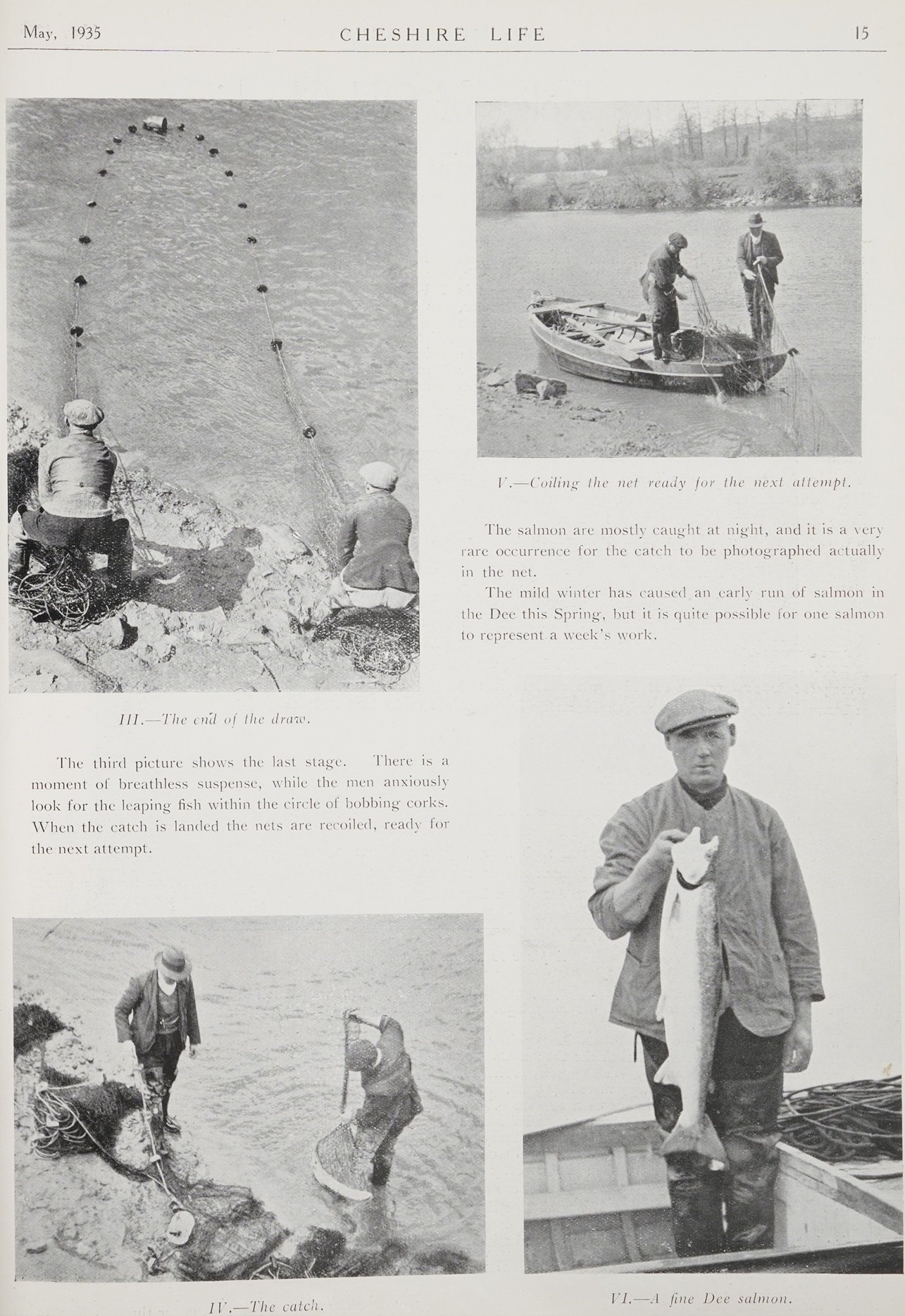
Salmon netting on the Dee at Handbridge. Picture III – “The end of the draw” – is described as follows: “There is a moment of breathless suspense, while the men anxiously look for the leaping fish within the circle of bobbing corks. When the catch is landed the nets are recoiled, ready for the next attempt”.