Carbon, Energy and Water

The University is committed to reducing its energy usage, improve efficiency, and identify buildings and sites to decarbonise to minimise its environmental impact and associated carbon emissions.
All our learning sites demonstrate our commitment to sustainability and serve as test beds for innovative solutions, where researchers can monitor impact before expanding across the wider estate. They show how we can:
- Operate more efficiently.
- Minimise our impact on the environment.
- Promote low-carbon lifestyles.
- Move towards a closed-loop system
Carbon and energy
The University is committed to reducing its carbon emissions in line with the United Nations Paris Agreement, which aims to keep the increase in global average temperature to well below 2 degrees Celsius of pre-industrial levels and pursue efforts to limit the increase to 1.5 degrees Celsius.
As part of its commitment, the University of Chester aims to:
- Achieve net zero for Scope 1 and 2 emissions across all its activities and operations by 2030.
- Determine its Scope 3 emissions baseline and set targets for reduction.
We have:
-
Reduced our Scope 1 and 2 emissions by 64% compared to our 2015 carbon footprint.
-
Installed over 1,700 solar photovoltaic panels across 23 University buildings.
-
Replaced ageing, inefficient heating systems with electric heating systems.
-
Replaced half of our petrol/diesel vehicle fleet with electric vehicles.
-
Since 2021, the University has delivered Carbon Literacy training to empower and support its students and staff in contributing to its Net Zero ambitions. This sustained commitment to embedding climate education and action across the institution has been recognised with Bronze Carbon Literate Educator (CLE) status.
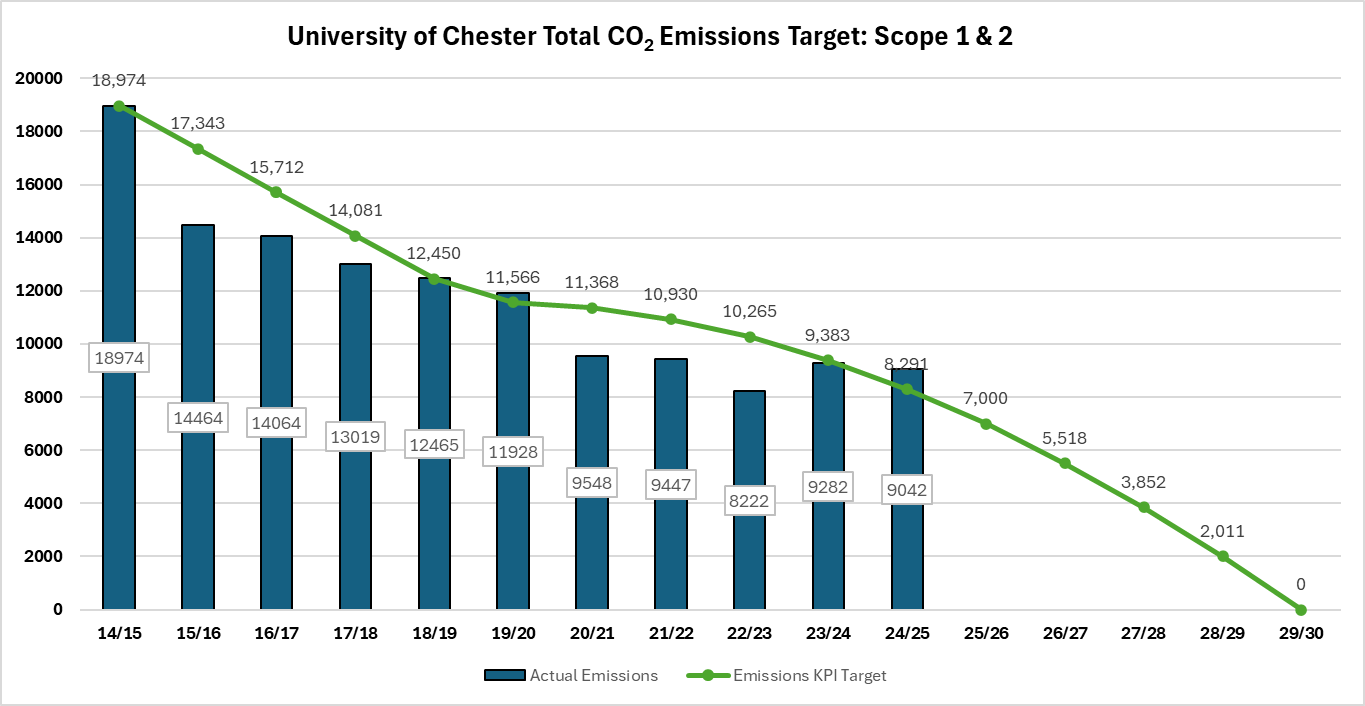
As a significant step towards delivering on its ambitious Net Zero target, the University has begun a large-scale decarbonisation scheme at two of our campuses in Chester city centre. Funded by a Public Sector Decarbonisation Scheme (PSDS) grant, the University is implementing a £5 million scheme to reduce emissions from its Queen’s Park and Wheeler sites. The project includes replacement of end-of-life gas boilers with Air Source Heat Pumps, installation of rooftop solar panels, draught-proofing measures and improvements to heating and cooling controls which aims to reduce the University's carbon emissions by an estimated 400tCO2 per annum. This ongoing project will be completed in early 2028 and significantly reduce our fossil fuel use.
The University is involved in several key networks related to clean energy in the North West. For example, as part of the Warrington Climate Emergency Commission, the University contributes to leading the local conversation on sustainability across the borough. Research-active academic staff engage in research and knowledge exchange activities that inform teaching and contribute to regional, national and international action. A student example of relevant research relates to a PhD student, funded via the HyNet Deployment project, who recently completed her thesis on enhancing local socioeconomics to deliver industrial decarbonisation.
The University’s Business School has led three major industrial decarbonisation studies, including a study on the skills needed for the industrial decarbonisation supply chain, which has influenced national government thinking. Most recently, the Business School has assimilated work on skills, workforce and EDI, funded via the Industrial Decarbonisation Research and Innovation Centre (IDRIC) to produce one of a series of Frontier Reports.
Water is essential for all life on Earth and covers about 71% of the planet’s surface. Globally, water is a valuable and precious resource that is needed for drinking and agriculture. Wasting water can also have negative impacts on local areas, and while not all catchments in the Dee Valley Water area experience water quality issues, everyone should still be encouraged to use water responsibly.
In 2024/25, the University used 111,505 m3 of water, equating to 21.331 tonnes of CO2e. To reduce water usage and improve the metering and monitoring of water consumption across the estate, we:
- Reduce water consumption by installing low-flow taps, efficient sanitary fittings, and water-saving technologies.
- Work with our water suppliers to identify opportunities for reducing consumption and wastage.
- Advise staff and students to report leaks or dripping taps to the Facilities Helpdesk to minimise unnecessary wastage.
- Record monthly meter readings and monitor consumption across our sites to ensure accuracy and quickly identify potential leaks.
- Implement systems for reuse, recycling, and conserving water in our landscaping, including rainwater harvesting.
- Capture rainwater at our Community Hub Garden with four watering cans attached to the greenhouse gutters and a waterbutt, which collects up to 210 litres of rainfall at a time.
- Promote engagement with training opportunities, such as Water Wise’s Water 2025/26 Literacy programme on water use and conservation.
- Over 30 water refill points have been installed across all learning sites, including outdoors near sports facilities, reducing the number of plastic bottles consumed on site.
- Kindly provided by Cheshire Wildlife Trust, the University installed 3 rain beds at its Exton Park site in 2025.
Christmas Switch-Off Campaign
The University’s annual Christmas Switch-Off campaign encourages staff and students to turn off appliances and turn down heating before the Christmas closure period. Through targeted communications and on-campus engagement, including promotion at the University’s Frost Fair, the campaign aims to cut energy consumption, reduce carbon emissions, and lower operational costs during a time of reduced occupancy.
In 2025/26, several of our larger buildings achieved electricity reductions of up to 30% compared to November usage levels, demonstrating the collective impact of small behavioural changes.
Building on this success, we are working to further optimise performance by:
- Enhancing our understanding of building energy management systems (BEMS)
- Strengthening targeted communications
- Collaborating with the Energy, Emissions and Water Action Group to drive continued improvement
Digital Clean Up
Launched as a pilot in 2026, the Digital Clean-Up campaign focuses on reducing the University’s digital carbon footprint by encouraging the removal of redundant data stored across onsite and cloud storage.
Although often overlooked, digital storage has a real environmental impact, requiring energy to store, process, and maintain data. Working in partnership with Learning and Information Services (LIS), we supported staff and students to identify and delete unnecessary files, including:
- Outdated documents and spreadsheets
- Old email attachments
- Unused OneDrive content
- Redundant project folders and recorded meetings
The campaign included a coordinated communications programme and on-campus pop-up support stations at Exton, Queen’s Park, Wheeler, Kingsway, and Marriss House, where students and staff could receive guidance.
Key outcomes from the pilot:
- 1 terabyte of data removed in a single day.
- Increased awareness of the environmental impact of digital storage.
The University currently holds approximately 300 terabytes of data, and we are working towards a long-term ambition to significantly reduce this footprint. We will build on the pilot’s success by improving engagement, refining our delivery approach, and strengthening communications to maximise impact in future campaigns.
Water Saving Week
Each year, Water Saving Week brings together the Sustainability Team and our Action Groups to highlight the importance of responsible water use and the role of individuals in conserving this vital resource.
Through a programme of communications and activities, the campaign explores:
- Global and local water scarcity.
- Domestic water use and practical conservation measures.
- The importance of wetland ecosystems.
- The role of water in supporting biodiversity.
Students and staff are encouraged to make simple, actionable pledges to reduce their water consumption, helping to embed sustainable habits across our community. The 2026 theme, “Protecting Water for Wildlife”, focused on the impact of water consumption on aquatic and semi-aquatic ecosystems, highlighting how reduced water availability can affect habitats and the species that depend on them. By the end of the week, participants reported a greater understanding of both the environmental value of water and the actions needed to protect it.