Rights Retention
This page provides guidance on Rights Retention and the University of Chester's Rights Retention Policy.
Rights Retention: an introduction
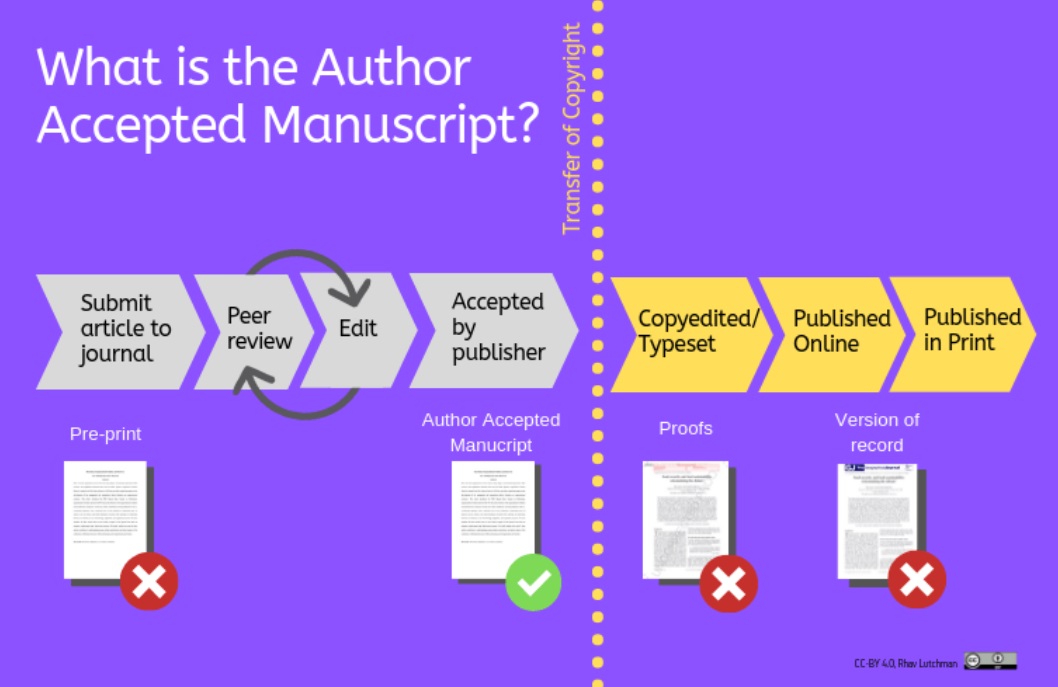
Rights Retention is a mechanism for authors to retain rights to the Author Accepted Manuscript (AAM) of their work. It facilitates Green Open Access (OA) publishing, which involves depositing an AAM to a repository and making it openly available there. For a more detailed explanation, see the Open Access page.
When authors publish in a hybrid/subscription journal and elect not to publish Gold Open Access (OA) (see the Open Access page for a definition), they may be asked to transfer some or all rights to the publisher. This subsequently gives the publisher (and not the author) control over how the work is shared and reused.
Rights Retention solves this problem by empowering authors to share and reuse their AAMs as they see fit. Even though the publisher will still own the rights to the final published version, they will not be able to impose restrictions on the AAM.
University of Chester Rights Retention Policy: key points
- The University of Chester Rights Retention Policy enables University authors (members of staff) to make the AAMs of their journal articles and conference papers with an ISSN (i.e. those published in journal proceedings) openly available immediately on publication under a Creative Commons Attribution licence (CC BY).
- Pursuant to the University of Chester Code of Practice for Research, the University permits staff to retain copyright in all scholarly works produced whilst under a contract of employment. In exchange, staff grant the University a non-exclusive, irrevocable, worldwide, royalty-free licence to make their AAMs available under a CC BY licence.
- The CC BY licence granted to the University is known as a 'prior licence' and takes precedence over any subsequent assignments or licences of copyright in the AAM.
- The University's LIS Research Support team have given official notice to a list of frequently used publishers. As further notice, authors are encouraged to include the following Rights Retention statement in the acknowledgements section of their manuscript and cover letter:
"For the purpose of open access, the author has applied a Creative Commons Attribution (CC BY) licence to any Author Accepted Manuscript version arising from this submission." - Authors should deposit their AAM as normal either on acceptance or no later than 10 weeks following acceptance as per the University's deposit mandate.
- LIS Research Support will make the AAM openly available on first publication (usually the online publication date).
Why are we introducing the Rights Retention Policy?
The Rights Retention Policy has a number of key benefits. These include:
- Compliance with all existing OA policies when publishing Green OA - major funders, such as the UKRI, stipulate that journal articles and conference papers with an ISSN (journal proceedings) must be openly available immediately under a CC BY licence. Authors no longer need to worry about embargoes on repositories and not complying with policy requirements when opting for Green OA.
- More cost-effective, sustainable and equitable open publishing - the AAM can be deposited and made openly available on a repository without the need to pay a fee. This means that you do not need to receive funding to publish openly.
- Greater publishing autonomy - an author is no longer limited to journals covered by the University's Transformative Agreements with publishers and can publish in a wider range of hybrid/subscription journals without risking non-compliance with OA requirements.
- Increased impact (and potentially citations!) - sharing work without delay under a CC BY licence allows for the widest possible dissemination whilst ensuring that the author receives full credit. This is why funders, such as the UKRI, mandate the use of this licence, as it ensures that publicly funded research can benefit as many people as possible.
What do you need to do?
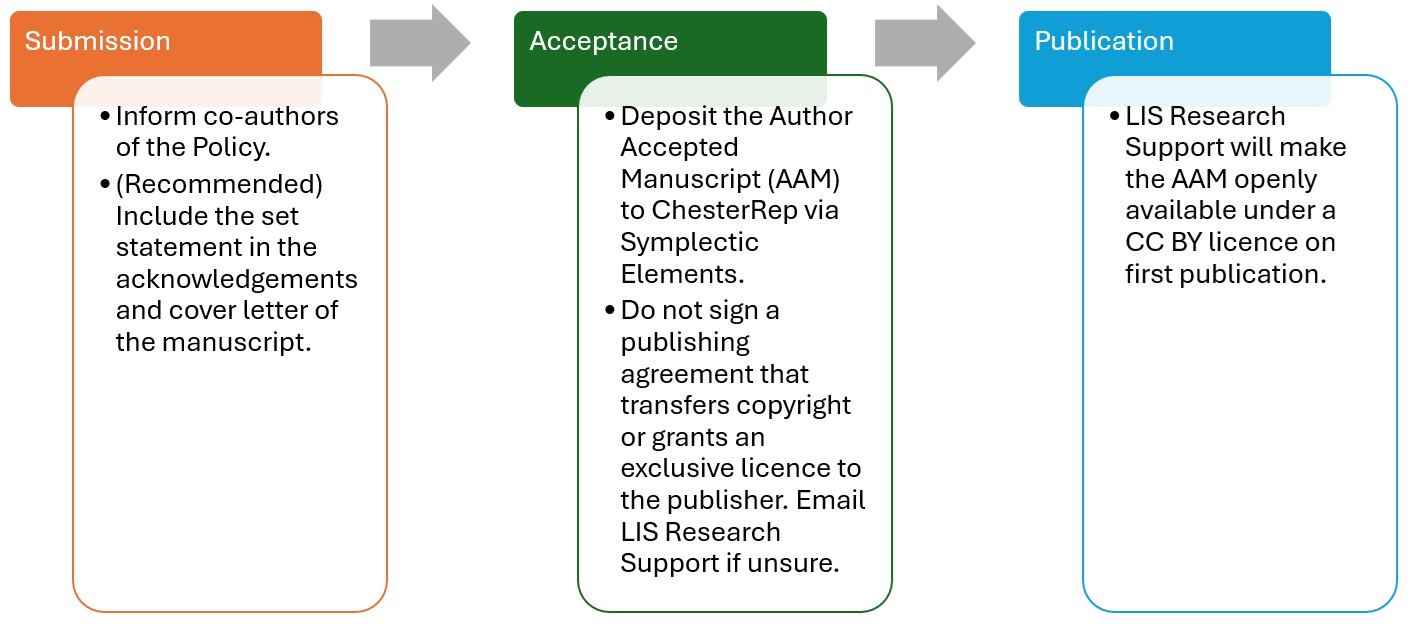
Fortunately, there is not much that authors need to do in addition to the usual steps taken in the publishing process. Below is an outline of what to consider at the submission, acceptance and publication stages.
On submission
- Inform co-authors of the University's Rights Retention Policy and the requirement to make the AAM openly available under a CC BY licence on publication. Potential wording for an email can be found in section 5 of the Policy document. If co-authors object to the Policy, opting out may be required. Contact LIS Research Support if this happens or complete the opt-out form.
- It is encouraged that you add the following set statement to the funding/acknowledgements section of your manuscript and cover letter:
"For the purpose of open access, the author has applied a Creative Commons Attribution (CC BY) licence to any Author Accepted Manuscript version arising from this submission."
Since the LIS Research Support team has notified various publishers, the inclusion of the set statement is not essential. However, you should consult the list of contacted publishers - if your publisher does not appear, we would advise you either to include the set statement or to contact LIS Research Support, and we will notify the publisher.
On acceptance
- Deposit the Author Accepted Manuscript (AAM) to ChesterRep via Symplectic Elements, ideally as soon as the publication has been accepted and no later than 10 weeks following acceptance.
- Where possible, avoid signing a publishing agreement that indicates the transfer of copyright. Contact LIS Research Support if you are unsure about the wording of a publishing agreement offered to you.
On publication
- LIS Research Support will make the document openly available on ChesterRep when the publication is first published (usually online).