



Mathematics with Finance students engaged in a university lecture, using laptops and digital tablets to analyse financial data and solve quantitative problems in a modern classroom.

BSc Mathematics with Finance at the University of Chester provides you with a unique opportunity of gaining a broad mathematical education while at the same time learning about finance. This combination of a comprehensive knowledge of the workings of financial markets underpinned by rigorous mathematical foundations will make you highly sought-after by employers.

Mathematics at the University of Chester is designed to provide you with in-demand skills such as logical reasoning, problem-solving ability, teamwork, and computational skills, all of which boost employability. Our academics have a diverse range of expertise and you will explore both pure and applied mathematics and also their computational aspects. The Finance modules are designed to equip you with the cutting-edge skills sought by the finance and accounting industries.  With a combination of mathematics with real-world finance experiences, you'll graduate fully prepared to step into a range of exciting career opportunities.

Small class sizes allow for personalised attention and regular feedback, creating a highly supportive learning environment for you. In the final year, you will have the opportunity to select projects from mathematical finance, with dedicated tutors providing regular one-to-one guidance. Our research-active lecturers deliver cutting-edge mathematical knowledge and are deeply committed to helping you thrive in your academic and professional journeys. In additional, several of our graduates have gone on to further study for Master’s or PhDs.


Why You'll Love It

Mathematics at the University of Chester

BSc (Hons) Mathematics

What You'll Study

In Year 1, you will be exposed to a diverse range of topics, laying a solid foundation to help your transition to being an undergraduate financial mathematician. This will include workshops on how to read, write and learn mathematics, equipping you for lifelong learning. You will learn topics including calculus, analysis, linear algebra, ordinary differential equations, probability, statistics and programming.

Core Modules

We introduce you to the foundational language and notation that is used throughout mathematics, including mathematical logic, set theory, proofs, number systems, functions, elementary number theory, symmetry groups etc. Through these diverse topics, you will gain a solid understanding of the foundational principles of mathematics, laying the groundwork for more advanced studies in the field. Our emphasis on logical reasoning and mathematical structures will equip you with the skills to construct rigorous mathematical arguments essential for all university-level mathematics.  We will also have a series of workshops focusing on how to write mathematics well, how to read and comprehend mathematics, and how to learn mathematics and use feedback effectively.  This will help you transition to becoming an university-level mathematician and are also critical transferable skills for future employment.

Topics may include:

  • Introduction to basic language, concepts, methods, and results in Mathematics, aiming to help students transition to university-level mathematics, including learning key independent and group study skills.
  • Exploration of mathematical language, logic, and methods of proof, including induction.
  • Elementary set theory.
  • Functions, including injective, surjective, and bijective functions, as well as inverses.
  • Operations, binary operations, equivalence relations and properties of algebraic structures.
  • Introduction to groups, permutation groups, and cyclic groups.
  • Elementary number theory: congruence, hcf and lcm, Euclidean algorithm, prime numbers, Fundamental Theorem of Arithmetic
  • Different types of infinity: countable and uncountable sets.

In modern life, probability, data and statistics are all around us. Computers allow us to collect ever-growing amounts of data right down to the fine details of our internet use and shopping habits. In order to make any sense of this, we need statistics to be able to analyse the data and look for hidden patterns and trends. Even so, many processes, from die rolls to the movement of the stock exchange are random and we need probability to understand them. The mathematical theory of chance and statistical inference underpins artificial intelligence and is indispensable to empirical deduction. This module introduces students to both the theoretical knowledge and applied skills required for understanding and interrogating data and modelling uncertainty in real-world scenarios.

Topics covered in this module include:

  • Introduction to a set-theoretic approach to probability

  • Combinatorics

  • Conditional probability, independence and Bayes' Theorem

  • Discrete and continuous random variables

  • Probability distributions, including expectation and variance

  • Introduction to commonly used distributions (e.g. Binomial, Poisson, Normal)

  • An introduction to joint probability distributions

  • Methods of data collection, including ethical considerations

  • Introduction to non-parametric and parametric hypothesis testing

  • Correlation and Regression

  • Forecasting and time-series

  • Confidence intervals and uncertainty in data

  • An introduction to machine learning and big data

  • Introduction to appropriate software tools for data analysis and interpretation

In this module you will have an introduction to both analysis and linear algebra.

Analysis

What is infinity? And how can we talk about a function 'tending to a limit'? Many problems in mathematics can't be solved exactly, but we can find a series of approximations tending to a true solution. However, our intuition can start to go very wrong in these cases as various pathological functions found in the 19th century illustrate. To make sense of this, we need rigorous definitions to enable us to definitively prove results; these can then be applied to accurately solve problems.

Analysis is the rigorous underpinnings and proof of calculus – differentiation and integration. In this module, we begin by laying the foundations for analysis by studying sequences and series. We then use this to explore functions and their continuity and differentiability.

Topics may include:

  • Basic properties of the real numbers.

  • Sequences and Series.

  • Introduction to real valued functions of one variable, including limits.

  • Continuous functions and their properties.

  • Continuous functions on closed interval: Boundedness Theorem, Extreme Value Theorem, Intermediate Value Theorem.

  • Differentiablility and properties of differentiable functions.

  • Rolle’s Theorem, Mean Value Theorem.

  • L’Hôpital's rule, Taylor’s Theorem.

Linear Algebra

Linear algebra is of fundamental importance throughout science, engineering and computing and it underpins almost all higher mathematics. Its real-world applications are extensive, encompassing error-correcting codes, noise and signal analysis, facial recognition, quantum computer algorithms, search engine ranking, computer game graphics and even providing you personalised suggestions on Netflix.

In this module, we adopt a dual approach, blending theoretical exploration with a computational and practical perspective on linear algebra. On the theoretical side, we will introduce the abstract notion of a vector space and explore linear transformations between them. We will use these theoretical results to tackle various computational questions ranging from solving systems of linear equations to utilising eigenspace structure for quick matrix computation.

Topics may include:

  • Introduction to vectors, Euclidean space and matrices.

  • Solving systems of linear equations using matrix techniques.

  • Matrices and elementary row operations.

  • Generalising Euclidean space over the real numbers to vector spaces over fields.

  • Linear dependence and independence, bases, dimension, subspaces.

  • Linear maps/transformations between vector spaces.

  • Kernel, Image and the Rank-Nullity theorem.

  • Matrix determinants and inverses.

  • Eigenvalues, eigenvectors and diagonalisation.

Differential equations play a pivotal role in modelling numerous mathematical, scientific and engineering problems, stretching across celestial motion dynamics, neuron interactions, cancer progression, bridge stability and financial market trends. This module serves as an introduction to the essential theory and numerical methods used in solving ordinary and partial differential equations (ODEs and PDEs) while exploring their varied applications.

In this module, we will review the essential calculus techniques, including methods of differentiation and integration, necessary to solve ODEs. We will introduce ODEs, see their applications to real-world problems and explore techniques for generating both exact and approximate solutions for ODEs. We will also give a brief introduction to PDEs and their applications.

Topics may include:

  • Review of trigonometric functions, hyperbolic functions, limits and differentiation.
  • Integration, techniques such as integration by parts, partial fractions, and multiple integration.
  • Review of sequences and series, covering convergence and divergence.
  • Exploration of complex numbers, covering axiomatic foundations, complex conjugates, loci, polar form, De Moivre's Theorem, and roots.
  • Notation and classification of ordinary differential equations.
  • Linear ODEs and their applications.
  • Selective exploration of non-linear ODEs and their applications.
  • Introduction to systems of ODEs.
  • Numerical integration: Trapezoidal Rule and Simpson’s Rule.
  • Numerical solutions for ODEs: Euler method, using computer code in, for example, MATLAB, or Python.
  • Partial differentiation, functions of two variables.
  • Brief introduction to PDEs and their applications.

Optional Modules

This module is designed with student's employability at the forefront, aiming to develop essential transferable skills which employers look for and value in Mathematics graduates.  Programming and computational techniques are all pervasive in today's society, from the next generation of quantum-secure algorithms allowing secure communication with your bank, to using mathematical computer simulations to model real-world phenomena.

The module is split into several different parts.  We will provide an in-depth introduction to algorithms and the process of translating these into computer programs, using state-of-the-art software tools, such as Python.  This will provide you with a solid foundational understanding to tackle any future computational and programming challenges.  You will develop important research and writing skills.  You will learn to use LaTeX, an industry-standard typesetting system for produce professional scientific documents.  Finally, we will also develop and practice key skills for gaining employment, such as CV building, interview techniques, and giving compelling and engaging presentations.

  • Comprehension and understanding of mathematical arguments.
  • How to write coherent mathematical arguments.
  • Introduction to mathematical and scientific typesetting with the LaTeX package and associated editors.
  • Incorporating graphs, figures, tables and bibliographic information in reports and articles, using LaTeX.
  • Referencing methodologies in the Mathematical Sciences.
  • Introduction to online search tools and searching the library catalogue.
  • Introduce algorithms and how to translate them into computer programs.
  • Introduce students to computer programming software, for example Python.
  • Learn about basic programming concepts including algorithms, loops, conditional statements and functions.  Also learn about more advanced scientific functions.
  • Introduction to numerical algorithms from a variety of mathematical areas.
  • Working & communicating as part of a scientific team.
  • Oral presentation design and delivery.
  • CV building, job applications and interview training.

Optional Language Modules

This module enables students with A-Level German or equivalent to further develop their grammar, vocabulary and expression and apply these to real world situations.You will work with written and recorded texts on a range of cultural, personal and social topics and will develop your oral and written communication skills at Post-A level.

This module is designed for students that have completed A-Level or equivalent in French. You will further develop your grammar, vocabulary and expression and apply these to real world situations. You will work with written and recorded texts on a range of cultural, personal and social topics and will develop your oral and written communication skills at Post-A level.

This module is designed for students that have completed a A-Level or equivalent in Spanish. You will further develop your grammar, vocabulary and expression and apply these to real world situations. You will work with written and recorded texts on a range of cultural, personal and social topics and will develop oral and written communication skills at Post-A level.

This module is designed for students who have completed GCSE in Chinese or equivalent. You will further develop your grammar, vocabulary and learning conventions for spelling and pronunciation. You will work with written and recorded texts on a range of cultural, personal and social topics and will develop oral and written communication skills at an intermediate level.

This module is designed for students who have completed GCSE or equivalent in French. You will further develop your grammar, vocabulary and learning conventions for spelling and pronunciation. You will work with written and recorded texts on a range of cultural, personal and social topics and will develop oral and written communication skills at an intermediate level.

This module is designed for students that have completed GCSE or equivalent in Spanish. You will further develop your grammar, vocabulary and learning conventions for spelling and pronunciation. You will work with written and recorded texts on a range of cultural, personal and social topics and will develop oral and written communication skills at an intermediate level.

This module provides the opportunity to study a new language from scratch and introduces you to basic grammar, vocabulary and cultural contexts. You will apply the language to practical situations using both oral and written skills. 

The information listed in this section is an overview of the academic content of the course that will take the form of either core or option modules and should be used as a guide. We review the content of our courses regularly, making changes where necessary to improve your experience and graduate prospects. If during a review process, course content is significantly changed, we will contact you to notify you of these changes if you receive an offer from us.

In Year 2, you will take two mathematics modules and two finance modules. You will explore key theoretical results from pure mathematics and important techniques in applied mathematics, which are highly valued in a variety of industries, such as linear programming and optimisations, and stochastic processes. You will also study topics from finance, such as data analysis, financial analytics, and investment and risk management. You will have the opportunity to put your skills into practice in a work-based learning module towards the end of this year.

Core Modules

Many optimisation problems in business and industry can be expressed in the form of a linear programming problem and this is even more apparent with increasing reliance on Artificial Intelligence and Machine Learning.  Businesses and industry use linear programming to determine what to make in order to maximise their profits, Amazon use it to schedule your parcels for delivery and it is also used widely in Game Theory: you can use it to beat your friends at rock-paper-scissors and other games!

In this module, we will study the theoretical background behind the linear programming methods, learn how to express real-world questions as linear programming problems and solve them by hand and using computer programs.  We will also explore some other optimisation methods used in AI and Machine Learning. Topics may include:

  • Canonical forms of linear programming problems.
  • Theoretical considerations: relevant results from set theory and geometry.
  • Integer linear programming.
  • Solutions of linear programming models: Simplex and dual simplex methods, Pivot algorithm, and computer-based techniques.
  • Degeneracy, cycling, duality.
  • Use of a mathematical computer software package, for example, Python, Matlab, Excel etc.
  • Application to logistics in transportation and assignment problems, VAM and the Hungarian algorithm.
  • Game theory: zero-sum matrix games, multi-phase games.
  • Non-linear optimisation techniques in Machine Learning

Stochastic processes serve as essential mathematical models for systems and phenomena exhibiting apparent randomness. Examples encompass diverse scenarios, such as the growth of a bacterial population, fluctuations in electrical current due to thermal noise, or the motion of gas molecules. The applications of stochastic processes span various disciplines, including biology, chemistry, ecology, neuroscience, physics, image processing, signal processing, and financial markets. In order to understand such random behaviour, we introduce and study Markov chains, random walks, Brownian motion and stochastic differential equations. Through these topics, students will not only establish a robust foundation in the principles of stochastic processes but will also gain valuable insights into their diverse applications across numerous domains. The module's goal is to equip students with analytical tools essential for comprehending and modelling complex uncertainties, thereby enhancing their capacity to address real-world challenges in mathematics, statistics, and related fields.

Topics covered include:

  • Brief review of Probability Theory via a Measure Theory approach.
  • Martingales: Basic definitions, filtrations, stopping times.
  • Doob's Martingale inequalities and Convergence Theorem.
  • Markov Chains.
  • Moment generating functions.
  • Characteristic functions.
  • Probability generating functions.

The intention of this module is to equip you with the key digital skills required to enhance the understanding of key concepts covered on this course. There will be special emphasis on the operationalisation of the concepts at the work environment, that is, how can technology be used to efficiently implement and enhance the level of productivity of the organisation. The operationalisation agenda required to be actioned from the perspective of the finance manager in using key technologies will the direction of the module. The expectation is that you will develop a broad and holistic understanding of the finance functions in the digital world. You will familiarise yourself with how technologies links various operations of the business activities of an organisation to enhance its value creation.
The module will also cover sustainability concepts and data ethics, focusing on responsible data use, regulatory protections, and ethical impacts of technology in finance. Through these areas, you will gain a broad and practical understanding of how digital tools, sustainability, and ethical thinking combine to enhance value creation in modern finance.

To achieve the intentions of the module, the following indicative contents will covered:

  • Data analytics (sources of data, descriptive analytics, predictive analytics and prescriptive analytics)
  • Data visualisation techniques.
  • Accounting software and information systems.
  • Artificial intelligence and automation.
  • Emerging technologies within accounting and finance
  • Cybersecurity within accounting, finance and banking
  • Ms Excel for accounting and finance (Analysis ToolPak and Solver, Pivot Tables-including Power Pivot and Power Query, logical functions - lookups, text functions and financial maths with Ms Excel)
  • Decision trees and experimentation
  • Sustainability and UN SDGs
  • Three pillars of sustainability 
  • Regulation and organisational roles in sustainability 
  • Data ethics and responsible technology use

The coverage of the above contents will provide a certain degree of mastery in the handling of technologies you require to become a competitive graduate. The value associated with the use of technology to implement key concepts within the accounting, finance and banking courses is immeasurable. For example, the provision of an experiential learning environment will enhance your employability skills thus making you a competitive graduate. 

This module aims to gain understating of credit risk and sustainability in the banking context. It includes understanding of financial difficulties for customers and clients leading to collections and recoveries and losses, and demonstrates the importance of policies and procedures and the PRA requirements on capital adequacy and liquidity for banks. It also covers the growing importance of the societal purpose and practices of sustainability in the banking industry including description of how the types of sustainability today change the way we operate in banking and identifying the key performances indicators in banking that reflect sustainability.

Students will be able to achieve the following learning outcomes by the end of this module:-

1. Understand how credit arrears are formed and the wider impact on the profit and loss account
2. Critically evaluate the regulatory framework within the banking sector and understand how losses, capital adequacy and liquidity have been determined to ensure compliance with PRA regulations.
3. Understand the importance of sustainability in banking including culture, conduct and ethics. 
4. Analyse the relationships between businesses and stakeholders with regards to sustainable practice
5. Interpret the principles and types of sustainability and assess how sustainability is measured within banking organisations.

Indictive contents:-

  • Financial analysis of credit losses.
  • Understanding arrears and losses.
  • Collections and recoveries practices.
  • Policies and procedures.
  • Financial conduct authority policies and regulations in banking and finance including PRA, capital adequacy and stress testing.
  • Why sustainable finance, ethics and conduct are important in banking.
  • Business and its stakeholders.
  • Principles of sustainability.
  • The types of sustainability (human, social, economic, environmental).
  • Finance practices and KPIs reflecting sustainability.
  • Industry case studies.

Optional Modules

This module provides a structured, university-level work placement for 4, 5 or 7 weeks (optional timeframe decided on a 1 2 1 basis) as one continuous block / period with a placement provider (i.e. industry apprioprate sector). It is designed to enhance your professional skills in a real-world job setting.

The placement can either be organised by you or with support from university staff.

All work placements within this module must be university-level; this means:

  • Undertaking high-skilled work commensurate with level 5 study (e.g. report writing, attending meetings, delivering presentations, producing spreadsheets, writing content on webpages, social media, marketing services/products etc)
  • Physically placed (albeit part of it can be hybrid) within an employer setting in one continuous block / period for 4, 5 or 7 weeks for a minimum of 140-147 hours over the course of the entire work placement

Where applicable, your existing part-time employer can be approached/used as the placement provider, if the high-skilled work.

  • criterion above is fulfilled for the full duration of the placement.
  • All quality assurances/agreements provided by the University are adhered to, by you and the employer.

The work placement context may not necessarily, reflect your degree discipline per se, but rather, it will give you an enriched experience to enhance your professional skills in a real-world job setting.

This is an experiential learning opportunity that incorporates 35 teaching contact hours/lectures to prepare for the 150 contract hours. L5 students can use all their skills learned to date on an actual real-world (external business) client-driven project, working in teams and producing an artefact. 

You are also expected to undertake around 215 hours of self-study.

This module not only gives them enhanced skills but the opportunity to work for a real client thus giving them a valuable CV and LInkedIn entry as work experience that can contribute to their employability portfolio. 

You will collaborate in teams and produce full client documentation alongside a reflection of their expereince and this all give some much needed contemplation of their skills to date and how to use them. 

Optional Language Modules

The module will provide the opportunity to further develop your language skills, building on your previous learning at advanced level. The second half of the module includes a placement abroad or, alternatively, a project on a sustainability issue in a target language country. The first half of the module will prepare you for placements abroad where appropriate as well as a deeper understanding of sustainability in target language contexts. Students of more than one language may take one language in the first half of the module and spend their time abroad developing a different language. 

The module will provide the opportunity to further develop your language skills, building on your previous learning at intermediate level. The first half of the module includes intensive taught sessions in interactive workshop mode which will prepare you for placements abroad or self-directed language development. The second half of the module includes an placement abroad or, alternatively, a project on a business or tourism issue in a target language country. Students of more than one language may take one language in the first half of the module and spend their time abroad developing a different language. 

The module will provide the opportunity to further develop your language skills, building on your previous learning at beginner level. The first half of the module includes intensive taught sessions in interactive workshop mode which will prepare you for placements abroad or self-directed language development. The second half of the module includes a placement abroad or, alternatively, a project on a cultural issue in a target language country. Students of more than one language may take one language in the first half of the module and spend their time abroad developing a different language. 

  • The multiple facets of global citizenship
  • Ethical engagement and practice
  • The United Nations Sustainable Development Goals
  • Cross-cultural issues and sensitivity
  • Intercultural communication
  • Culture shock
  • Cultural adjustment
  • Self- assessment of needs: identification of the range of transferable skills, competencies and attitudes employees need and employers expect graduates to possess-with a strong focus on understanding the intercultural competencies (ICC) needed to live and work abroad.
  • Critical analysis/evaluation of individual requirements in relation to culture/cultural adjustment/culture shock/visas/medical.
  • Critical analysis/evaluation of skills already acquired in relation to key skills related to ICC.
  • Devising strategies to improve one’s own prospects of working abroad in the future.
  • Devising an action plan to address gaps in transferable skills based on organisational analysis and sector opportunities.

Part A:      

Preparation for Experiential Overseas Learning will take place at the University of Chester during level 5 and will include:  

  • The multiple facets of Global citizenship
  • Ethical engagement and practice
  • Cross-cultural issues and sensitivity
  • Intercultural communication

Theories, models and strategies of learning

  • Theories and models Intercultural competence
  • Theories and models of Integration and Multiculturalism
  • Critical thinking skills and models of Reflection
  • Experiential learning models
  • Self-directed experiential learning

Personal and placement-related skills

  • Enhanced independence
  • Improved command of multicultural behaviour
  • Increased knowledge and confidence in their individual facets of personal identity
  • Effective time management and organisational skills
  • Project management – working away from University and independent study
  • Self-management and personal development
  • Team building and team work

Part B:            Overseas

Students will engage in experiential learning activities overseas for at least 150 hours 

Optional Placement Year

Year in Industry placement year for computing students. 

This is a placement module where students acquire a 1 year paid work placement related to their area of study.

Full attendance at the work placement and University-scheduled events is mandatory.

The placement hours stated for this module are only the minimum required hours for this module, it is likely most placements will last for 9 months - 12 months and exceed the minimum 1,180 placements hours.

The traditional academic programme structure is not applicable. The placement content is freely structured and determined by negotiation between the student, placement supervisor and host organisation. It is generally informed by the aims and learning outcomes and by the objective of optimising added value for both the host organisation and the student experience

Optional International Placement Year

Preparation for the year abroad will take place in Chester during level 5 and will include:

  • Cross-cultural issues and sensitivity
  • Host-country orientation, study methods– economic, political and social reality of the country
  • Orientation specific to exchange – health, education, gender issues
  • The United Nations Sustainable Development Goals
  • Practical matters relating to living and studying in the wider world

Theories, models and strategies of learning

  • Critical thinking skills, experiential learning and models of reflection

Personal and placement-related transversal skills

  • Effective self-motivation and independent resourcefulness
  • Effective time management and organisational skills
  • Project management – working away from University and independent study
  • Self-management and personal development

Whilst abroad:

You will undertake study at one of the University of Chester's partner universities or undertake and approved work placement or virtual placement. If you are a student,  it is expected that you will choose a series of modules at the university abroad which must be agreed by the host institution and the Module Leader. you must supply details of you modules on a learning agreement within 4 weeks of arrival at the host university.

The information listed in this section is an overview of the academic content of the course that will take the form of either core or option modules and should be used as a guide. We review the content of our courses regularly, making changes where necessary to improve your experience and graduate prospects. If during a review process, course content is significantly changed, we will contact you to notify you of these changes if you receive an offer from us.

In Year 3, you will study two modules from mathematics and two from finance. The maths topics will relate to the research interests of academic staff in the mathematics group, which are closely linked to real-world applications, such as numerical analysis and partial differential equations. You will also have the chance to explore more advanced topics in finance, such as big data, machine learning for finance, and actuarial science. In your final year project, you will have the chance to direct your own learning and explore a topic which could have real-word impact and which you are personally interested in and passionate about. You will be supervised and guided in this by an experienced and dedicated research-active academic.

Core Modules

Quality Control is an important application of statistical theory and methods. Since the industrial revolution, factories have needed to find ways to manufacture high quality products while minimising cost to maintain a competitive edge. From monitoring an automotive production line to stop out-of-control processes, to sampling techniques in the food production industries designed to minimise food waste, quality control procedures form a key part of the modern manufacturing process.


In this module you will learn the techniques companies employ to achieve the above. Topics for this module may include:

  • Introduction to quality control: summary of relevant probability theory and probability distributions.
  • Methods and philosophy of statistical process control.
  • Control charts for variables: mean, median and range charts, special charts.
  • Control charts for attributes: p-charts, np-charts, u-charts, c-charts.
  • Process capability studies.
  • Acceptance control charts.
  • Acceptance sampling: single, double, and sequential sampling plans, rectifying inspections.
  • Modified control limits.
  • Cumulative sum techniques: CUSUM Charts, V-Masks, Tabular CUSUM.

Numerical analysis is the exploration of algorithms that rely on numerical approximation; this is invaluable for the study of many complicated problems, where an exact solution is very difficult, or even impossible to obtain.  Its applications extend across mathematics, physical sciences and engineering, and, in the 21st century, have expanded into life sciences, social sciences, medicine, business, and even the arts.  This module serves as an introduction to the fundamental techniques and methodologies for solving mathematical problems using numerical methods and equips students with the skills needed to analyse, design, and implement numerical algorithms effectively across a broad range of mathematical problems.

The topics include:

  • Solving nonlinear equations, finding roots, Newton iteration and related methods.
  • Introduction to optimisation, optimisation of functions of several variables, with and without constraints.
  • Interpolation and approximations: Lagrange interpolation, Hermite interpolations,
  • Numerical integration and differentiation: Trapezoidal method, Simpson method.
  • Solutions of ordinary differential equations: Euler method, Runge-Kutta method, multistep methods, stability, convergence.
  • Solution techniques for partial differential equations including the heat equation.
  • Implementation and programming, e.g., Python, MATLAB.
  • Error analysis: developing an understanding of the sources of error in numerical computations and methods for analysing and controlling numerical errors.

The aim of this module is to examine strategic finance issues faced by multinational companies from an international perspective. It focuses on how these companies operate within the global financial environment. Students will learn to identify and analyze the various forms and sources of business risks that multinational companies encounter.

Specifically, the module aims to:

1. To enable students to critically evaluate the international financial environment of a multinational corporation, including financial institutions, financial markets and exchange rate systems.

2. To critically examine and evaluate the principal concepts in the theory and practice of international financial management.

3. To analyse, apply and evaluate financial strategies through application of relevant analytical tools to examine and assess major issues and developments in international financial management.

4. To provide a critical understanding of the principles of risk exposures and the management of its international financial operations

On successful completion of this module students should be able to:

1. Analyse the environment in which international financial management is undertaken and discuss the structure of a MNC.

2. Critically assess the operations of the currency and derivatives markets and theories of exchange rate determination.

3. Define, assess and apply techniques and methods to evaluate and manage exposures and risks deriving from international business.

4. Apply the principal concepts, theories and appropriate tools in international financial management and reflect upon contemporary thinking to analyse and evaluate the international financial strategies of organisations, capital structure and financing of MNCs.

5. Assess a wide body of empirical research literature on contemporary issues relating to international financial management and critically appraise it. 

The module aims to develop students' ability to apply financial models and related advanced analytical techniques to inform business decisions and to evaluate possible decision outcomes in a competitive business environment.

This module will include topics such as, but not limited to:

  • Principles of business and financial planning
  • Introduction to financial modelling for business finance
  • Techniques of quantitative and qualitative financial analysis
  • Decision Making under risk and uncertainty
  • Analysing and interpreting the financial performance

The project is an opportunity for you to explore deeply an area of mathematics of your choice.  This may be a topic not already covered in the degree, or you may explore in more depth a topic covered before.

You will engage with mathematical literature, seeking out material and learning for yourself, supported by regular meetings with your project supervisor.  You will develop skills of self-discipline and project management, and study the art of mathematical writing and communication.

You will negotiate with tutors the precise title and objectives for the project.

The information listed in this section is an overview of the academic content of the course that will take the form of either core or option modules and should be used as a guide. We review the content of our courses regularly, making changes where necessary to improve your experience and graduate prospects. If during a review process, course content is significantly changed, we will contact you to notify you of these changes if you receive an offer from us.

How You'll Learn

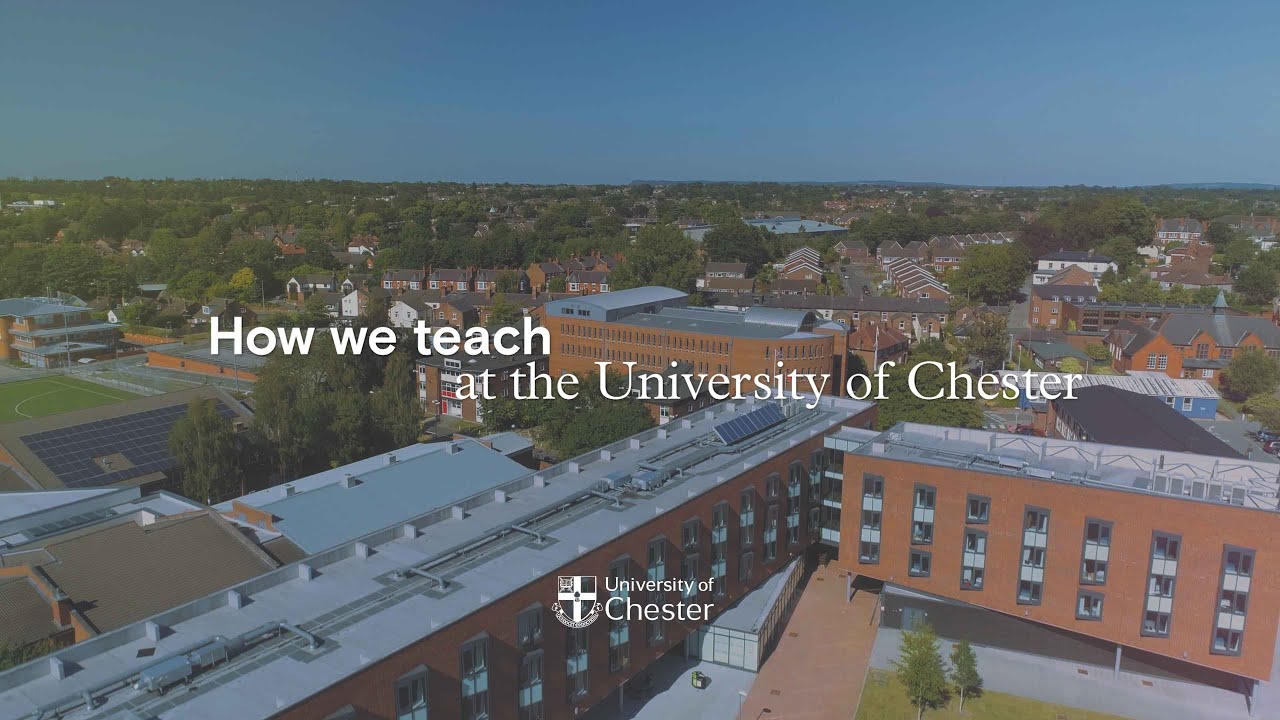
An aerial photograph of Exton Park with the text 'How we teach at the University of Chester'

How we teach at the University of Chester

This course is delivered in three terms of ten weeks each. In each term, you will study 40 credits split into one or two modules. You can expect between nine and twelve hours of in-person sessions per week, depending upon level of study and the complexity of the material being taught. These will mostly be lectures, but will also include workshops, example classes, computer labs and seminars.

You are expected to spend an average of 25-30 hours per week on independent study. To support you with this, we will provide detailed lecture notes and online material in addition to the books and resources in the university’s newly refurbished library. The dedicated mathematics lecturers will also offer you drop-in sessions for further one-to-one support and are always open to discussing mathematics with you.

You will be taught by the experienced, enthusiastic and innovative mathematics staff. All our Mathematics with Finance staff are research active and internationally recognised with an extensive network of research collaborations with leading researchers in the UK, Europe and worldwide.

You can expect to be assessed in a number of different ways throughout the course.  Your learning in most of your modules will be supported by assessed problem sheets and online quizzes.  In addition to traditional exams, you will also learn how to give presentations, write computer programs and engage with group-work projects. Alongside this, reports and your final year project will give you the opportunity to develop your research and communication skills, crucial for your future careers.

All teaching is delivered by experienced academics and practitioners, with the fundamental principles of the Chester Future Skills Curriculum at its core - building your subject competence, confidence, and key transferable skills to shape you into a world-ready Chester graduate.

Your Future Career

Job Prospects

Our graduates have excellent employment prospects. In the last five years, our Mathematics graduates have successfully obtained roles in the finance, banking and business sectors, including:

  • Actuary, insurance firm
  • Pricing Analyst, insurance firm
  • Auditor, banking sector
  • Chartered Accountant, financial sector
  • Credit Risk Analyst, financial sector
  • Tax professional, HMRC
  • Business Intelligence Developer, law firm
  • Utility Expense Analyst, energy sector

Careers Service

The University has an award-winning Careers and Employability service which provides a variety of employability-enhancing experiences; through the curriculum, through employer contact, tailored group sessions, individual information, advice and guidance.

Careers and Employability aims to deliver a service which is inclusive, impartial, welcoming, informed and tailored to your personal goals and aspirations, to enable you to develop as an individual and contribute to the business and community in which you will live and work.

We are here to help you plan your future, make the most of your time at University and to enhance your employability. We provide access to part-time jobs, extra-curricular employability-enhancing workshops and offer practical one-to-one help with career planning, including help with CVs, applications and mock interviews. We also deliver group sessions on career planning within each course and we have a wide range of extensive information covering graduate jobs and postgraduate study.

What Our Students Think

Entry Requirements

112 UCAS points

UCAS Points

112 UCAS points from GCE A Levels or equivalent, including Mathematics.

GCE A Level

Typical offer - BCC/BBC

Must include A-level Maths

BTEC

DMM plus GCE A Level Mathematics

International Baccalaureate

28 points - Including 5 in an appropriate HL Mathematics course

Irish/Scottish Highers

H3 H3 H3 H3 H4 (Including H3 in Maths)

Scottish Highers - BBBB (Including Maths at grade B)

Access requirements

Access to HE Diploma, to include 45 credits at level 3, of which 30 must be at Merit or above, including at least 15 in Maths

T Level

Merit

OCR Cambridge Technicals

DMM

Extra Requirements

Welsh Baccalaureate Advanced and A level General Studies will be recognised in our offer. We will also consider a combination of A Levels and BTECs/OCRs.

Students from outside the UK are expected to hold qualifications broadly equivalent to UK standards - typically A Level for undergraduate study and a Bachelor's degree (or equivalent) for postgraduate study.

To help you interpret these equivalents, please select your country/region of residence. This will provide details on equivalent entry requirements, as well as information about local representatives, events, and key contacts.

We accept a wide range of qualifications and assess all applications on an individual basis. Relevant work experience may also be taken into consideration where appropriate.

For more information on our entry requirements, please visit International Entry Requirements.

English Language Requirements

IELTS

6.0 (minimum 5.5 in each band)

Fees and Funding

£9,790 per year for a full-time course (2026/27)

The full-time tuition fees for Home students entering in 2026/27 are £9,790 a year, or £1,590 per 20-credit module for part-time study.

You can find more information about undergraduate fees on our Fees and Finance pages.

Students from the UK, Isle of Man, Guernsey, Jersey and the Republic of Ireland are treated as Home students for tuition fee purposes.

Students from countries in the European Economic Area and the EU will pay International Tuition Fees.

Students who have been granted Settled Status may be eligible for Home Fee Status and if eligible will be able to apply for Tuition Fee Loans and Maintenance Loans.

Students who have been granted Pre-settled Status may be eligible for Home Fee Status and if eligible will be able to apply for Tuition Fee Loans.

£14,950 per year for a full-time course* (2026/27)

The tuition fees for international students studying courses in 2026/27 are £14,950 per year for a full-time course. This fee is set for each year of study.

For courses with a Foundation Year, the tuition fees for Year 1 are £11,250 and £14,950 for Years 2-4 in 2026/27.

The University of Chester offers generous international and merit-based scholarships, providing a significant reduction to the published headline tuition fee. You will automatically be considered for these scholarships when your application is reviewed, and any award given will be stated on your offer letter.

For more information, go to our International Fees, Scholarship and Finance section.

Irish Nationals living in the UK or ROI are treated as Home students for Tuition Fee Purposes. 

Your course will involve additional costs not covered by your tuition fees. This may include books, printing, photocopying, educational stationery and related materials, specialist clothing, travel to placements, optional field trips and software. Compulsory field trips are covered by your tuition fees. 

If you are living away from home during your time at university, you will need to cover costs such as accommodation, food, travel and bills.

The University of Chester supports fair access for students who may need additional support through a range of bursaries and scholarships. 

Full details, as well as terms and conditions for all bursaries and scholarships can be found on the Fees and Finance section of our website.

Study a Common First Year

This course shares a common first year with students on Mathematics, Mathematics with Data Science and Mathematics with Computer Science courses.

This means that you’ll learn alongside students studying a similar discipline, helping to broaden your knowledge and exposure to other concepts, perspectives and professions in the first year of your degree.

As you learn and collaborate with students from other courses, you'll not only widen your social and professional network but also learn new skills that will set you up for success in your industry.

In your second and third years, you will progress to studying more specialist modules within mathematics and finance, developing your skills to become a World Ready graduate.

Who You'll Learn From

Dr Yubin Yan

Associate Professor
Dr Yubin Yan

Dr Justin Mcinroy

Senior Lecturer
Justin McInroy

Dr Zach Mckenzie

Senior Lecturer
Dr Zachiri McKenzie

Dr Yanting Hu

Senior Lecturer
Yanting Hu

James Hoult

Visiting Lecturer
James Hoult

Mary Bagby

Senior Lecturer
Mary Bagby

Dominic Aku

Visiting Lecturer
Blank profile picture placeholder

Dr Majduleen Zeyadeh

Visiting Lecturer
Majd Zeyadeh profile photo

George Dewhirst

Visiting Lecturer
George Dewhirst profile photo

Dr Anna Sung

Senior Lecturer
Anna Sung

Dr Ahmed Kholeif

Programme Leader MSc International Finance
Dr Ahmed Kholeif

Dr Muhammad Sanusi

Senior Lecturer
Dr Muhammad Sanusi

Enquire about a course

Could not set cookie saved_courses_compare