Publishing and Sharing Research
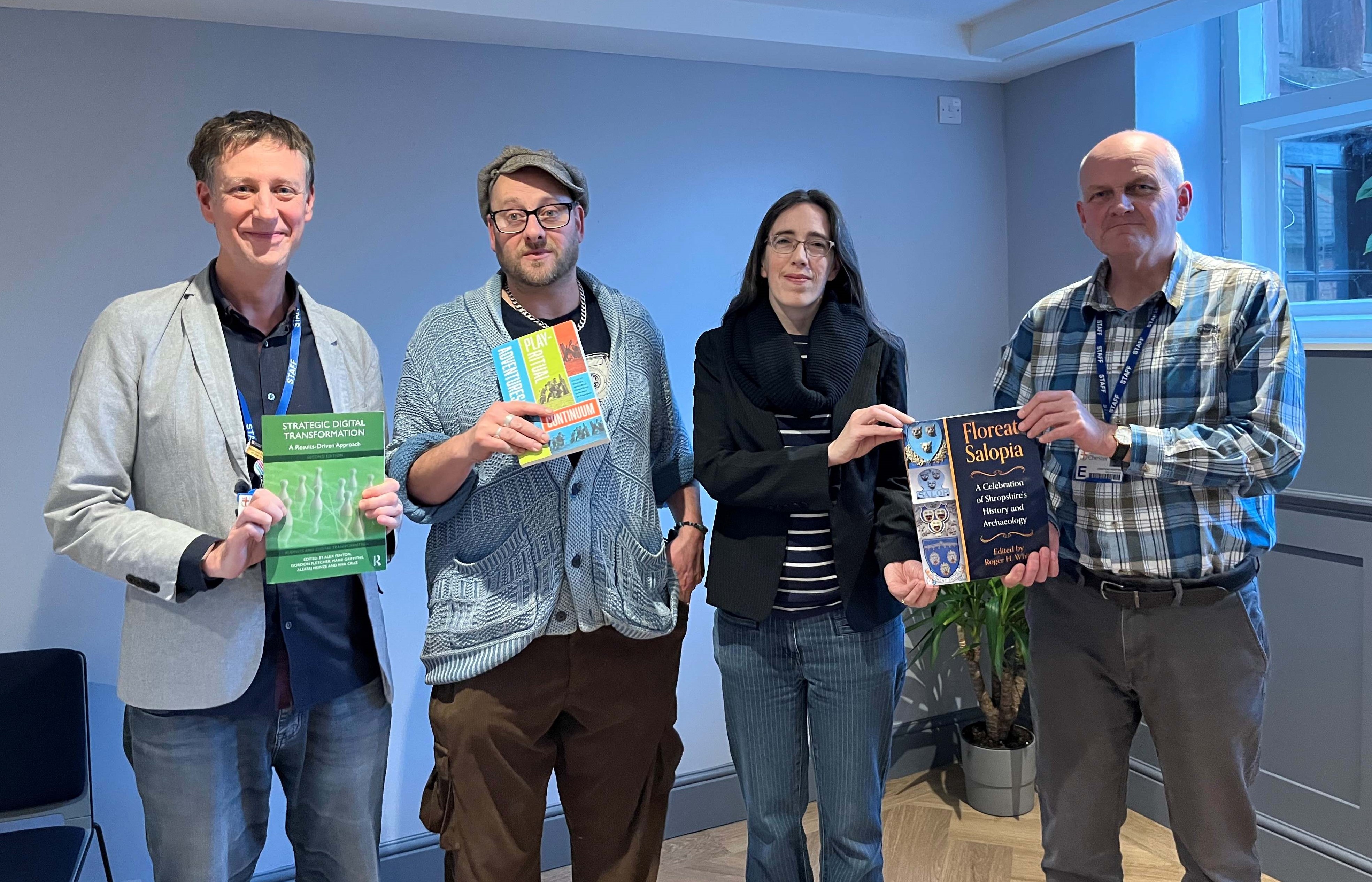
RKEI books

This page offers guidance on publishing and sharing research, including essential information on copyright.

Guidance on Publishing

University guide to publishing

The University of Chester's LIS Research Support team have produced a comprehensive guide which is useful for those new to publishing as well as those with more experience. The guide advises on: 

  • Publishing a journal article or conference paper 
  • Publishing a book or chapter 
  • Avoiding predatory journals and publishers 
  • Responsible authorship and fair attribution  
  • Open Access policies and practices 
  • The storage and management of publications. 

Read the University guide to publishing [University login required].

The Role of Author Identifiers

Due to the volume of researchers currently publishing, it can be hard to link them with their papers. Author identifiers make this process easier because they:  

  • Ensure authors receive credit for their work 
  • Eliminate confusion with other researchers who have an identical or similar name 
  • Are not tied to a particular institution or role, so they can be used throughout a researcher’s career.  

Author identifiers are often accompanied by a profile that displays other useful information, such as citation counts. Some profiles are largely curated automatically (e.g. those in indexing databases) whereas others allow for more manual input (e.g. ORCID). 

The author identifiers listed below are integrated with Symplectic Elements, the University’s Current Research Information System (CRIS). This means that papers associated with a known identifier will automatically be imported into an Elements profile, making it easier for you to display, manage and deposit newly published outputs. 


Types of author identifier

ORCID (Open Researcher and Contributor ID) is a 16-digit persistent identifier that allows researchers to be uniquely identified. It is created and controlled by the researcher and is not linked to any one institution or service. It is increasingly used by funders, publishers and bibliographic databases (e.g. Scopus and Web of Science) to associate publications with researchers. A profile page is automatically generated on the ORCID site, but researchers can control what is displayed.  

The benefits of an ORCID include the ability to:

  • Connect individuals more easily to their publications and other career-related contributions. The ORCID profile can be updated automatically with new publications and grants information whenever an ORCID is used. 
  • Minimise the risk of mistaken attribution. An ORCID is unique and stays with the researcher, even when changing institutions or name. 
  • Track engagement with publications across different platforms (an ORCID is interoperable and works with different funders, publishers and institutions). 

More funders, research organisations and publishers now ask researchers to provide an ORCID iD. If you do not already have one, we recommend registering for an ORCID iD. Registration is quick and easy. You can find step-by-step instructions on how to register on the ORCID website.

Scopus is a large bibliographic database of peer-reviewed literature. Unlike an ORCID, a researcher does not register for a Scopus ID. If they have published in any of the indexed titles, they will be assigned a Scopus ID and an author profile. Since Scopus IDs and profiles are automatically generated, they are not always accurate. However, profiles can be merged and changes requested in the Author Feedback Wizard.  

The benefits of a Scopus ID include the ability to:

  • Compile publications automatically into a single overarching profile. 
  • View and analyse citation metrics linked to publications. These can, in turn, help researchers demonstrate the impact of their research. 
  • Link the ScopusID to various other profiles (e.g. ORCID) and systems, such as a Current Research Information System (CRIS), thereby enabling automatic harvesting of outputs.

Please be advised that Scopus has strict indexing criteria, which means that not all publications may appear on your Scopus profile. 

What to consider

  • Perform an author search of your name to see if you have an existing profile(s). 
  • Check for duplicate profiles - this can happen if you have changed institution. If you spot any duplicates, select the profiles and click on 'Request to merge authors' at the top of the search results.

You can find more information about managing your Scopus profile.

The ResearcherID is a unique identifier that can be used to track citations and publications indexed in the Web of Science (WoS) database. Like Scopus, WoS is a large citations and abstract database used to search for, track and analyse peer-reviewed literature. There are two ways of creating a ResearcherID. You can: 

  1. Register for a WoS researcher profile.
  2. Claim an automatically generated author record and ResearcherID (you can only do this if you have publications that are already indexed in Web of Science). 

The benefits of a ResearcherID include the ability to: 

  • Link documents by the same author and collate an author's record into a single overarching profile. 
  • Add the ResearcherID to a Current Research Information System (CRIS), such as Symplectic Elements. This enables automatic harvesting of publications indexed in WoS into a researcher's CRIS profile.
  • Generate metrics on publications. 

What to consider

  • Search using your name and institution to check whether you have an automatically generated author record.
  • If you find an author record, check whether the publications compiled belong to you. Sometimes, WoS makes mistakes!
  • You can manually add publications or follow the suggestions WoS may make. 

Guidance from WoS

Learn more about: creating a ResearcherID and WoS Researcher Profile; merging and correcting profiles and adding publications to a Researcher Profile

Dimensions is another bibliographic database and competitor to Scopus and Web of Science. It was created by Digital Science, who have also developed the University's Current Research Information System (CRIS), Symplectic Elements. As a result, Dimensions Researcher IDs are used, and can be added to, researchers' Symplectic Elements profiles.

The benefits of a Dimensions Researcher ID include the ability to: 

  • Bring together a researcher's publications, citation metrics, policy documents, grants, patents and datasets. 
  • Collate publications and other sources into a single, overarching profile.
  • Use the ID in the University's CRIS, Symplectic Elements, helping researchers update their profile with any new publications by automatically harvesting them from Dimensions. 
  • Be a powerful searching tool due to the variety of content harvested. 

What to consider

  • Researchers will need to register for a Dimensions account using their University email address. 
  • Like in Scopus and Web of Science, profiles are automatically generated and can be found by performing an author search. Use the main search box and put the researcher's first and surname in inverted commas/speech marks. Locate the 'Researcher' filter on the left-hand side. If the correct researcher appears in the initial list, click on 'Limit to' next to their name. If the correct researcher doesn't appear, click on 'View more'. Watch a step-by-step video guide on how to complete this process. 
  • Watch out for multiple profiles - researchers who have been at several institutions may have separate profiles linked to each institutional affiliation. To amend a profile or merge multiple profiles, contact the Dimensions support team:  support@dimensions.ai.
  • Researchers should consider linking their ORCID to their Dimensions profile. This can only be done when signed in. 

Sharing Research on Networking and Social Media Platforms

ResearchGate and Academia.edu are commercial platforms that enable researchers to forge connections and showcase their publications. Users can create a profile, list their outputs and in some cases, share manuscripts. However, copyright considerations are crucial. Before uploading work, you must check whether sharing the manuscript is permitted. If a publication is not Open Access, the final published version cannot be shared openly. 

If you are unsure, contact LIS Research Support (researchsupport.lis@chester.ac.uk) or use the Request Full Text feature to share work privately with specific individuals.

Why institutional repositories are better than academic networking sites for depositing and sharing work

Academic networking sites should complement, not replace, institutional repositories, such as ChesterRep. Institutional repositories offer several key advantages. These include the fact that they are:

  1. Officially recognised by funders, publishers and governments. 
  2. Essential for compliance with funder and REF Open Access requirements. 
  3. Curated by librarians, who check publisher permissions and reduce copyright risk. 
  4. Permanent, secure and not-for-profit, unlike the commercially run academic networking sites, which may change or discontinue services depending on profits. Furthermore, some publishers do not permit work to be commercially shared, making it trickier to share on an academic networking site. 

Sharing research on social media 

Social media platforms allow researchers to engage with academic and non-academic audiences. They can also extend threach of their researchdemonstrate impact and create collaboration opportunities.  

Microblogging 

Researchers can ‘microblog’ about their research on platforms like X (formerly Twitter), which limits posts to 280 characters. X is particularly useful for taking part in academic discussions, following conferences and connecting with editors. However, many academics have chosen to leave X in recent years and joined an alternative microblogging platform called BlueSkyIt looks very similar to Twitter but has additional features for networking and lacks an algorithm (the general feed simply shows posts from people you follow, in date order). New users can follow curated groups of users known as Starter Packs, which help get a profile off the ground. Other features, such as custom feeds (compiled sets of posts on a specific topic, subject or theme), introduce new users to other researchers with similar interests. 

In order to get the most out of social media, tips include:  

  • Tagging journals (in which your papers are published), collaborators and institutions.  
  • Using hashtags linked to the research or the post’s content.
  • Resharing and reposting content, especially if a topic is trending or appears in the news.
  • Asking a question to your audience/followers which can spark a conversation.
  • Including a link to your published work (on the publisher’s website). From a copyright perspective, this is safer than uploading the document itself. 

Copyright for Researchers

Copyright protects the intellectual property of researchers and provides the legal framework for the ethical sharing of research. The information below offers basic information and guidance for students and staff. If you have a specific query on copyright in your research, please contact LIS Research Support (researchsupport.lis@chester.ac.uk).

You can also consult the University's internal guidance on Portal [University login required]. 

Essential guidance on copyright

Copyright is a form of intellectual property protection governed in the UK by the Copyright, Designs and Patents Act 1988. It gives the creators of original work control over how it is used and allows them to earn from it. Protection applies to work in both print and digital formats as soon as it has been created. Users must seek permission to copy, distribute, perform, broadcast or adapt the work or check what uses are permitted by the copyright licence. In specific circumstances, exceptions largely related to educational use may enable authors to use copyrighted material without permission

Copyright protection begins automatically when a work is created and typically lasts 70 years after the author’s death, or 50 years from first broadcast for broadcasts. 

Copyright in works created during employment, such as teaching materials, usually belongs to the employer (i.e. the University). However, staff and students will own the copyright in their own ‘scholarly works’, such as journal articles, as set out in the University’s Code of Practice for Research (this document outlines protections for works created for study and research).  

It is possible, although not always essential, for copyright holders to transfer their rights to others, such as through a publishing contract or agreement. The concept of copyright transfer via a publishing agreement is discussed in the University's Rights Retention Policy and on the Rights Retention webpage.  

The rights of copyright holders typically relate to reproduction (making copies of the work), distribution (sharing copies of the work), adaptation (creating derivatives of the work) and public performance (presenting the work to the public, including digitally). 

Copyright is infringed when work is copied, performed, broadcast, adapted/translated or published without the permission of the copyright holder and is not covered by an exception.  

Limited copying can be carried out if:  

  • It can be justified within the concept of fair dealing 
  • The terms of a licensing scheme permit it 
  • Written permission of the copyright holder is obtained when necessary.


A key role of copyright law is to balance creators’ exclusive rights with limits on those rights in certain circumstances. This is achieved through specific copyright exceptions (or permitted acts), which enable limited reuse of copyrighted material without the copyright holder's permission. Reuse of copyrighted work under an exception may be subject to a test known as 'fair dealing'.  

Fair dealing is the right to reproduce limited amounts of copyrighted works without permission. There is no statutory definition of fair dealing, which means that judgement is required by the person wishing to use the copyrighted work. Whilst fairness cannot be guaranteed, use is generally considered ‘fair’ when the user: 

  • Is not depriving the copyholder of revenue 
  • Copies only what is needed 
  • Acknowledges the creator or author.  

Examples of exceptions which may qualify as fair dealing include:  

  • Research (non-commercial) and private study 
  • Criticism, review and quotation 
  • News reporting 
  • Caricature, parodying and pastiche. 

Please be aware that the term fair dealing is distinct from the US term 'fair use', which is applied differently. 

Read the copyright guidance for educational purposes [University login required].

Copyright holders can choose to grant permissions for specific uses of their work through licences, allowing others to use it under defined conditions. 

Licensing agencies work on behalf of rights holders by granting limited copying permissions to support teaching, learning and research in exchange for a fee, which is paid to the rights holders as royalties. The University subscribes to a number of licences that enable University researchers to copy and scan material for educational purposes. These include: 

Licence What does it enable?
Copyright Licensing Agency (CLA) Higher Education Licence Copies from books, magazines, journals and any websites covered by the licence. It is permissible to copy one chapter or 10% of a book (whichever is greater) and two articles or 10% of a journal issue (whichever is greater). Copies can be shared with students and staff and stored on an intranet.
Educational Recording Agency (ERA) Licence University staff to record and copy television broadcasts for teaching and learning purposes. These recordings may be shared with students and must be clearly labelled as recorded under the ERA licence.
Newspaper Licensing Agency (NLA) Licence

University staff to copy, store and share print and digital newspaper articles from UK national newspapers and selected additional titles. Articles can be stored on an intranet.

Open licences 

Creative Commons (CC) licences are the leading type of open licence. Information about these licences can also be found on the Open Access page

Copyright and Doctoral Theses

Students are normally the copyright holders of any research outputs, including theses, produced whilst at the University of Chester. Whilst the University encourages the use of freely accessible material, it is possible that you may need or want to use third-party copyrighted material (e.g. images, maps, tables, long extracts etc.) in your thesis. This will need to be cleared before the thesis and any related outputs can be made available. The information below offers advice on what you need to consider if your thesis (or dissertation) contains copyrighted material. 

Use of third-party copyrighted material

Before a thesis is sent to LIS Research Support for deposit, you should check whether you have used any copyrighted material and, if so, seek permission from the copyright holder to use it in your thesis.

If a thesis contains material from journal articles, the publisher may use the Copyright Clearance Center (CCC) service to manage requests relating to copyright and the reuse of material in a specific article. Applications to reuse material can be made via the permission, reuse and/or rights link on the webpage record of the article. You can also to contact the publisher's permissions and rights department.

If a thesis includes material from museums, galleries or archives, it may be covered by a blanket licence for reuse in research. Contact the institution and ask for advice. 

If permission cannot be sought, two options are available, namely to:

  • Redact (remove) the copyrighted material and make the thesis openly available.
  • Retain the copyrighted material, but apply a permanent embargo (restricted access) to the thesis. 

Making research openly available is the default expectation at the University of Chester. It may also be necessary if doctoral research is funded by a funder with Open Access (OA) requirements, e.g. the UKRI. However, applying a permanent embargo may be the only solution if third-party material cannot be redacted. This might arise if the copyrighted material has been heavily analysed or critiqued, so its omission would look odd and seriously impede meaning. 

Publishing from your thesis prior to submission

When you publish work prior to the submission of your thesis, review the terms of the publishing contract carefully. If you have signed a contract assigning copyright to the publisher, you may not be able to reproduce the material in your thesis without contacting the publisher for permission. The University therefore recommends that students: 

  • Publish OA whenever possible. Check whether the paper is eligible for financial support if the payment of an Article Processing Charge (APC) is required. Please refer to the University's Transformative Agreements or get in touch with LIS Research Support. 
  • Publish under one of the Creative Commons licences (the University recommends the CC BY licence) which provide permissions for reuse. 

Publishing from your thesis post submission

Most publishers do not view a thesis as a prior publication. It is therefore not necessary to apply an embargo to your thesis on the University's repository, ChesterRep, if you plan to publish articles in the future that are based on your thesis. However, it is worth checking the policies of the publisher and/or journal, as some may have specific requirements, such as an acknowledgement that the research was undertaken as part of your PhD. Examples of publishers who do not view a thesis as a prior publication are Elsevier, Oxford University Press, PLOS, Taylor & Francis, Springer Nature, Wiley, Institute of Physics and the Royal Society of Chemistry (this is not an exhaustive list). In cases of uncertainty, contact LIS Research Support before submitting a manuscript. 

If you plan to turn your thesis into a monograph (book), it is recommended that you apply an embargo to your thesis on ChesterRep. It should be long enough to stretch to the potential publication date of the monograph.

An embargo is requested via a thesis deposit form, which must be completed and signed by the student, supervisor and Personal Academic Tutor (PTA) before the thesis can be added to ChesterRep by LIS Research Support. You can apply to extend an embargo at a later date, but you will need to complete a new deposit form. You cannot apply an embargo to a thesis that has already been openly available.